
Quick Reference
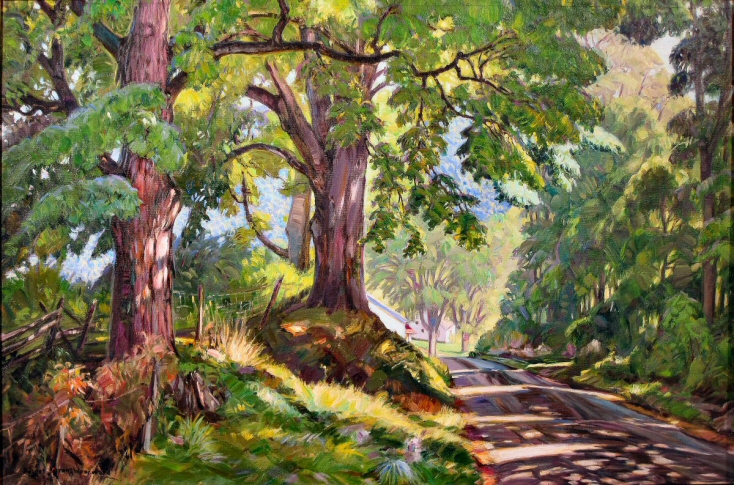
c. 1952
Charlemont Road
Buckland, MA
Oil on Canvas
Landscape
Trees
24" x 36"
Deerfield Valley Artist Assoc.,1952★
> Award: Best Oil Painting
Painting remained in RSW estate.
NA
Related Links
- See also the...
180.png) Accolades & Awards Gallery to view related pieces.
Accolades & Awards Gallery to view related pieces.
- See also the...
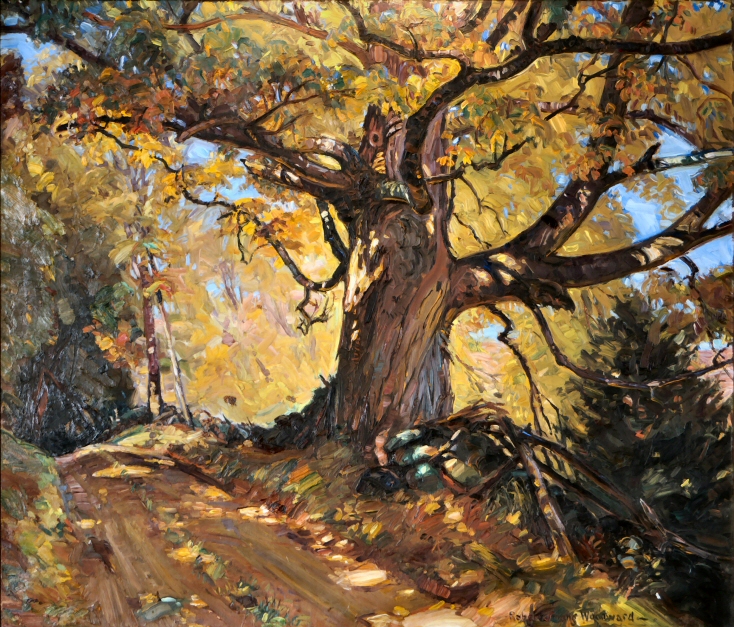 Trees Gallery to view related pieces.
- See also the...
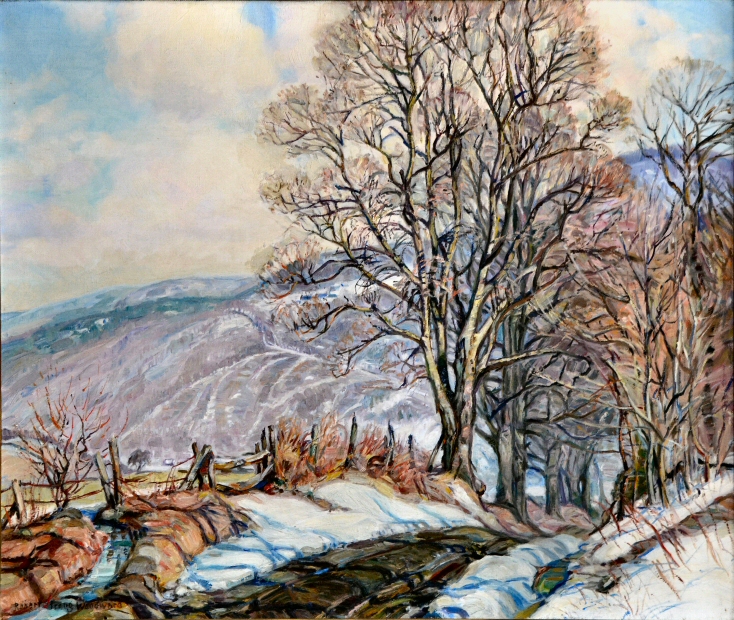 Roads & Streets Gallery to view related pieces.
- See also the...
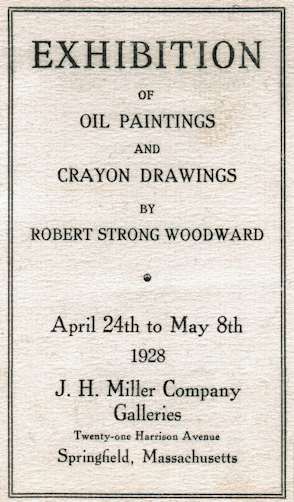 Exhibition List for a complete list of events
- See also the...
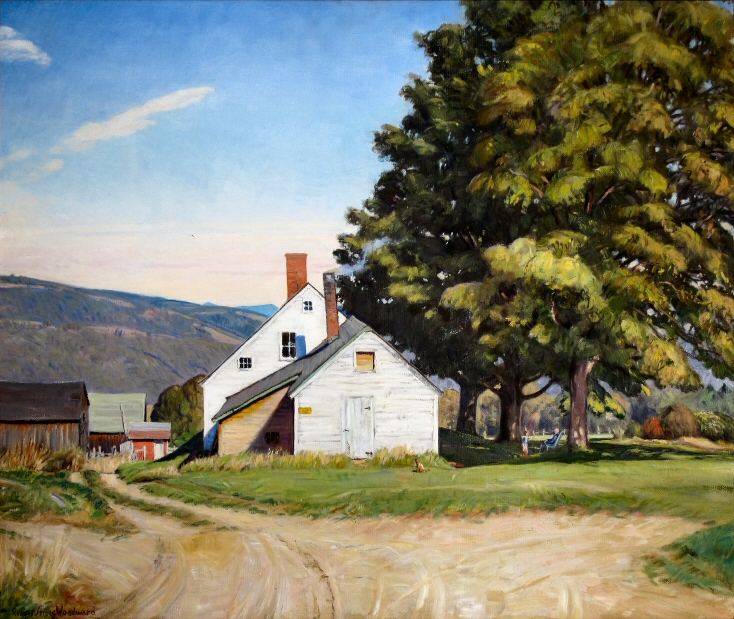 Late Summer Gallery to view related pieces.
- See also the...
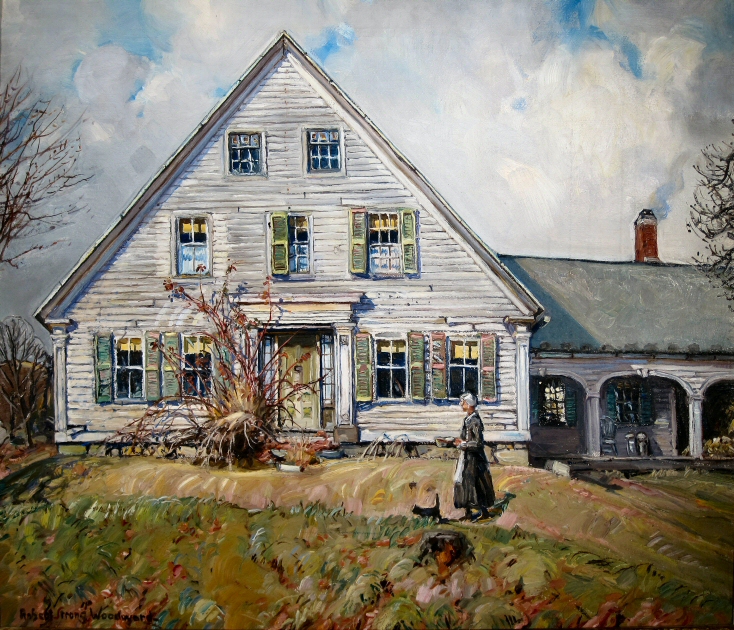 Houses Gallery to view related pieces.
- See also the Landscapes & Views Gallery to view related pieces.
.png)
Featured Artwork: Maple Guardians 
RSW's Diary Comments
• There is no entry for this painting in the painting diary.
Comments on the back of a sepia print:
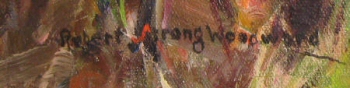
A close up of RSW's signature from lower left corner.
"Rich summer greens, spotted with sunlight against opal blue mountain-side. Gray-violet roadway. Tree trunks dull rose and violet. Left foreground colorful weeds and grasses."
Editor's Note:
Given the year, this might just be one of the artist's last paintings. Woodward would retire
in 1952 due to what he simply called neuropathy. He no longer had the hand control and steadiness he once did.
The irony here is that it does not show in this award-winning painting. Actually, there are a number of late
career paintings that are some of his most skillfully made and most refined pieces. There is no evidence of
diminished capacity; in fact, it is quite the opposite. The works all appear to transcend his condition,
mirroring his life in general.
He had similar difficulty in the second half of the 1920s when he was
working to get his career back on track. In fact, he made twice as many pastels (he called chalk drawings),
than he did oil paintings between 1927 and 1929. The pastels were exhibited at his 1928 J.H. Miller exhibition
and made up one third of the shows inventory. We also believe, when he recovered, he was left with so many
pastels, the decision was made to feature them in their own show leading to the 1929 Pynchon Gallery Exhibit.
Additional Notes
Recorder Gazette July 22, 1952:
"DVAA Members Vote Best Oil Prize to Woodward. Members vote on the opening night, the best oil painting, Robert Strong Woodward's Maple Guardians ..."
OR-power_pointLG.png?url=photos/NonArtwork/maple_guardians(26)OR-power_pointLG.png)
 An image of Dr. Mark's original Power Point
Slide for Maple Guardians
Corrections:
It is unclear when the original information for this artwork page got mixed up with another painting, the similarly named, Road Guardians, but it must be Brian's mistake because we do not believe Dr. Mark would have forgotten he owned the painting. We simply do not know what happened. We went back to every backup version of the website and the only one wrong was this version. The good news is, we have corrected the mix up when the postcard below. Our best guess is that when we did an audit of Road Guardians we erroneously copied and pasted something to the wrong page.
♦ It is unfortunate there is no diary entry for this painting but 1952 was the year Woodward retired from painting because of neuropathy in his hands. There is some indication it exhibited at the Southern Vermont Artists Association (SVAA) but we have to record of it. If it did, it was after 1952 and Woodward did not get a program of the show. Still, the SVAA had a picture of the painting because it was made into a postcard SEE BELOW ⮟
Bonus Material
900.png?url=photos/NonArtwork/maple_guardian_postcard(26-HR)900.png)
A 1950s postcard of Maple Guardians with caption.
⮜ When the painting New Snow in the Orchard was for sale on eBay in April of 2026, there was also this postcard of Woodward's Maple Guardians being offered by another seller. A bit pricey for a postcard, we purchased it anyway. It is a nice addition to the collection. Black and white was an odd choice for a time when color was definitely available. Worse yet, note how dark it is. We scanned it with no manipulation. It is so dark that we couldn't add light to it to take a regular picture. It is much darker than the sepia on record and its negative. We explain this later...
-verso.png?url=photos/NonArtwork/maple_guardian_postcard(26-LG)-verso.png)
"Where we drove to the Vermont Art Center where
I am at present the road looked like this - narrow, wind-
ing, & thru the trees to the top of one of the many mount-
ains here." (signed) TW. Dated: June 22, 1955, Address-
ed: Miss Artice Sinkey, Vet. Med. Library, Vet. Med.
Bldg; Ohio State University, Columbus 10, Ohio
⮞ It is postmarked June 22, 1955, Woodward is retired (since 1952) and still alive (he will
pass in 1957). The sender of the postcard has a wonderful description of their drive to the Vermont Art Center
(read to the right). Woodward has a long history with the Vermont Art Center in Manchester, VT. He was an original
member when the Southern Vermont Artists Association was founded in 1927. Actually, the sender of the postcard
does not specify which "art center" she is referring to, but it is postmarked in Manchester, VT, so it can only
be the Southern Vermont Art Center. There was another "Vermont Art Center" in Rutland, VT. Woodward exhibited
there in 1944, so we suspect the Manchester art center was the "Southern" art center in 1955 as well.
We could not read the name of the recipient, so we took a shot in the dark and looked up the Ohio State
University Veterinarian Library to see if we could contact them and ask if someone could identify the name from
their records. We lucked out BIG time! Right on the library's home page is the wonderful, smiling face of the
library's director, Jessica Page, inviting us to contact her. We cannot express how rare something like this is.
We wrote Jessica, and she responded within a couple of hours, with Lela Artice Sinkey's name, and that Artice,
the name she went by, was the library's fourth librarian from 1946 to 1961. We could not be more grateful for
her help and approach to being so accessible. Thank you, Jessica Page! Finally, we do not know who the sender
is because they simply signed it with their initials
---------------------------------------------------------------------------------------------------------------------------------
900.png?url=photos/NonArtwork/maple_guardians(26)900.png)
An image of the painting's sepia print.
⮜ To the left is the sepia made from the painting's original negative. We are sure this is
the source that was used to produce the postcard, and it is a lesson in the use of black on paper and over-
saturation. Compare the two images below, and you can see just how much detail was lost in the print process.
Here is another crazy point to make: we have no record of this painting exhibiting in Manchester, so we do not
know its connection to the art center until now.
To help with the comparison of the two images, we
made a side-by-side image below ⮟
postcard-negative900.png?url=photos/NonArtwork/maple_guardian_postcard(26)postcard-negative900.png)
A side-by-side comparison of postcard to the painting's negative.
Here is what we believe might have happened... The first home of the So. The Vermont Art Center was purchased in 1950 by the Southern Vermont Artist Association. The new museum needed merchandise, and we think they went through their collection of sepia prints from previous years and selected what would work as postcards. Maple Guardians is one of those choices. What they did was make a copy of the sepia rather than get the negative from the artist. This process darkened the image, losing much of its beautiful details. The lesson here is that a copy of a copy never works.