
Quick Reference
1931
probably Leyden, MA
Pastel on Board
Landscape
Farm
22" x 29"
Boston's Tercentennial Exhibition ?
-Horticultural Hall, 1930
Myles Standish Gallery, 2x, 1931
"Art Week" (Bos),J. Marsh Gall., '31
Unknown
NA
.png)
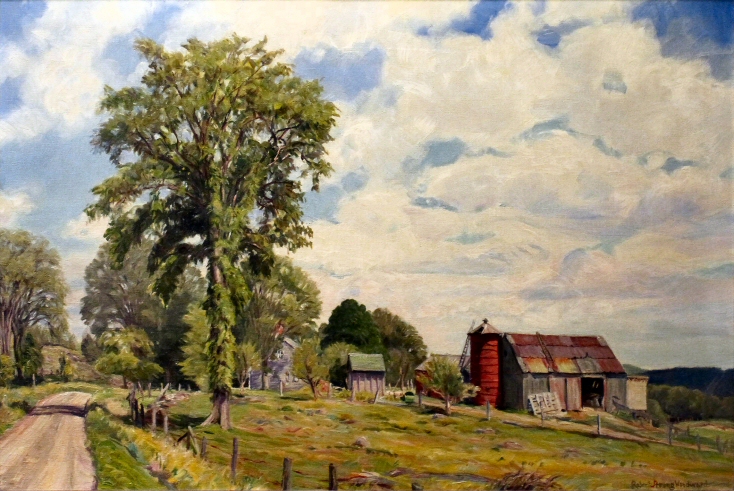
Featured Artwork: Old Heights
RSW's Diary Comments
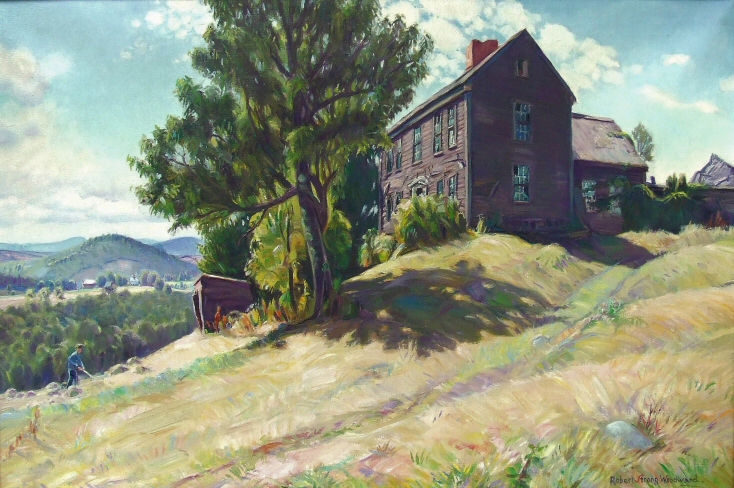
• Woodward did not keep records of the pastels he called "chalk drawings."
Editor's Note:
This is really just a guess, but it is based on descriptions from the three newspaper columns
that mention this painting (see below). We know enough about how Woodward named his paintings and how he would
vary the names of similar scenes of the same subject.
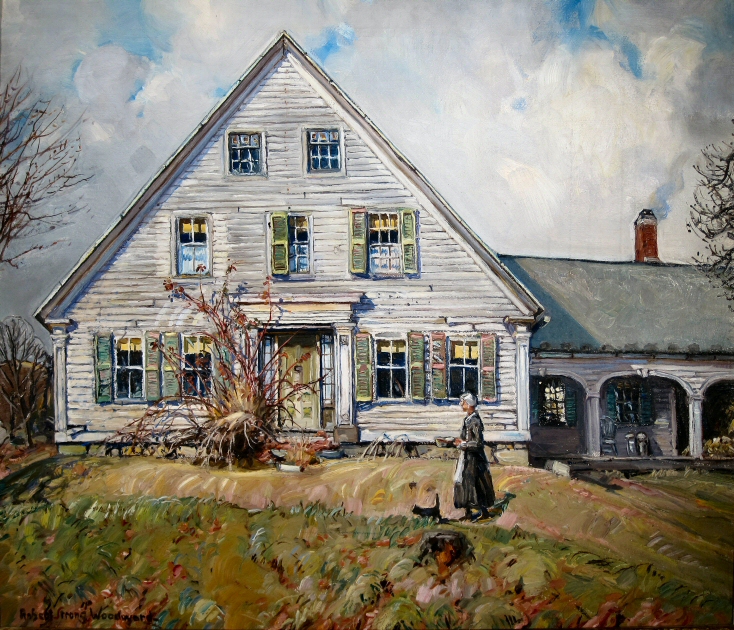
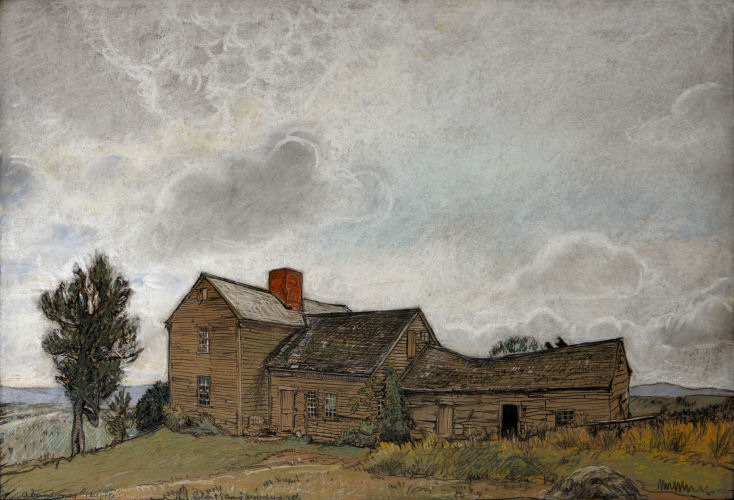
To the right ⮞ are two paintings of a
somewhat abandoned farm high up in Leyden, Massa-chusetts. We say 'somewhat abandon" because in the three
versions (one oil, two chalks) we have of the subject there is a man tending to the landscape. He looks like he
is raking. This is not uncommon. Even Woodward's abandoned Halifax House was being
"hayed" by someone.
We believe Old Heights is the same abandon home. However, the vantage
point is more New England Essence than it is Abandoned Heights because of the descriptions
below. You cannot see the "knoll" in Abandoned Heights. Also, if you look closely, the rear addition to
the back of the house has collapsed in the 1943 canvas dating the pastel to be pre-1943. Our guess would be
around the same time as Old Heights. Maybe Woodward made both pastels around the same time.
Additional Notes
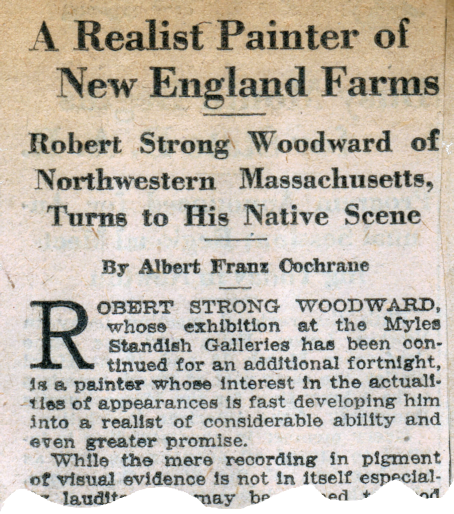
 Boston Herald Tribune, Mar. 11, 1931
⮜ Boston Herald Tribune, Mar. 11, 1931
"Old Heights -- a farm house on a knoll..."
Boston Globe, March 9, 1931
"His Old Heights is another stunning New England landscape."
Boston Evening Transcript, Mar. 11, 1931 ⮟
"Robert Strong Woodward's forthrightly painted farm house entitled Old Heights....."
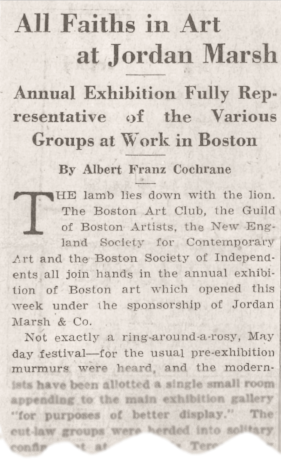
Boston Evening Transcript, Mar. 11, 1931
Additional Editor's Notes:
In reading the article to the right by Boston art critic Albert Franz Cochrane as he praises
Old Heights, he follows that up mentioning that Woodward as well as a couple of other artists for the
1931 "Art Week" show sponsored by the Jordan Marsh Department Store hung paintings that hung at the previous
year's Tercentennial Celebration of Bos-ton's 300th birthday at Horticultural Hall. Woodward won a gold medal
for New England Drama but there is no mention of
another painting anywhere but here. Actually, we find it very strange that there is little information on the
Tercentennial exhibit in Woodward's scrapbooks. His early years scrapbook, we call Scrapbook One, his clippings
of the first New England Society of Contemporary Artists show in January of 1930, then the March 1930 "Art Week"
exhibit, and nothing after that! The next page goes straight to 1931. For this reason, we have added Old
Heights to the 1930 Tercentennial event with a question mark.
It is also perhaps worth mentioning
that the first six months of 1931 were absolutely insane for Woodward and his new found popularity. Woodward had
89 total paintings circulating in the first six months of 1931 and those paintings filled 137 open spots on
walls in the numerous shows he was committed to... Old Heights hung at Myles Standish, then Jordan
March, and back to Myles Standish again all in the same month. 1931 is far and away Woodward's most exhibited
year of his career (1930 is one of the least).