
Quick Reference
Prior to 1926
Unknown
Pastel on Board
Landscape
Unclassified
Unknown
The Museum on South Street...
- Pittsfield, MA, 1927
J. H. Miller Co. Galleries, 1928
Valleyhead Sanitarium, 1931
Mt. Holyoke Coll. Dwight Hall, 1931
Amherst Coll. Jones Library, 1932
Unknown
NA
Related Links
- See also the...
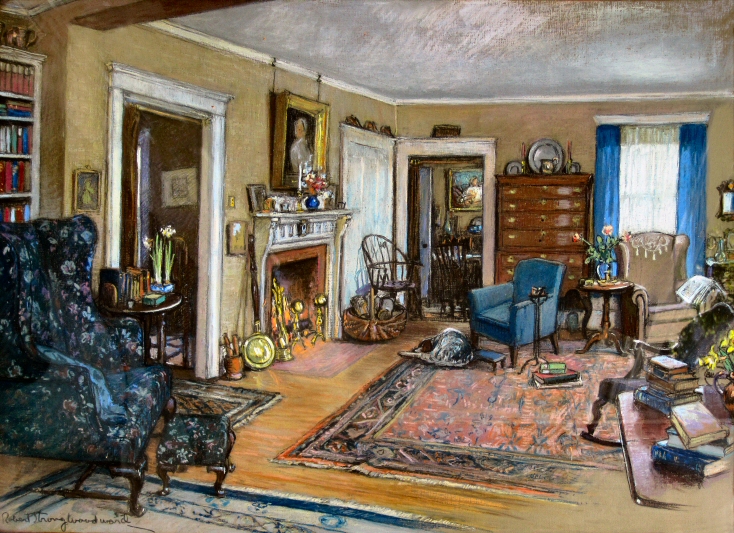 Chalks & Crayons Gallery to view other drawings
- See also the...
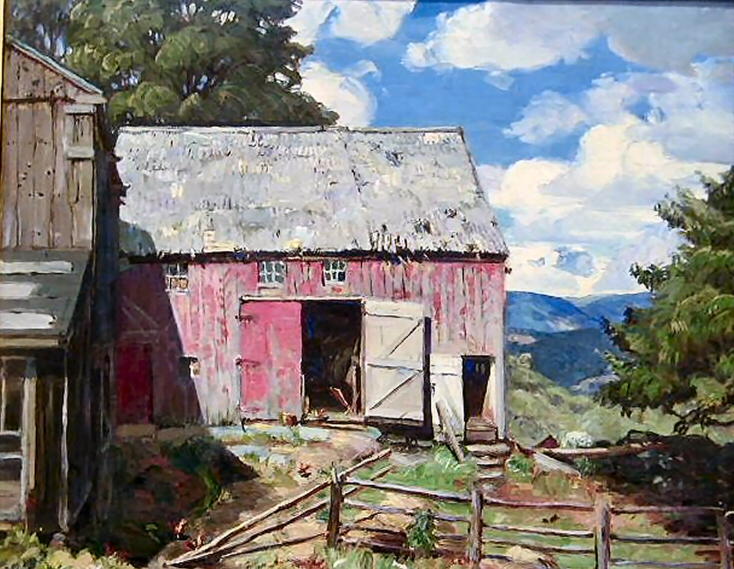 Barns Gallery to view related pieces.
- See also the...
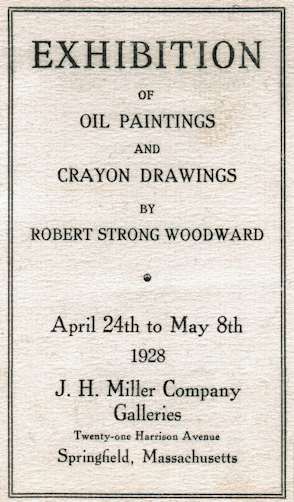 Exhibition List for a complete list of events
- See also the...
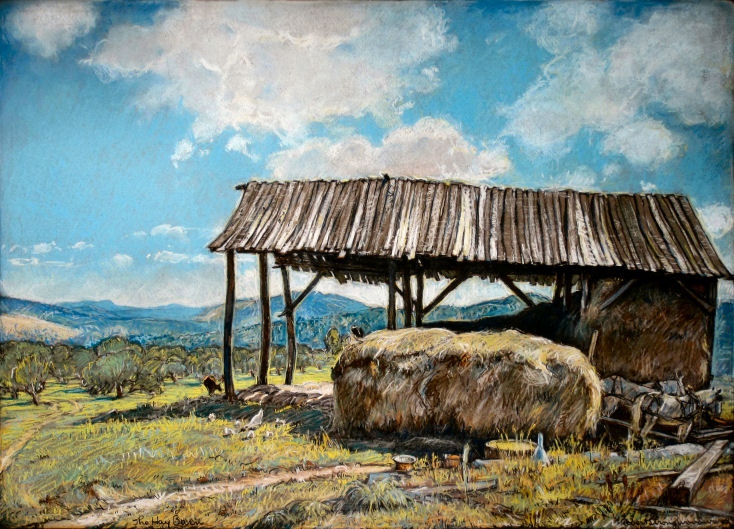 Buildings Gallery to view related pieces.
- See also the...
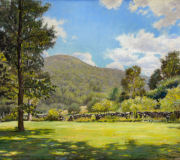 Landscapes & Views Gallery to view related pieces.
.png)
Featured Artwork: The Patient Angel
RSW's Diary Comments
TrumpetingPicHLN.png?url=photos/Newspapers/1926-12_08-BostonPost(LymanEx)TrumpetingPicLG.png)
 The Boston Post, December 8, 1926
• Woodward did not keep records of the pastels he called "chalk drawings."
Editor's Note:
The 1928 J.H. Miller exhibition held at the gallery in Springfield, MA, would be another major step in Woodward's climb back from his disastrous 1922 Redgate Studio fire. It is his FIRST gallery exhibit since his 1922 Miller gallery show. The artist resumed his career in 1926 after recovering from an unspecified illness. In December of 1926 Ronald Lyman hosted an exhibit of Woodward's work in the second floor ballroom of his fine Beacon Street home. We believe this was because no gallery would book him after he left the Macbeth Gallery in New York City in the lurch because of the fire. He would do another home exhibit at Miss Anne Koch's Greenfield (MA) home in November of 1928. In 1929 he would exhibit in Utica, NY, at the Littlecote Gallery, and then Troy, NY, at an unnamed gallery, to the Myles Standish Gallery in Boston and Myles would become his art dealer in Boston up to 1936.
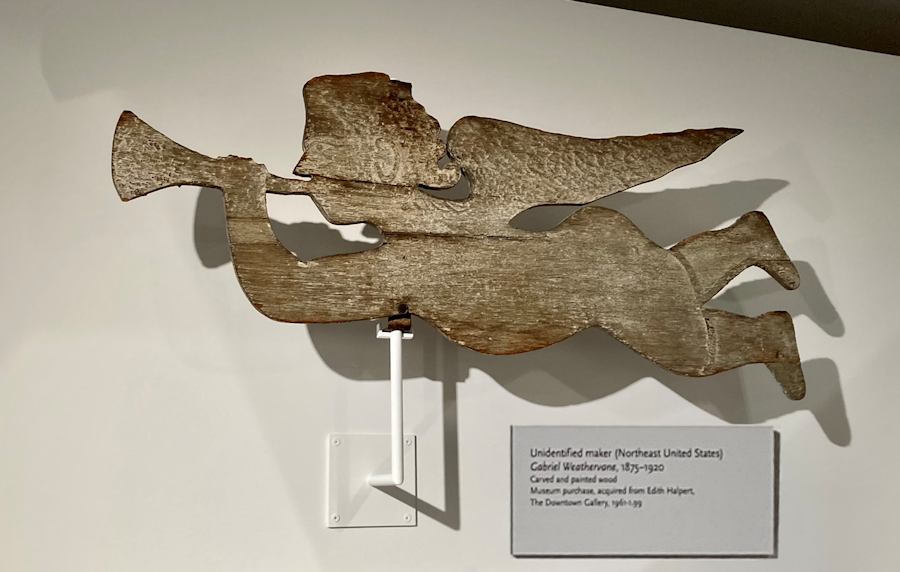
A Gabriel Weathervane found at the Shelburne
Museum, Shelburne, VT. There are several varieties of
this style and several different metals and woods. The
one on the canvas is likely wood. Its years 1875-1920.
According to Jeanette Matthews of the Springfield Union Republican the angel (below), "is the same," angel seen in "The Trumpeting Angel,". However, the barn and barnyard is different and the angel no longer is playing the trumpet. We cannot say for sure if Woodward drew another scene of another angel or if he took some creative liberties and used his imagination... How would Ms. Matthews know it is the same angel? Maybe, what she meant was it is the same angel sans the trumpet on a different farm. These weathervanes were primarily made of wood and could be quite similar.
However, without the trumpet, the meaning changes significantly. It is no longer about a reckoning. Still, the meaning of "patient" is not lost either. Here it is two years after the Lyman exhibit and Woodward is still working his way back. Perhaps his patience is wearing thin. Maybe he is starting to worry that he will not fully recover. Also, here he is STILL exhibiting at J.H. Miller eleven years into his professional career. What he does not know is it will be his last show at Miller and his career will not only ascend. It will exceed his expectations. More Below ⮟
Additional Notes
Springfield Union, April 25, 1928, by Jeanette Matthews
"The crayons are something comparatively new for Mr. Woodward. The most satisfying one strangely enough is the least colorful, The Patient Angel," and surely it is the same angel that trumpets in "The Trumpeting Angel," which I have commented on before... but this angel has found a new barn and a new barnyard to watch over and he no longer trumpets. You feel that he is just what his name says, and the soft restfulness of his patience creeps into your very bones."
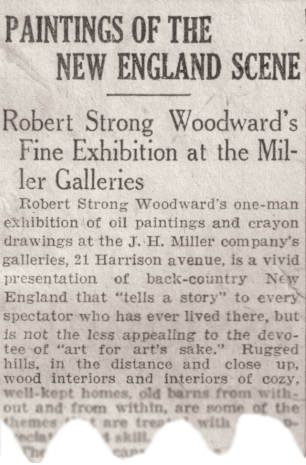
The Springfield Daily Republican,
Apr. 28, 1928
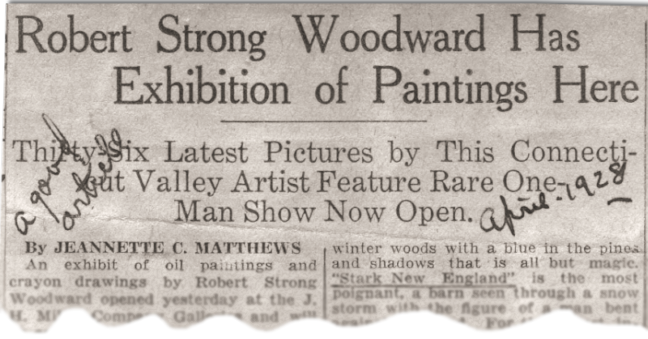
The Springfield Daily Republican, Apr. 25, 1928
⮜ ⮝ Here are two articles related to the 1928 J.H. Miller Gallery exhibition. It is a bit confusing because the Springfield Republican newspaper was going through a lot of changes in the 1920s. We have clippings where it is referred to as the 'Daily Republican' or the 'Union Republican' and there are also clippings listed as the 'Republican Tribune,' and perhaps at some time it was called the 'Herald Republican,' though we can't think of an example off the top of our head. As accurate as we try to be with these things, we do not always have the "folio" (the top part of the newspaper page with the name of the paper, the date, and day of the week) as part of the clipping in RSW's scrapbook.
---------------------------------------------------------------------------------------------------------------------------------
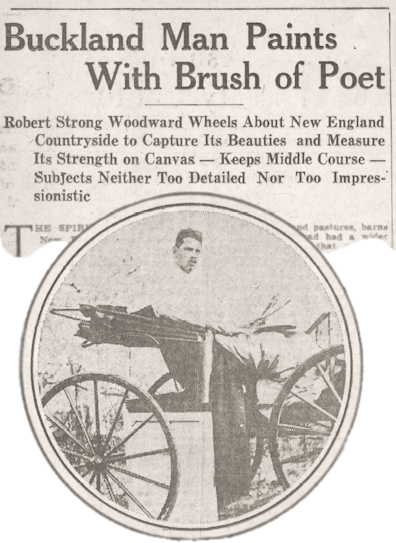
Springfield Sunday Union Republican, May 18, 1928
This is a featured profile on RSW written by Jeanette
Matthews a couple weeks later. This is where we learn of
Woodward's neuropathy problems among other things.
Again note the completely DIFFERENT name of the same paper in the article to the right ⮞
Another interesting piece to this story is that Woodward was having issues with neuropathy in his hands in 1928 and '29 which made it difficult to handle a paintbrush the way he needed to, so he invested more time into making pastels. From 1927 to 1929, he made 4 pastels to every oil. The Miller exhibit would be the first to feature a third of all the paintings to be pastel... and it was a hit from the reviews given below. This effort would culminate in the 1929 Pynchon Gallery Exhibit that featured his pastels in the main room and if you wanted to see their companion oil canvases, they were in another room! Below is a rare black and white photo of a chalk ⮟

⮜ The photo indicates that it exhibited. It is the only known record we have. It is found in a scrapbook. The time period is from the other items in the book.