Quick Reference
c. 1942
Apple Valley,
Ashfield, MA
Oil on Canvas
Landscape
Brook, Ponds, Rivers
27" x 30"
Unknown
Unknown
N/A
734.png)
.png)
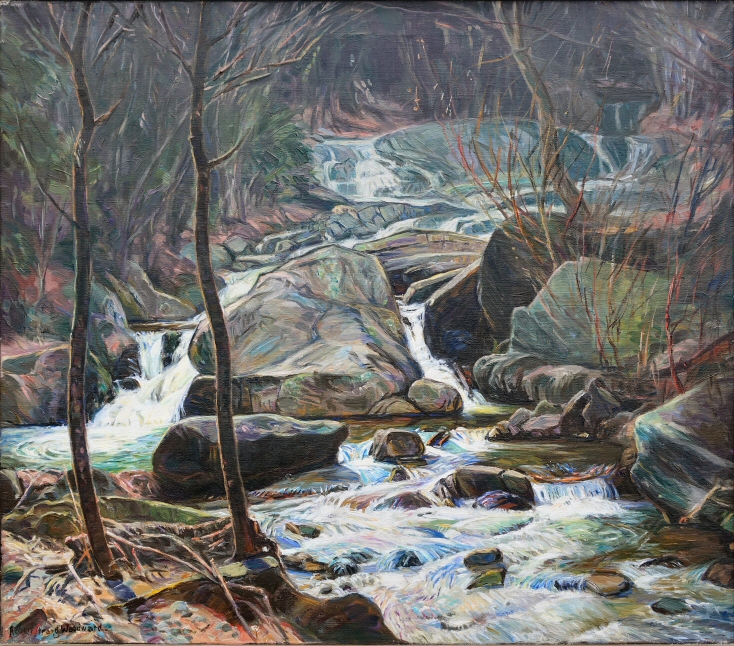
Featured Artwork: Rushing Brook
RSW's Diary Comments
"Painted in winter 1942. A repainting made in the studio from an old canvas of the same size. The old one I destroyed. The brook is the Apple Valley Brook, near the first bridge at the foot of the road in Ashfield."
Comments on the back of a sepia print:
"Painted in early spring before direct greens come to the woods. Colors surrounding brook are neutral dull greens, violets, and pinks. Water very iridescent, sparkling, moving. A lively canvas, but very peaceful and liveable. Almost no direct green in this."
Editor's Note:
Repainting canvases was not an uncommon practice for Woodward but what is unusual is the
number of paintings, he held in store for nearly two decades where pulled out and repainted between the years
1937 and 1945. There are more than a dozen we know of and wonder how many others we do not know about. The
artist also began making what he called "composite" paintings taking a subject he liked and adding features
and elements from other painting to compose a scene...
We have pieced together what influenced these
unusual patterns and we believe it has to do with the sudden passing of Francis Garvan eight days after buying Enduring New England. Mr. Garvan commissioned Woodward to paint historic churches
of New England. Upon his death, Mrs. Garvan refused to honor the commission. The two men were just a few years
apart in age and there is a dramatic change in behavior by Woodward. He stopped traveling as much and focused
on immediate subjects surrounding him. The year 1937 was ALSO the year he began making his Window Picture Paintings, on a regular basis, which he can
do without leaving his studio. One of the churches Woodward made for Mr. Garvan's commission, Village Church in Winter was a re-make of
another early 1920s painting and the first canvas of his repainted paintings. As far as we know, ALL originals
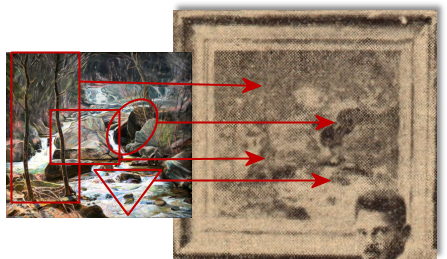
canvases repainted during this time were destroyed. BELOW is a newspaper clipping where this original
appears hanging over the posed artist in 1922 ⮟
Additional Notes

 May 16, 1922, Newspaper clip-
ping of RSW under original canvas
The 1922 clipping to the right was once thought to be the painting The Brook, however, a note in RSW's handwriting puts that painting location at "Clock Hollow" in Buckland, whereas this painting is in Ashfield.
Although we can't get a better image of the clipping, our side-by-side comparison below shows enough evidence to believe this may well be the original painting RSW refers to in his dairy comments.