
Quick Reference
c. 1926
Chesterfield, MA
Oil on Canvas
Landscape
Unknown
27" x 30"
Mrs. Henry P. King
NA
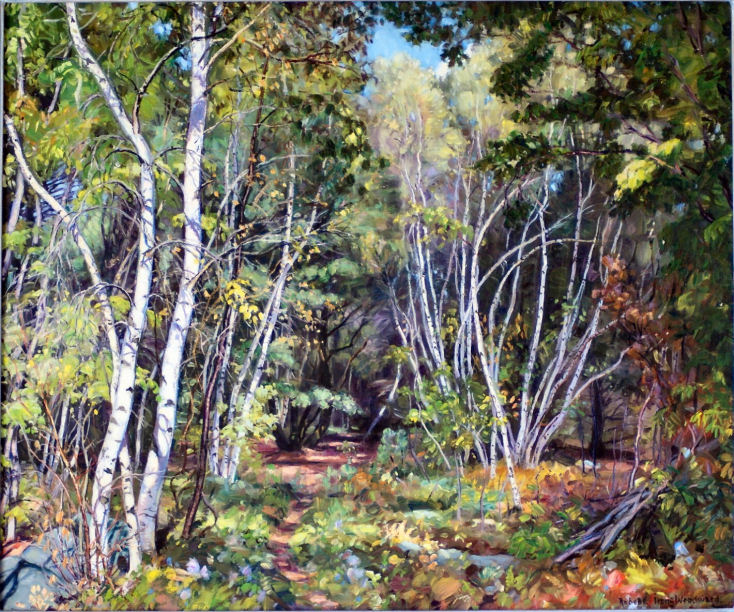

.png)

Featured Artwork: The Spring Tub
RSW's Diary Comments
734.png?url=photos/in_the_sugar_house_boiling(23)734.png)
 In The Sugar House; Boiling, c. 1930:
We know this
In The Sugar House; Boiling, c. 1930:
We know this
is not what Woodward is referring to but this is more a
"tub" than it is a trough which to us would be rectangular.
"Painted prior to 1929. A painting of an old big round red water trough set against deep woodland, ferns and wild growth about it, water trickling from it. Painted at Connie Jarvis" farm (a former Lithuanian hired man I used to have and whom I used to visit with Miss Cowles for 'painting change' after Connie left me and bought this farm.) On the road between West Chesterfield and Worthington, about Chesterfield Gorge. Bought from one of my early Boston exhibitions by Mrs. Henry P. King, 118 Beacon St., Boston, the sister of John T. Spaulding of 99 Beacon St. As Mrs. King is now dead, I do not know who owns the canvas. Mrs. King's summer residence was at Prides Crossing (Mass) next to that of Mrs. Wm. H. Moore."

Mrs. Ada Small Moore
Editor's Note:
Woodward illustrates how close knit the Boston elite are... Mrs. King is the sister of
John Spaulding the famous art collector who bought The Window: Still Life and a Winter
Scene as the first painting sold at the 1926 Lyman Residence Exhibit. It is now in Boston's Museum of
Fine Art. Mrs. King is also the next door neighbor of Mrs. Ada Moore in the North Boston shoreline community of
Pride's Crossing, Mrs. Moore is Woodward's patron-saint who created a trust to pay for the artist's medical care,
nurses, and attendants around 1924. She also bought his touring cars he used to paint en plein air.
We want to add how unique the scene Woodward describes above is. We have not real example to illustrate it.
Woodward did, early in his career, place himself on a road somewhere and paint subjects in the surround woods.
There is Birch Woodland or
Laurel and Wild Cherry, and even May Woods... all true
wood scenes. Still, nowhere does a man-made object appear.
Additional Notes
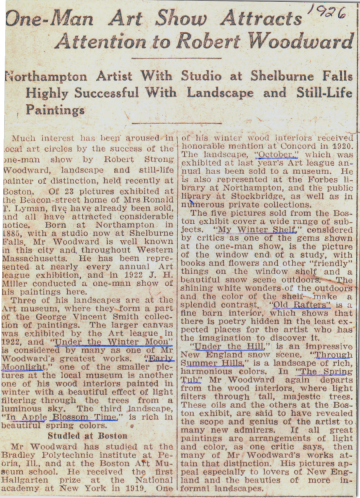
The Boston Post, December 9, 1926
Springfield Union, 1926 ⮞
"'The Spring Tub,' Mr. Woodward again departs from the wood interiors, where light filters through tall, majestic trees."
Boston Globe, May 1929, by A. J. Philpott ⮟
"The Spring Tub is a colorful, luminous picture---a simple roadside scene---glorified."
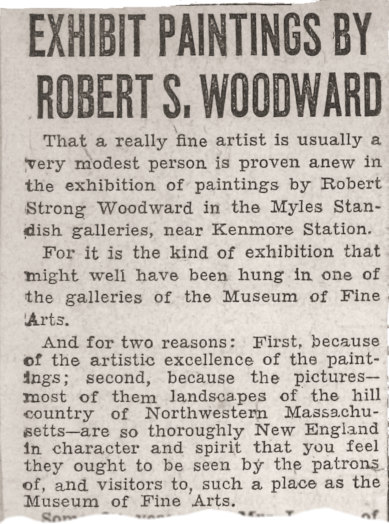
The Boston Globe, May 5, 1929,
by A. J. Philpott
We want to add the wonderful quote by A.J. Philpott to begin the the article above. "...For it is the kind of exhibition that might well have been hung in one of the galleries of the Museum of Fine Arts. And for two reasons: First, because of the artistic excellence of the paintings; second, because the pictures- most of them landscapes of the hill country of Northwestern Massachusetts- are so thoroughly New England in character and spirit that you feel they ought to be seen by the patrons, of, and visitors to, such a place as the Museum of Fine Arts.