
"A Riddle, Wrapped in a Mystery, Inside an Enigma"
The Strange Story of the December Farm Painting


 December Farm, dated unknown, 36" x 42", oil on canvas
NONSENSICAL: Intentionally Poetic?
There will always be unanswerable questions when it comes to anything related to the personal
past of someone. Like puzzles missing several pieces, the picture is incomplete. However, this painting resides in a completely different realm of mystery.
It is signed and named, yet in Woodward's lifetime there is no record of it ever exhibiting. No only that, there is inexplicibly no entry for it in his painting diary despite hanging
in his home for nearly 30 years. Woodward obviously admired the scene. There are multiple chalk/pastel versions of the same scene, all with varying differences in their name
that HAVE exhibited and frequently between 1929 and 1933, original being December Farm, A
Winter Sketch, 1929.
We believe there are three other drawings of this scene:
 A Winter Sketch,1931
New England Farm, A Winter Sketch,1931
New England Winter,1932
(Unfortunately, their whereabouts are currently unknown.)
The December Farm painting could have exhibited and we simply do not have the records. It could have gotten its name that way. But the name now becomes a mystery because the scene is not nearly as wintry and austere as the chalk sketches. In fact, it is hard for us to say what season this is. The hills have coloring you would see before the spring bloom or late fall after the leaves have dropped. Spring's early bloom can have many of the same hues and tones in the painting but the absence of any yellow leads us to say it can't be spring leaving us with later fall, early winter as most likely. It is possible this is December and the crops you see in the ground are Autumn or Winter Cabbage or both.

A close up of the crops.
Note the flatbed truck parked inside the barn.
The truck is notably absent in the sketch.

Springfield Republican, 1929
It then occurred to us that perhaps Woodward was being "poetic" with the name. That maybe "December" is a reference to the impending demise of a farm on its last legs or in its twilight. Is it possible Woodward knows something about the future of this farm and he is recording it for prosperity? Did he go back after a dusting of snow and the crops harvested to make the stark scenes of the chalks as a poetic device? And yet, as Jeanette Matthews points out in her review of December Farm, A Winter Sketch, 1929 that Woodward hints at a glimmer of hope and positivity with his glow of subtle light cast on the depressed farm.
Springfield Republican, 1929, by Jeanette C. Matthews
"'December Farm, a Winter Sketch,' is modern in spirit and design. All the crazy outbuildings of a hillside farm; including an angular not a circular silo, and viewed at an angle that ranges them down two sides of a triangle stand bleaky here in the most cheerful winter sunlight. It may be a hard, incomprehensible world, but there is always sunlight- in New England."
Is Ms. Matthews on to something? Did she see its message of hope? Although we do not believe
Woodward focused on hope as much as he did the promise of potential and an absolute faith in renewal and new life there is something to this leading us back to its name - the
cycles and seasons of life.
It is important to offer some additional context here... December 1929 is just weeks after the most devastating financial disasters in
American history, Black Tuesday, the stockmarket crash that brought on the era of the Great Depression. It is possible that RSW painted the oil the year before and went back when
the farm was shuttered. Note that the landscape in the sketch is bare. The garage barn no longer has the truck parked inside it. Is this a farm that went under as a result of the crash
giving the oil painting its poetic name? If this is the case, that would make December Farm, A Winter Sketch
a depression era editorial piece similar to Genial Old House, Chalk, 1929 and
Country Piazza, 1929.
We may never learn the answer to any of these questions. That is unless we find an exhibit where this oil hung on the walls.
Only then will we know if it was, as we suspect, painted before the sketch was made and the two are a series of before (December Farm) and after (December
Farm: A Winter Sketch) paintings.

A close up of the crops.
Note the flatbed truck parked inside the barn.
The truck is notably absent in the sketch.
A lot of our largest gaps of information regarding Woodward often appear to be intentional ommissions.
That is he is deliberate in leaving an air of mystery to certain things and the December Farm oil painting is a great example- especially when it is in someway or form social
commentary. The artist kept his beliefs very close to the vest. If it not for the childhood letters to his friend
Helen Ives Schermerhorn we would hardly know what he values at all. As an adult he burn ALL but a couple correspondences.
His personal diaries are like weather
reports or a ship Captain's logs, 'the weather today was sunny with clear skies... ran errands with mother..." There is little-to-no editorial commentary. The same could be said of his
Painting Diary, he never remarks on a painting's subject other than by it description. He complained about some things and would, on rare occasion, comment how he felt on about a
painting, but never the context in which it was painted. We published something recently how Woodward's phrasing of things are often misunderstood or could be interpreted a number
of different ways. It is as if he intentionally leaves out the context of something or perhaps he is just simply an "a-matter-of-fact" kind of guy. He was often criticized as being too literal.
And his response to that may say more about the man than us going on and on about it:
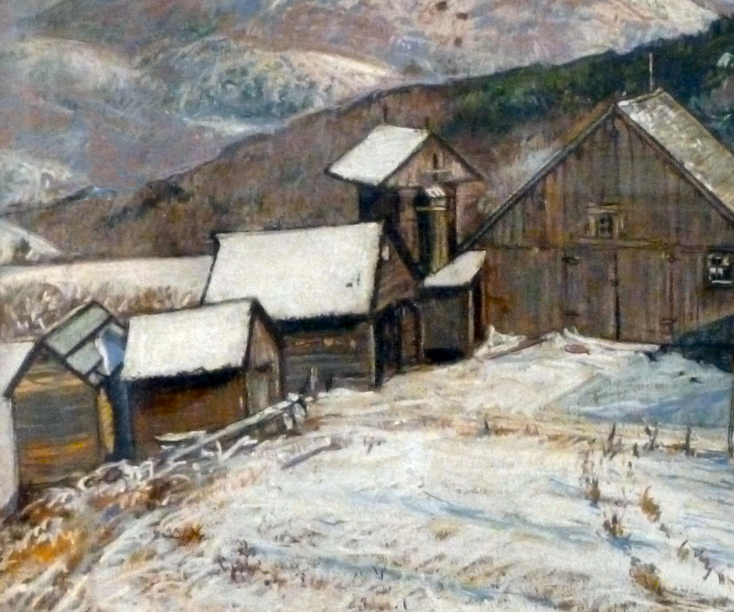
The chalk drawing, "Winter Sketch" barns show-
ing no signs of life or occupancy. Even if packed up for
the winter. Where is the truck?, Tools? Anything?
All of the oil paintings that accompanied their sister
chalk drawings appear to be complimentary with this
one exception, adding to the mystery of its origins.
Woodward to R. William. Macbeth, owner of the Macbeth Galleries, NYC, October 12 ,1920:
"It is reported to me that the work was felt to be too 'literal' and lacking in
'freedom'. As for the first word, the outlook does not begin to be as literal as that of Ben Foster, for example, -- but has what his work never has owned, a strong and seriously thot out
sense of design. Upon close inspection, the point of view is not so literal in my work, after all, but all is expressed so powerfully it gives that effect - yes, perchance too powerfully."
But here is something else we have learned about Woodward, he finds it poetic to hide things in plain sight. He, in fact, is not trying to hide it at all (as he alludes to in the letter above). He is simply encouraging the romance of mystery. It is there for you to find. Much the way a poet paints a picture with deliberately selected words, as does Woodward write a story in the selection of the subject he paints. Hence, the dramatic contrast between the oil painting and the chalk drawing most likely made AFTER the 1929 stock market crash and shortly before it exhibited at the Pynchon Gallery in Springfield on December 12, 1929, along with Genial Old House, Chalk which crazy enough does NOT match the description of the 1933 oil paintings but DOES match the 1929 oil, Country Piazza... and these are not the only oddities of the Pynchon exhibition.
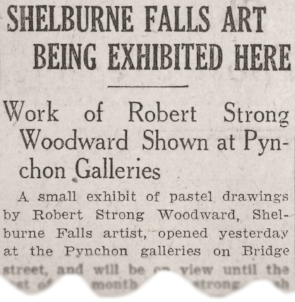
December 12, 1929, Springfield Daily
THE MISSING LINK: An Overlooked Article
Jeanette Matthews lengthy and wonderful review of the 1929 Pynchon Gallery Show gets ALL of the attention
in regard to the gallery's event. It appears in all of the artwork pages for every piece of work named in it. It focuses almost entirely on the chalks with just a brief mention of an oil painting
and yet, Ms Matthews does not give any context other than to say how compariable Woodward's treatment of both mediums are. This is the second significant review of Woodward's work
by Matthews. The previous year's One-man showing at Springfield's J.H. Miller Galleries is perhaps the MOST published article on the entire website. One Woodward made a special note of,
writing, "A good article," over its headline.
When we start to put all these separate things together a number of items begin to jump out. The first is, that the 1928 J.H. Miller
event, while primarily oil paintings (25), had a number of chalks (12) as part of the exhibit. Several of those chalks where matching scenes of the featured oil paintings. The second thing
is, that the Pynchon Gallery event appears to feature the chalk drawings, however, it exhibited 16 pieces which is not that much more than the 12 at the Miller show. It really is not all that
much more. However, and this is the third thing; we know from putting together a chronological order of Woodward's work that from 1927 to 1928 Woodward made nearly twice the
number of chalks as he did oil paintings. An interesting shift culminating up to the Pynchon show.
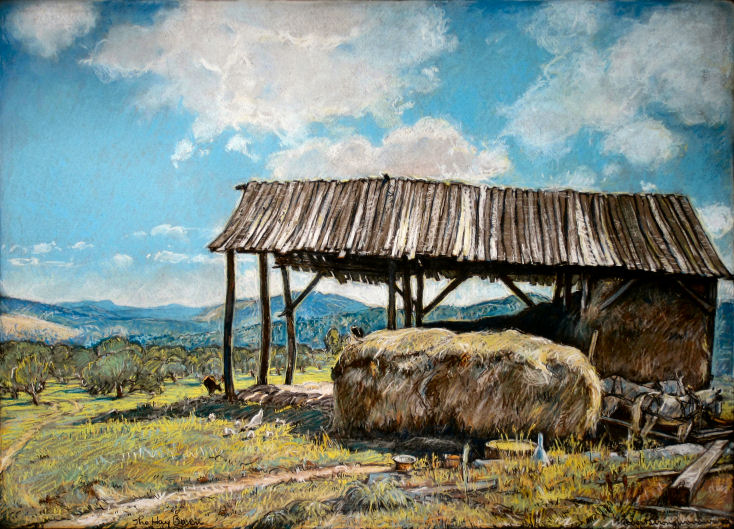
The Hay Barn, 1927-'28
Hung at the 1928 J.H. Miller Galleries Exhibit
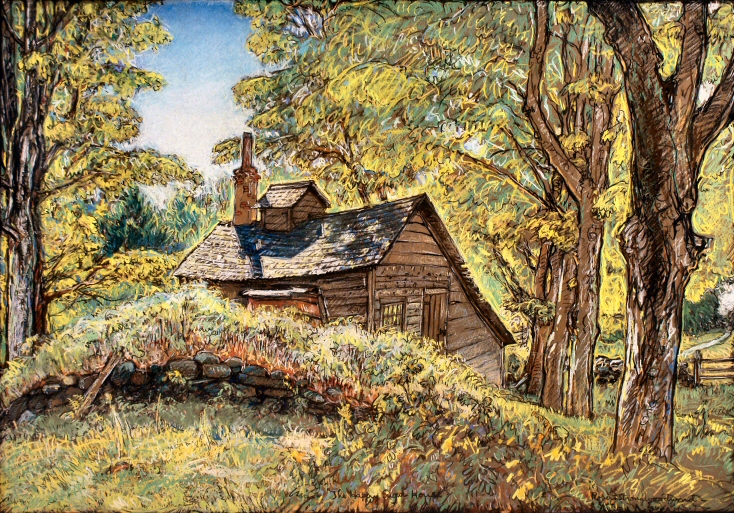
The Happy Sugar House, 1927-'28
Hung at the 1928 J.H. Miller Galleries Exhibit
We have wondered for some time the reason for this build up of the chalk drawings. From reading the two reviews by Ms Matthews you get the sense that Woodward is trying to make a point and Matthews sees it and makes it for him:
Jeanette Matthews, Art Critic, Springfield Republican December 12, 1929:
"Mr. Woodward has an unusual gift for seeing what the other-worldly-minded
have called the 'soul' of a place. He has also a remarkable power for transmitting to canvas, or board, the crisp clear quality of New England air, such air blows through heaven's casements,
if there is either in that no longer fashionable place. And thirdly and always Mr. Woodward can draw, whatever his medium. These 15 pastels illustrate notably each of these
characteristics.
To the layman it is astonishing that in a medium so different from oil, a medium familiarly employed for delicate, misty effects, one should
have light quite as satisfying and distinctive as in oil."
We have held the hypothesis for some time now, and it is part of the mystery and story of December Farm, that Woodward came out of the tragic Redgate fire seemingly determined to find his own distinct style and originality. A large part of that theory is that Woodward sought to make his oils express and radiate the irrredescent colors that the pastel medium naturally possesses. Furthermore, he moves even more so away from the impressionism of the time towards a truer representation, much like an illustration or drawing would do. Matthews mentions how many artist use the quality of pastel for, "delicate, misty effects," yet Woodward goes for bold, pellucid clarity and his paintings follow suit. For the first oil painting in this new style, see The Flying Fox.
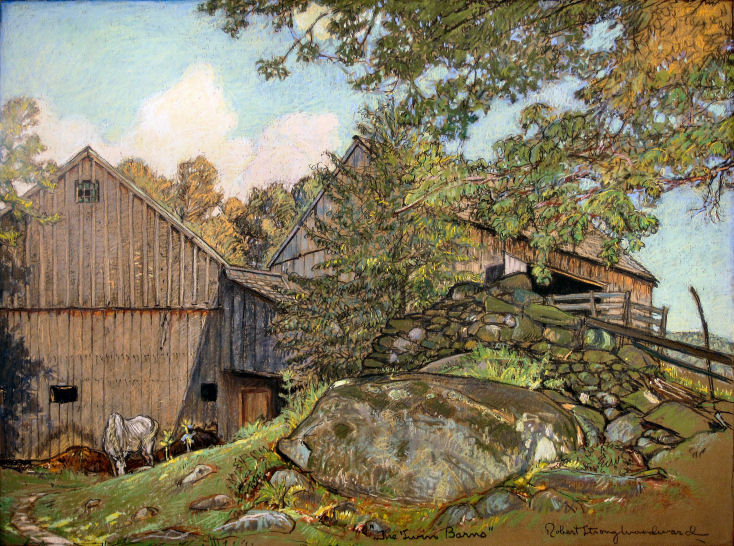
Twin Barns, 1928-'29
Hung at the 1929 Pynchon Gallery Exhibit
At least 5 chalk drawings listed at Pynchon can be
linked to oil paintings besides the December Farm oil
painting and chalk drawing. Twin Barns is not one.
Up to now we have been unable to support our theory. We have only a couple of examples where the oil painting
mirrors its counterpart chalk drawing. There is a clear change in his oil paintings from tonalistic treatments and impressionism towards a more representational, detailed view of the scene
without becoming too real. This technique requires more design and well - drawing with paint. It is the vibrancy of his colors and light that brings the oil paintings closer to the look of the chalk
drawings.
What about Woodward's chalk drawings? Matthews points out that he is not using the medium in a commonly used technique. He is being bold and expressive with
the vividness of the medium's pigment. The closest representation of the truest expression of color of any medium. This means, how it is applied is how it will appear. Whereas oil looks
different as it dries and will change over time given the need for preservatives... varnishes, lacquer or what have you in Woodward's time. There is no interference between your eye and the color of a
pastel. It is a dry application. The drawback is that the chalks get spoiled by the glass they have to sit behind for protection. Glare is an enemy to the appreciation of the work in both cases!
Taking a picture of an early painting compared to one painted after 1935 is night and day.
For all intents and purposes, Woodward is trying to find a middle ground. A pervading theme in his life. The search for balance. The pastels coloring and luminance with the smooth, blended, finely detailed, flat brush style with minimal interference to the eye. And he succeeds so much so that there are some chalks we have images of that even confuse us-- is this an oil or a chalk?

Enduring New England, Oil, 1931
A terrific example from around the same time as the
Pynchon Gallery show are these two paintings. Above,
the oil version and below, the pastel. But this is not a
fair comparison because the chalk is infected with
mold from a batch of pastels that were spoiled
somehow with moisture and darkened as a result.
The blotches are visible in the sky of the chalk drawing.
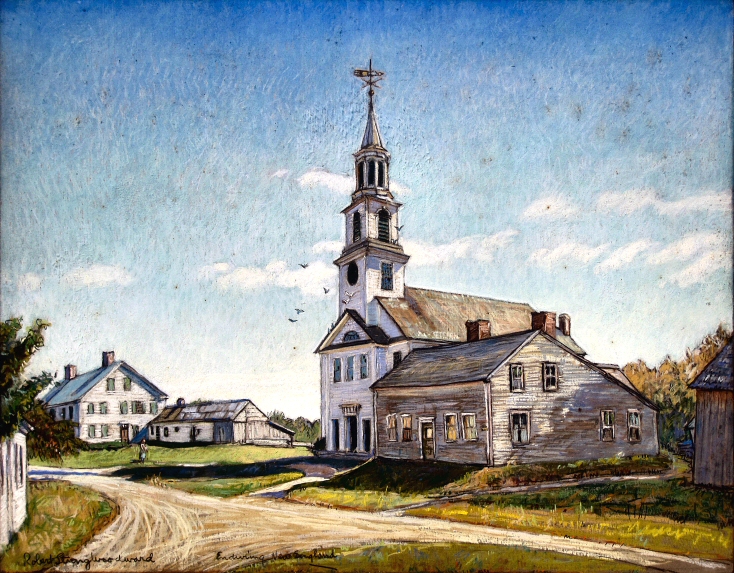
Enduring New England; Chalk, 1931
Still, one has to ask, what could possibly be the motive behind this effort? We believe the answer is socio-economic. Social economics was a favorite subject of Woodward's as a youth. Him and his classmates discussed and debated the subjects falling under its influence as an activity on their outings. In what should be common knowledge now because we have been introducing it the matter for years now. Woodward had a great appreciation for Japanese Culture.
A Letter-to-the-Editor by Flora White, Springfield Republican, June 3, 1931:
"Robert Strong Woodward has discovered and portrayed
reality as revealed in the skies and hills and streams of New England; he has portrayed it with the
profound integrity that one finds in Hiroshige's 'Pines at Hamamatsu.' In that master-piece the two
pines not only dominate the scene but they appear to create it; their very speech and plaint vibrating
from the thin wash of the Japanese print in touching cadence..."
"The situation seems a bit tragic and a bit anomalous. We can produce great art but we cannot
produce sufficient sensitivity and appreciation for its main-tenance. Perhaps, the youth movement, of
which we hear so much, will develop a higher type of desires until the fostering genius and the
promotion of noble works of art becomes the passion of our people. When that time comes we may
justly claim to possess an American culture."
Click the link below to see a PDF of Hiroshige's:
'Pines at Hamamatsu'
One of the reasons we believe is that in Japan "art" is highly esteemed. The social staus of artist ranks higher than that of a merchant and in many cases even higher than a samurai. In Japanese culture they aspire to make even the most mundane things, such as making a simple cup of tea, an artform. Full of purpose and meaning. In Eastern Culture in general, to become a "sage" is to be an artist. One first masters the skill of the pen (calligraphy). That is followed by scholarly pursuits. With a certain mastery of academic matters, one now writes poetry. However, it is not until one can paint an image of truth that reflects their distinct personality (unique perspective) that they are considered a "teacher" or Sage. Because in the East and particularly Japan, art was meant for the masses; to educate, be shared, and inspire.
This is the tradition in Japan. Some of the most famous works of art that even the novice would recognize
were in many cases wood block reproductions. Copies run off and distributed to market places throughout the country and affordable to the general public and it is THIS
that Woodward wanted of his chalk drawings... for them to be affordable to the general public and have them be hardly distinguishable from his much more expensive oil paintings.
The quote to the upper right, taken from a letter to the editor of the Springfield Republican by Woodward's cousin, renown educator Flora White, touches on these very issues. Flora
often accompanied Woodward on his painting excursions and I am certain she knew him and his beliefs as well as anyone. We do not think her comparison of Woodward's work to a
specific piece of Japanese work is mere coincidence. He was probably her source. It is an enrichment of identity and culture that lifts a nation.
The West has a very different history. Warriors are celebrated over artist but more than that, the East had inexpensive and reliable paper centuries before the West. The west were
still using labor-intensive and expensive animal skins well into the late 1400's after the printing press was invented. In the west the only people that could afford paper (or books
for that matter) were the elite upper classes of society even after the printing press was invented! This is was socio-economic factors directly address... the causes of poverty, ignorance
and illiteracy.
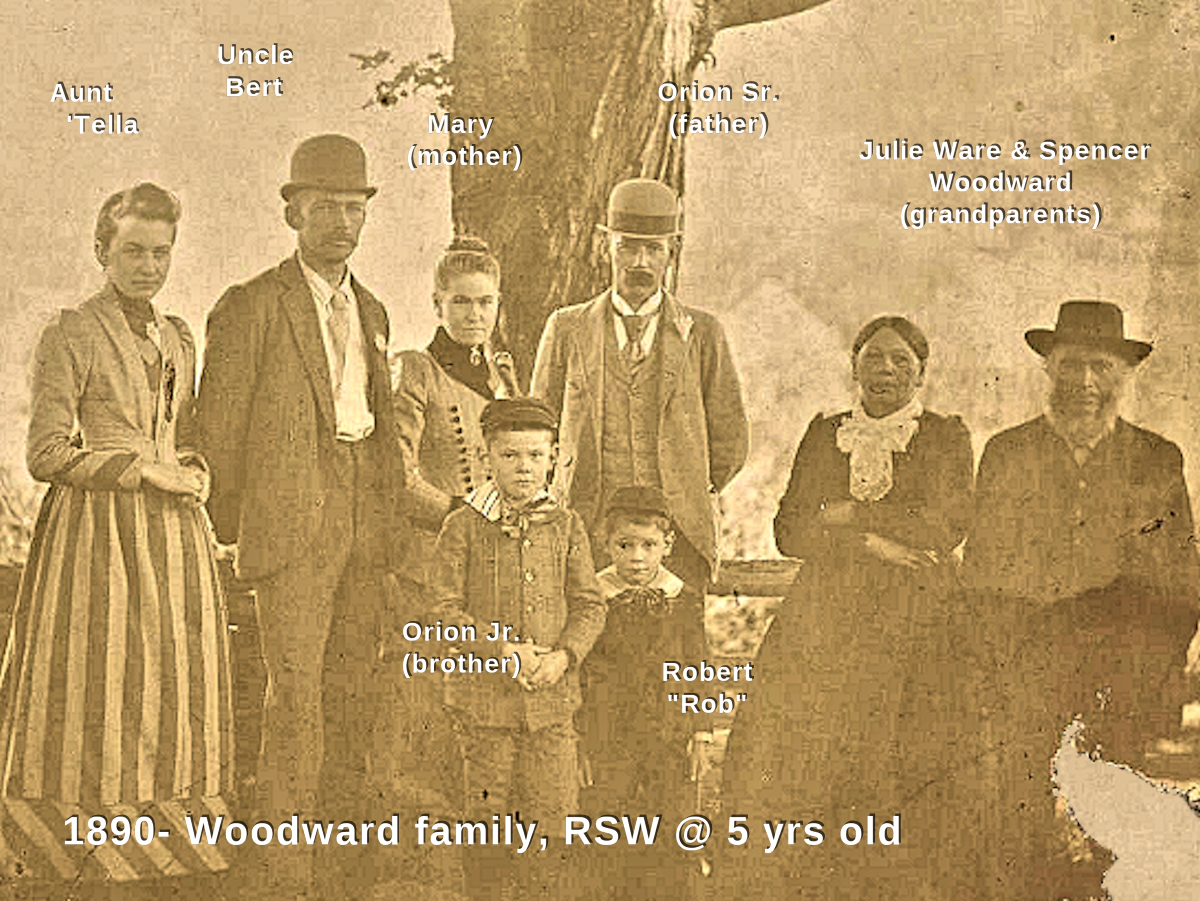
Five year old RSW with posing with his
family the day before leaving for Tennessee
Woodward in his lifetime was greatly influenced by the advancement in printing and paper technology. The Golden Age of print began in the early 1840s and in many ways is the start of the information age flourished in his lifetime. Along with this technology came the need and demand for compulsory education and public schools. Note the founding dates of many state colleges and universities and you will see, 1855 (Penn State, Michigan State), 1863 (UMass), 1873, Ohio State, and compulsory education is now being required of children up to 13 years old- Massachusetts: 1852, Connecticut: 1872, Rhode Island: 1883.

Woodward in the classroom of
McKinley Elementary
When Woodward and his family left for Knoxville, Tennessee in 1890, Tennessee would not yet have compulsory education (TN: 1905) but by 1892 when they arrive in Ohio he would attend public schools for the first time. Woodward was always insecure about his education calling it "Catch as catch can." Book prices in his childhood dropped nearly 40% of what they once cost just a decade earlier. Making books more affordable meant more people would have access to books and literature, increasing literacy. We believe Woodward felt the same way about fine art- the more accessible it is to the public, the greater the literacy of fine art and hence the advancement of culture.
Five year old RSW with posing with his
family the day before leaving for Tennessee
By the time Woodward is in high school, illustrators are the rock stars of the art world... Book illustrators, magazines are popping up by the dozens, and greeting cards are a growing industry and grew out of the nation's post card initiatives. Art was springing up in every conceivable nook and cranny of society and we believe this it his true desire in his youth and that is to be a rock star, not a virtuoso of the high arts.
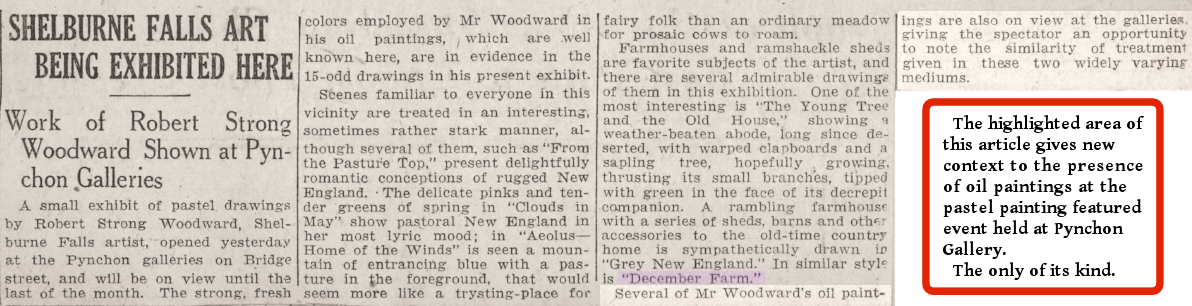
December 12, 1929, Springfield Daily
Proin sollicitudin eget erat vel varius. Suspendisse sit amet mi vestibulum, malesuada neque sed, eleifend magna. Etiam quis dolor quis mi condimentum pulvinar quis fringilla arcu. Aenean id ornare velit. Sed eget varius purus. Suspendisse hendrerit pharetra tempus. Suspendisse potenti. Nunc neque odio, malesuada id maximus ut, cursus at lectus. Integer ac hendrerit ante. Duis ut urna in velit elementum rutrum sit amet at tellus. Mauris consequat, tellus sit amet pulvinar hendrerit, ex nulla egestas arcu, convallis varius dui ex sed neque. Suspendisse potenti. Vestibulum sollicitudin mollis ipsum, vitae egestas nisl tempus sed. Proin vel nulla leo. Morbi fringilla porta dui eu scelerisque. Nunc non lobortis nulla.
Vestibulum dapibus, ante quis imperdiet tristique, massa magna finibus magna, ac iaculis sapien erat sed tellus. In varius sollicitudin nulla ac ullamcorper. Duis ut mattis ante. Aenean viverra sed ipsum et pharetra. In fringilla nisi at commodo condimentum. Integer scelerisque nec nisl malesuada tincidunt. Nunc bibendum fermentum mauris, non semper justo vehicula ut. Suspendisse sagittis tellus eget faucibus hendrerit. Phasellus eleifend faucibus libero id mollis. Nulla non dui id lectus sagittis rutrum. Donec mollis erat nec erat tempus molestie. Sed tincidunt ultrices dui, at rutrum lorem gravida fringilla. Nulla eget ex libero. Fusce malesuada turpis hendrerit viverra varius.
Donec turpis urna, consequat eget accumsan id, tincidunt in sapien. Aliquam imperdiet risus in tortor suscipit, sed malesuada ligula consequat. Nam feugiat viverra quam id sagittis. Curabitur egestas vel metus ornare fermentum. Phasellus mattis, nulla vitae condimentum fermentum, nisi diam dapibus nunc, at consectetur est felis posuere eros. Suspendisse potenti. Vestibulum sollicitudin mollis ipsum, vitae egestas nisl tempus sed. Proin vel nulla leo. Morbi fringilla porta dui eu scelerisque. Nunc non lobortis nulla.

####
#####
#####

####
#####
#####
####
HEADLINE #4: with SUBTITLE HEADLINE
Lorem ipsum dolor sit amet, consectetur adipiscing elit. Curabitur egestas nibh ut purus posuere, vitae fringilla orci dignissim. Etiam tincidunt odio ut ante vestibulum hendrerit. Donec a justo risus. Duis eget congue arcu. Aliquam congue scelerisque diam eu lobortis. Quisque non nunc quis dui pellentesque lacinia sed et nibh. In vitae varius erat. In congue dapibus rhoncus. Ut eget semper quam, vel viverra metus. Suspendisse euismod leo non sagittis sagittis. Ut faucibus, quam ac malesuada posuere, felis erat tristique sapien, sed scelerisque neque ipsum et velit. Aliquam in libero erat. Mauris iaculis ante a velit rhoncus feugiat. Vivamus faucibus non justo vel iaculis.
###
Lorem ipsum dolor sit amet, consectetur adipiscing elit. Curabitur egestas nibh ut purus posuere, vitae fringilla orci dignissim. Etiam tincidunt odio ut ante vestibulum hendrerit. Donec a justo risus. Duis eget congue arcu. Aliquam congue scelerisque diam eu lobortis. Quisque non nunc quis dui pellentesque lacinia sed et nibh. In vitae varius erat. In congue dapibus rhoncus. Ut eget semper quam, vel viverra metus. Suspendisse euismod leo non sagittis sagittis. Ut faucibus, quam ac malesuada posuere, felis erat tristique sapien, sed scelerisque neque ipsum et velit. Aliquam in libero erat. Mauris iaculis ante a velit rhoncus feugiat. Vivamus faucibus non justo vel iaculis. Curabitur egestas vel metus ornare fermentum. Phasellus mattis, nulla vitae condimentum fermentum, nisi diam dapibus nunc, at consectetur est felis posuere eros. Suspendisse potenti.
####
Proin sollicitudin eget erat vel varius. Suspendisse sit amet mi vestibulum, malesuada neque sed, eleifend magna. Etiam quis dolor quis mi condimentum pulvinar quis fringilla arcu. Aenean id ornare velit. Sed eget varius purus. Suspendisse hendrerit pharetra tempus. Suspendisse potenti. Nunc neque odio, malesuada id maximus ut, cursus at lectus. Integer ac hendrerit ante. Duis ut urna in velit elementum rutrum sit amet at tellus. Mauris consequat, tellus sit amet pulvinar hendrerit.
AUTHOR to RECIEPTIANT, DAY MONTH, YEAR:
"Aenean id ornare velit. Sed eget varius purus. Suspendisse hendrerit pharetra tempus. Suspendisse potenti. Nunc neque odio."
Vestibulum dapibus, ante quis imperdiet tristique, massa magna finibus magna, ac iaculis sapien erat sed tellus. In varius sollicitudin nulla ac ullamcorper. Duis ut mattis ante. Aenean viverra sed ipsum et pharetra. In fringilla nisi at commodo condimentum. Integer scelerisque nec nisl malesuada tincidunt. Nunc bibendum fermentum mauris, non semper justo vehicula ut. Suspendisse sagittis tellus eget faucibus hendrerit. Phasellus eleifend faucibus libero id mollis. Nulla non dui id lectus sagittis rutrum. Donec mollis erat nec erat tempus molestie. Sed tincidunt ultrices dui, at rutrum lorem gravida fringilla. Nulla eget ex libero. Fusce malesuada turpis hendrerit viverra varius.
Donec turpis urna, consequat eget accumsan id, tincidunt in sapien. Aliquam imperdiet risus in tortor suscipit, sed malesuada ligula consequat. Nam feugiat viverra quam id sagittis. Curabitur egestas vel metus ornare fermentum. Phasellus mattis, nulla vitae condimentum fermentum, nisi diam dapibus nunc, at consectetur est felis posuere eros. Suspendisse potenti. Vestibulum sollicitudin mollis ipsum, vitae egestas nisl tempus sed. Proin vel nulla leo. Morbi fringilla porta dui eu scelerisque. Nunc non lobortis nulla.