
Lucy Bridgman (1893-1989) and God's Quiet Acre

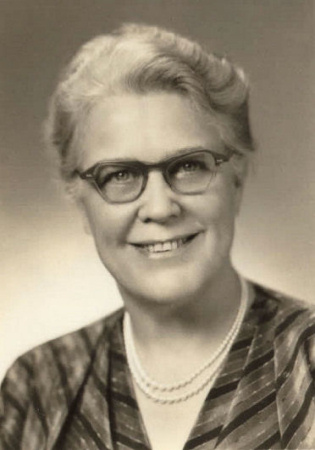
Aunt Lucy in 1956 (Lucy Bridgman Merrill)
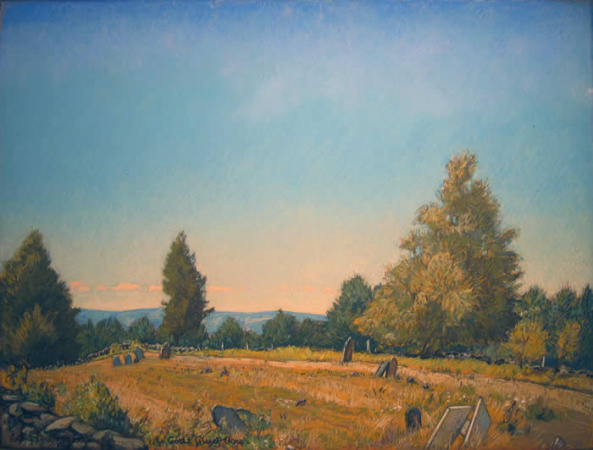
God's Quiet Acre - a chalk drawing by Robert Strong Woodward

 Northfield Seminary Exhibition Card
list 18 oil paintings hung between
June 3 to the 12th, 1933 using three
rooms. What is not listed are the 14
chalk drawing to also be shown,
including God's Quiet Acre
Aunt Lucy, Mr. Woodward, and God's Quiet Acre
by James E. Bridgman
My great-aunt, Lucy Whipple Bridgman, first met the artist, Robert Strong Woodward in June of 1933, after attending a showing of his work at Northfield Seminary. Aunt Lucy had graduated from Northfield in 1914, and she returned to the school frequently for alumnae gatherings and other class meetings. Mr. Woodward's show ran from June 3 through June 12, and one day during that time Aunt Lucy stopped in to Margaret Olivia Hall to see his work. She was immediately entranced by the eighteen oils and thirteen chalk drawings on display.
Her first thought, however, was that she would never be able to own "a Woodward," since the oil paintings at that time were selling for $450 and the chalk drawings for $100. Mr. Woodward later told her that before the depression had set in the oils sold for $600 and the chalks for $150, and that one day they would return to those prices. Aunt Lucy was not a wealthy woman, and it was hard for her to imagine spending that kind of money on a work of art.

The Auditorium, Northfield Seminary
East Northfield, Mass.
Color printed postcard published by
Detroit Photographic Co. Number 9351.
Copyright 1904. Probably published circa 1907
Born in 1893 into a hard-working family of modest means, Aunt Lucy had been raised on a farm in Westhampton, Massachusetts, the youngest of six children. After graduating from Northfield, she taught for a year and a half in the one-room schoolhouse in Loudville - a small factory hamlet a half mile down the road from her parents' farm. (Coincidentally, Robert Strong Woodward would later tell her that he was descended from some Loudville families.) In 1918, she followed her older sister Ruth to Boston to attend Gordon Bible College.

The original Frost Hall of the then Gordon Bible College,
now Gordon College. The college moved here, 30 Evans Way
in Boston, in 1917. Bought by Wentworth Institute of Techn-
ology in 1955, it is now Tudbury Hall, a dormitory.
After receiving her degree in 1920, she began work as a
secretary for the City Missionary Society, whose offices were located on Beacon Street in the heart of
Boston.
Meanwhile her parents turned control of the family farm over to two of their sons and moved to 5
Lambert Avenue in Roxbury to provide a home for their two unwed daughters. Aunt Lucy loved her work in Boston but it
was definitely not highly paid.

Clifton Spring Sanitarium
To further compromise her financial situation, in 1931 Aunt Lucy suffered an emotional breakdown and was forced to resign from her work. She spent a short time at the Clifton Springs Sanitarium in New York State, a convalescent home for people suffering from emotional distress.

The Bridgman family circa 1925.
Mary S. Bridgman, Lucy W. Bridgman,
Edwin B. Bridgman, Ruth J. Bridgman,
and niece Mary Lillian Boggs
The next two years she was mostly at home in either Westhampton
or Roxbury, during which time she did not work. Given her lack of employment in the midst of the Great Depression, it
is a strong testament to the power of Mr. Woodward's art that after attending his show, Aunt Lucy was giving serious
consideration to spending $100 on one of the chalk drawings. She later said that she felt it was important to feed
one's soul, as well as one's body, and she even attributed her recent breakdown in part to "too much
economy."
A few days after visiting the Northfield show, Aunt Lucy and her elderly father - neither of whom
drove - were chauffeured by Aunt Lucy's cousin Bertha Bridgman up to Buckland, where they paid a call at Mr.
Woodward's studio. This was at the so-called Hiram Woodward place on Woodward Road.

Editor's Note:
Woodward's
relationship with the property known as the "Hiram Woodward Place" goes back as far 1914-'15 when he rents a small
cottage on the western edge of the property built by the property's current owner, David Burnham. He would begin
renting the main house on the land in 1917 and buy the 9 acre farm after his Redgate
Studio fire in May of 1923.

Open Tulips, 1930-'31
This oil painting is just one example of the atmosphere
Woodward liked to surround himself, particularly in his
studios. See the Still Life Gallery for more...
Once again, Aunt Lucy was captivated - not just by the
paintings but also by the entire atmosphere that Mr. Woodward had created in his surroundings. Much has been written
about this studio, and of the time and effort Mr. Woodward and his hired man Fabian Stone put into restoring the
beloved old house and grounds. Aunt Lucy, in writing to Mr. Woodward afterwards, said, "I couldn't help taking away
the impression of artistic arrangement in every detail." Mr. Woodward deflected the compliment by writing back, "I was
embarrassed to be caught with the studio quite shabby and with faded flowers in the bowl; that is something which
rarely happens!"
In her note to Mr. Woodward Aunt Lucy thanked him for the visit and apologized for
interrupting his work. She said that her father had enjoyed the visit, too, but had been embarrassed to leave without
making a purchase. Mr. Woodward wrote back, "Tell your father he need not worry about having called to see my few
paintings last week and having bought nothing. I by no means expected him to walk out with a picture under his arm. It
is simply part of my profession to show people who are genuinely interested what work I have on hand, whether they
definitely intend to buy or not."

Aunt Lucy's mother, Mary Sophronia
Bridgman. God's Quiet Acre was purchased
in tribute to her memory
Although Aunt Lucy's father could not imagine investing money in expensive art - Aunt Lucy said, "he could go Coolidge one better on economy" - she herself had privately made up her mind to purchase a chalk drawing. She was especially drawn to one entitled, God's Quiet Acre, a peaceful scene of an abandoned cemetery in Buckland. She later said that it was the title that resonated with her more than the cemetery scene itself, and that she saw the picture as a memorial to her beloved mother, who had died in 1926 and was now in "God's Quiet Acre" in Westhampton.
She wrote Mr. Woodward,
"When I read the name I
immediately felt the spirit of the picture
and it would have hung permanently in my mind whether I
could
have obtained the original or not."
In her letter Aunt Lucy enquired about the specifics of the terms of sale, stressing that she was eager that her father remain in the dark as to the price paid. "He is distressed at my extravagances and I know he'll enjoy the picture much more if left in ignorance on that score - and he'd never guess the amount within a mile!" In his response, Mr. Woodward wrote a general letter that she could share with her family, but in deference to her wishes he enclosed a small sealed envelope entitled, "Personal Word to Miss Lucy W. Bridgman," in which he discussed the financial side of the transaction. Mr. Woodward also wrote, "Fabian, my chauffeur, will deliver the drawing to your sister in Brookline at the address you have given me, next Tuesday or Wednesday." Thus the deal was made and Aunt Lucy, in exchange for a bank note of $100, became the proud owner of God's Quiet Acre.
Her intent from the beginning was that the drawing should hang in the office of her sister Ruth, who was secretary at the Harvard Church in Brookline, and it is not clear why she did not want to keep the picture at home. At one point there was some hesitation about whether the Harvard Church location was suitable, as "the light there wasn't right," but eventually an appropriate location in the church offices was found. There is no record of her father's thoughts on her purchase, or if he ever learned the price, but several times Mr. Bridgman told Aunt Lucy and others how much he had enjoyed the visit to Mr. Woodward's studio.

Aunt Lucy at a piano, in her 30s
smiling she plays the keys.

The Harvard Church in Brookline

Aunt Lucy's desk at the Congrega-
tional Board of Pastoral Supply,

Aunt Lucy, retired and in her 90's with just a bit of
"God's Quiet Acre" showing above her desk
The Correspondance Continues, a Friendship Forms
Throughout the summer of 1933, Aunt Lucy and Mr. Woodward continued to exchange letters every few weeks. Soon they were discussing favorite books. In her second letter to him she asked, "Mr. Woodward, do you know the two books - The Roadmender by Michael Fairless, and The Prophet by Kahlil Gibran?
If not, may I loan them to you? To me they are the perfection
of art in the literary world - at least they are most satisfying to my soul. I cannot imagine a more perfect setting
in which to read them than in your new studio - or out by the brook."
Mr. Woodward wrote back, "No, I have
read neither of the books to which you refer - The Roadmender or The Prophet. I thoroughly love to read, but my
strength and time these days are so very limited for executing just my painting alone that I get little chance for
books and so fall behind the march in things literary and progressive. However, someday I should surely like to delve
into the two books you mention."
Aunt Lucy took him at his word and sent to Roxbury to have her sister send the two books out to Westhampton so that she could forward them to Buckland. When Mr. Woodward received the package, he wrote, "About The Prophet by Kahlil Gibran, I have a confession to make. The very second the wrappings fell off your package I realized that I knew the book well, owned it and had read it a number of times!" He said his own copy of the book was larger than Aunt Lucy's and contained "12 very fascinating illustrations by Gibran himself" that, not surprisingly, "meant almost as much to me as the symbolic and imaginative verse itself." He offered to send his copy on to Aunt Lucy so that she could see the images. She readily accepted the offer and wrote, "It is a joy to find so kindred a spirit in the appreciation of The Prophet. I dare expect now that you will enjoy The Roadmender, too."

The Roadmender by Margaret Fairless Barber
under the pseudonmyn Michael Fairless. Barber, an
English Christian writer, first published her book of
meditations in 1902. It became an instant classic.
There are two things to note here. The first is Barber
being English. The second, a Christian writer. (See Next)

The Prophet by Kahlil Gibran. Woodward
has 3 copies of it in his last collection of
books left in his last studio. Gibran, like
another RSW favorite, William Blake, is
a poet, philosopher, and artist. The
trifecta he once aspired to in his youth.
As it turned out, Mr. Woodward did not send the book to Aunt
Lucy, for one day in mid-August he personally delivered it (and another book by Gibran entitled Sand and Foam) to the
farm in Westhampton, driven there by his chauffeur, Fabian Stone. The visit was unannounced, and unfortunately Aunt
Lucy had gone in to Northampton for the day, so she missed the call that would have meant so much to her. But Mr.
Woodward visited from his seat in the car with Aunt Lucy's sisters.
While at the farm, Mr. Woodward couldn't
help noticing the giant elm tree that stood at the foot of the driveway. Aunt Lucy had sent him a picture of the tree,
a landmark in the local area, knowing that Mr. Woodward found great beauty in majestic trees - and probably secretly
hoping that he'd be interested in painting it. Before he left that afternoon, Mr. Woodward wrote Aunt Lucy a short
note,

The note left by Robert Strong Woodward and saved by Lucy Bridgman
"Miss Bridgman - I'm so sorry not to be able to wait, but I have
duties which require my early return. I've found the wondrous elm (also the old red barn and silo), had a visit with
your sisters, and am coming again soon to make a painting. On that day I'll really write ahead and surely see
you.
- Earnestly, Robert Strong Woodward."
The exciting news that Mr. Woodward might do a painting of the elm erased Aunt Lucy's disappointment that she had missed his visit. "You have fairly taken me off my feet with your decision to do some painting right here on our place," she enthused in a note written the next morning, "I confess that I had hopes of taking you up on a 'high hill' and showing you the 'kingdoms' viewed from there with the hope of tempting you to do some painting here in town. But . . . well, I am wondering how you are ever going to get returns from your efforts here - it gives me a terribly responsible feeling."

The Bridgman farm in Westhampton around
1897 showing the "Wondrous Elm."
"Don't be alarmed at the prospect of my painting someday on 'your home place'." replied Mr. Woodward, "I don't need the high places for inspiration. The family elm is a rare and lovely thing. Before the season is spent I hope to make a painting of it. I can't say just when it will be."
The prospect of Robert Strong Woodward doing a painting at the Bridgman farm in Westhampton filled Aunt Lucy with anticipation. She now began planning how to best meet his needs. Her first thoughts were to offer him the use of her summer camp in an old converted farm building. "I am quite at sea in knowing how to plan most helpfully. If your Fabian is a 'chef' as well as a chauffeur, and your health permits camp life, Camp Whip-poor-will will be at your disposal for whatever convenience it may be to you while you are at work here or in this vicinity. Perhaps you can judge that best if you know that there is a living room with stove, kitchen with three-burner oil stove, and running cold water, and breakfast nook, and a separate sleeping cabin (unscreened). The toilet is an improvised affair in the barn. If such a place has any possibilities for serving you I shall be most happy to turn it over to you - for one day or many days."