
Quick Reference
c. 1932
North Hadley, MA
Oil on Canvas
Landscape
Villages, Churches, Farms, Ponds
30" x 30"
Unknown
Unknown
NA
There is also a pastel painting of a very similar name, only transposed - The Village in April.
Related Links
- See also the...
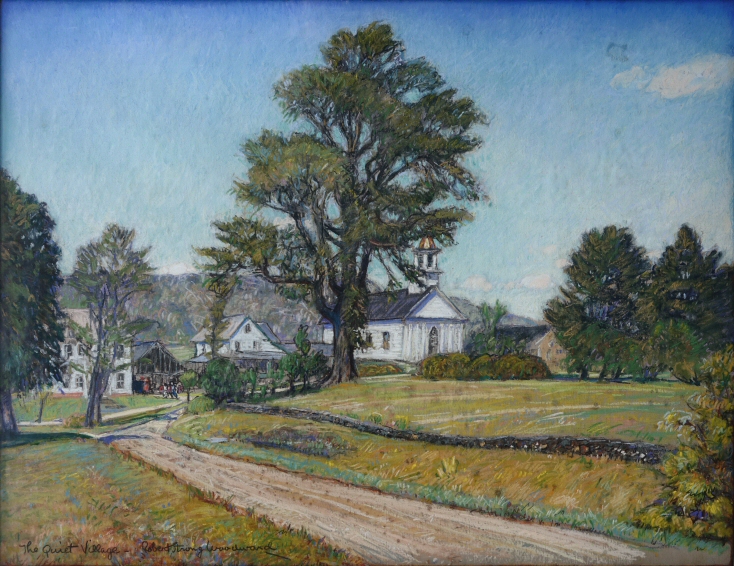 Villages Gallery to view related pieces.
- See also the...
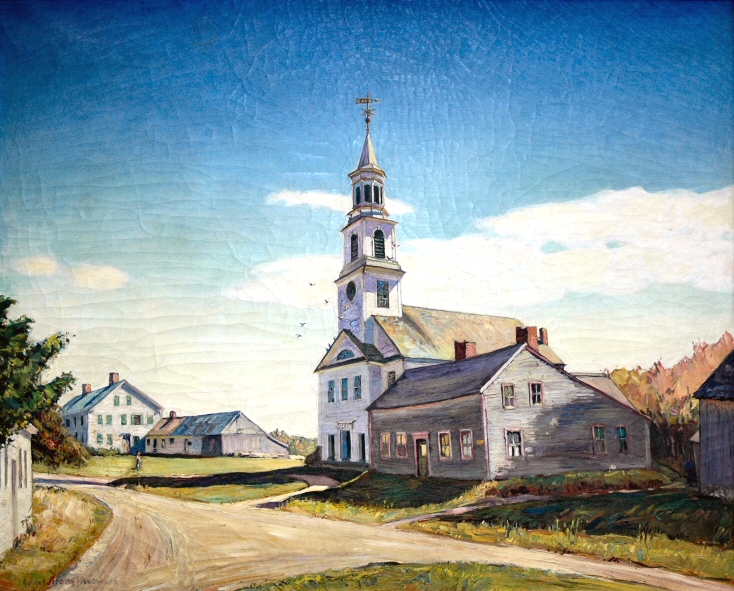 Churches & Cemetery Gallery to view related pieces.
- See also the...
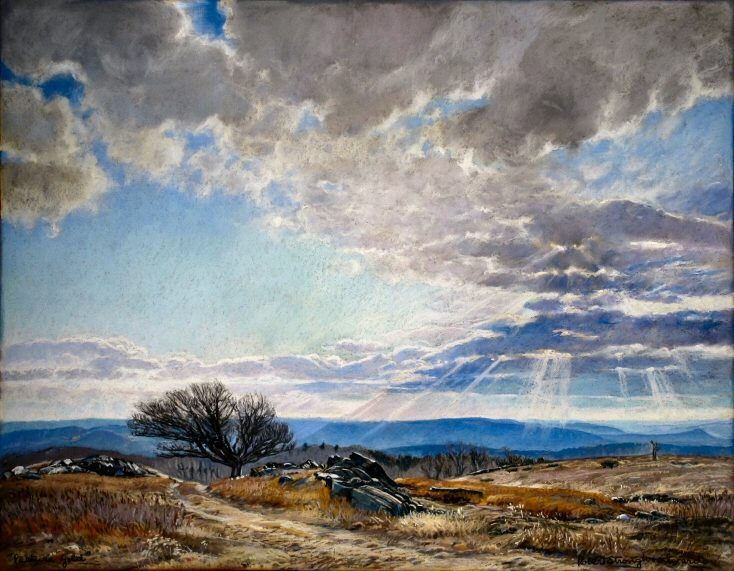 Stunning Skies Gallery to view related pieces.
- See also the...
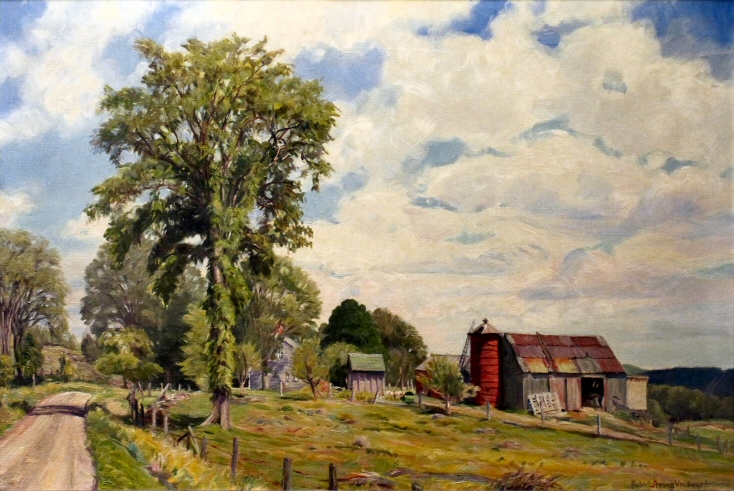 Farms Gallery to view related pieces.
- See also the...
 Brooks, Ponds, Rivers Gallery for related pieces.
- See also Dr. Purninton's...
 Clouds essay for more

Featured Artwork: April In the Village

THIS IMAGE IS USED ON 3 OTHER PAGES TO ILLUSTRATE THIS SUBJECT. IT IS THE ONLY COLOR IMAGE WE HAVE.
Click here for a high resolution image of the painting
RSW's Diary Comments

 Woodward did not remark on this painting.
Editor's Notes:
We have two images of this scene of the village of North Hadley. One is the correct image for
this page. The other is a sepia print for the painting The Village in
Spring.
The two images are mostly the same and differ only in that April in the
Village has more width showing more landscape. In fact, we have determined that there is an additional 1
inch on the left side of the painting and 2 inches on its right. Note the lone tree on the very far right of the
painting that is clipped in the sepia print.
This helped us realize there was more than one version of
this subject.

 April in North Hadley
This image is April in the Village which we used to
illustrate how April in North Hadley later became
The Village in Spring. While there are 4 names con-
nected to this subject. There are only 3 physical
paintings that actually exist and only two images.
Upon realizing that there was more than one version of this subject, we search out what other
titles we had that could match this painting using "Hadley" "Spring," and "Village" as keywords. We found four
in all.
That is when everything started to come together. April in North Hadley is the
original painting (1931). It is a 36" x 30" painting that was cut down to a size of 30" x 27" (the illustration
to the left). Woodward's diary comment for The Village in Spring helped put that together for
us.
Now we were left with two more paintings to identify. The two remaining paintings have very
similar names. In fact, they are an inverse of each other- this painting named April in the Village and
the other being, The Village in April.
The Village in April is a chalk (pastel)
drawing that exhibited at the Macbeth Galleries in New York City in Dec. of 1932 through January of 1933. We
have a record of it leaving this painting, April in the Village, as the ONLY possible name for this
painting, yet it is still unconfirmed. We are attempting to confirm it, however, the image is 18 years old at
this point and we do not have Dr. Mark's notes
as to how he obtained the photo.
Additional Notes

The Church and Meeting Hall... the distinct
steeple can be seen clearly in the painting. Past that
church one can see the bell tower of the other church.
To the right: is the Congregational Church and Town Meeting Hall of the North Hadley Historic District that appeal in the painting behind the two barns.
The following is a quote from the newspaper regarding The Village in
April. Though the reviewer does not mention the medium of the artwork, it is clear they are referring
to this scene...
New York Post, Dec. 22, 1932
"...Tender color in the budding elms and pale sky of April In the Village, contrasted with the rich notes of the old weathered red barns..."
Note the mix up in the name. We do not know, nor have we confirmed whether Dr. Mark added the name of this painting to the catalog as a result of

New York Post, Dec. 22, 1932
this article where we believe the reviewer transposed the name and got it wrong... OR if that is the
name of the painting in the picture we are using that Dr. Mark got from its owner 18 years ago.
We
are 80% confident the reviewer mixed up the name for two reason:
[1] The name April In the
Village, does not appear in our exhibition list, and...
[2] We have the program of the 1932
Macbeth exhibition and only The Village in April is listed and it is listed as a chalk drawing.
The remaining 20% uncertainty is the fact that as often as reviewers get the name of a painting wrong, so do
printer manager to forget to include a painting on its program. There is also the fact that at times there are
last minute substitutions and it is too late to change the program. This does happen with equal
frequency.
There is one more thing that may be possible. Woodward, at times, would feature a
chalk drawing and an oil painting together- not mentioning the oil painting at all, such as at the 1929 Pynchon
Gallery Exhibition that solely featured the chalk drawings but have now learned had corresponding oil paintings
matching the chalks in another room.
We believe this was his way of showing off, 'Hey, I can draw
as well as I paint and I paint as well as I draw... AND you can hardly tell the difference.' There is more and
more evidence pointing to this theory as well as how meaningful the pastels are to the artist which is why they
are important. But that is an essay for another day soon to come.