
Quick Reference
c. 1922
Unknown
Oil on Canvas
Unknown
Unclassified
Unknown
Unknown
Unknown
NA
Related Links
- See also RSW's ...
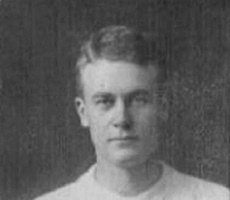 Personal Friends Gallery
( pictured is Lawrence Lunt) - See also RSW's ...
 Famous Owners Gallery
- See also the...
 In Bloom Gallery to view related pieces.
- See also the...
 Burning Autumn Gallery to view related pieces.
- See our page devoted to ...
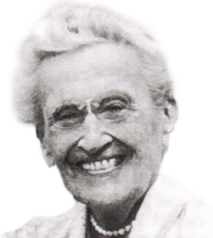 RSW sponsor, patron-saint Ada Small Moore
- See our page on ...
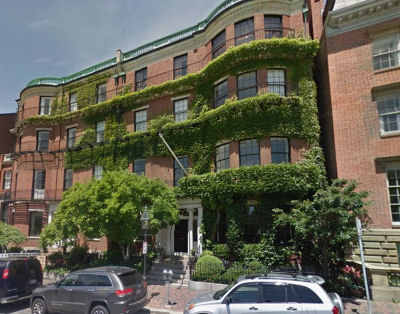 the 1926 Longfellow House Exhibit
.png)

Featured Artwork: The Chambered Nautilus
RSW's Diary Comments
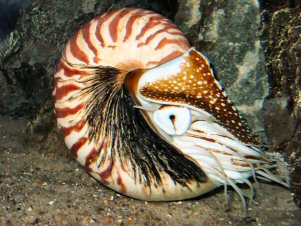
An image of a chambered nautilus
Remarkably, there are no diary comments for this painting adding to its
mystery.
Woodward enjoyed waxing poet with his painting names but his true poetry was when he
bridged the gap between the figurative and literal where both held a strong presence. With this painting name,
however, there is no telling what the subject matter could possibly be. It joins the ranks of "Spring Tub", or
"Rocking Mourning".
Still, the owner, Oliver Wendell Holmes Jr. the son of the poet, who once wrote a
poem titled The Chambered Nautilus in 1858 for his The Atlantic Monthly column suggest to us
that the subject might just be quite literal. So literal, in fact that we wonder if it was a commission.
After some consideration, we wonder if this painting might be a still life. Perhaps it is a chambered
nautilus resting on a book shelf with other brick-a-brac... similar to a scene found in The Book Corner or A Chinese Lily.
If that is the case, then maybe he once had a nautilus or what if it is a commission and Woodward made it of
Judge Holmes's study? It is our hope that this painting surfaces someday.
Read the poem
below!
|
The Chambered Nautilus This is the ship of pearl, which, poets feign, |
Thanks for the heavenly message brought by
thee, ------------------------------------------------------------------ For more on the meaning of this poem, among other things, see "Additional Notes" below and scroll down. |
Additional Notes
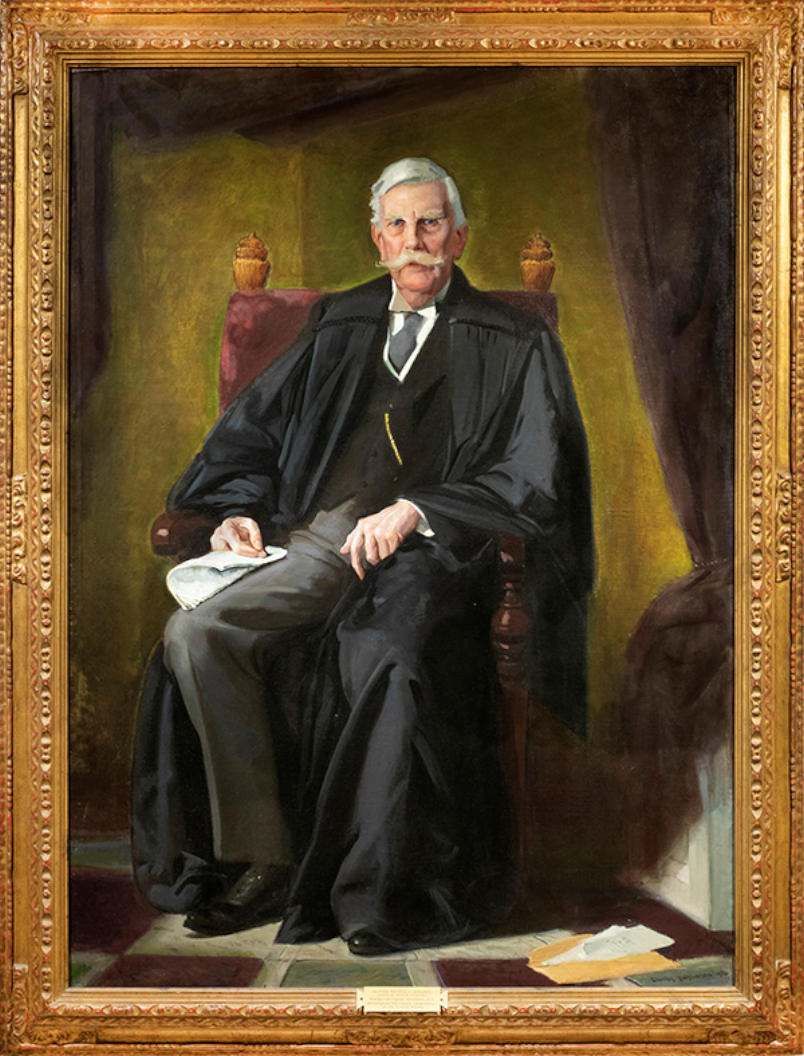
 The portrait of associate justice
Oliver Wendell Holmes Jr.
From Wikipedia:
"Oliver Wendell Holmes Jr. (March 8, 1841 - March 6, 1935) was an American jurist and legal scholar who served as an associate justice of the Supreme Court of the United States from 1902 to 1932. He is one of the most widely cited U.S. Supreme Court justices and most influential American common law judges in history, noted for his long service, concise, and pithy opinions-particularly for opinions on civil liberties and American constitutional democracy-and deference to the decisions of elected legislatures..."
It is not known what connection Woodward had with Judge Holmes other than to say he also had the jurist's
step son Walter Scott Fitz and his mother, Judge Holmes's second wife, Eliza Roberts Holmes, and their son,
Fitz's step brother Dr. Edward Jackson Holmes as customers. W. Scott Fitz lived at 42 Beacon Street, the home
right next to the Longfellow House (38 Beacon St. then the Lyman residence) where Woodward held his first
one-man exhibition in Boston in 1926. The person credited with arranging that exhibition was Woodward's
strongest advocate and supporter, Mrs. Mary "Minnie" Eliot who was critical in raising the funds to bring
Woodward east, back to New England in 1910
It is also very possible that his connection to Judge Holmes
is through Minnie's cousin and long time Woodward friend, Lawrence Lunt
whose father is the Honorable Horace Grey Lunt, a district court judge in Colorado and a Harvard Graduate where
Judge Holmes taught for years. Horace is also the son of one of the founders of Northeastern University and Law
School.
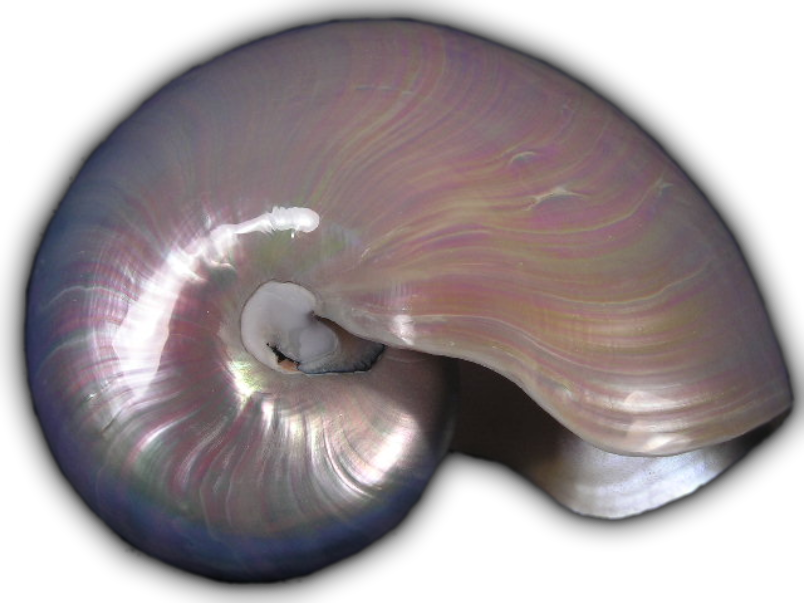
The Chambered Nautilus shell
Something about this work of art feels customized to us, either Woodward made it by commission or he made it specifically for Judge Holmes perhaps out of repsect for him, a progressive Republican, or as tribute to his father, the poet, to whom Woodward may have greatly admired.
 Woodward loved poetry and the written word nearly as much as
art. He always had a book collection, despite having lost it to fire twice in his life.
Woodward loved poetry and the written word nearly as much as
art. He always had a book collection, despite having lost it to fire twice in his life.
Judge Holmes is considered one of the most scholarly jurist to
even preside on the Supreme Court and Woodward resulting from his insecurity of an education he once referred to
as, "catch as catch can," engrossed himself in scholarly and philosophical pursuits.
The chambered nautilus symbolizes the "golden ratio" structure
of nature's beauty and symmetry.
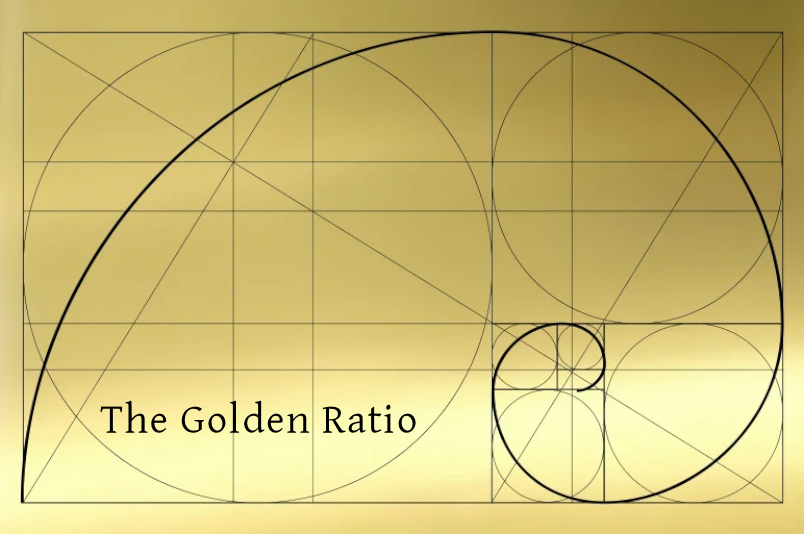
An illustration of the Golden Ratio first
defined by Greek mathematician Euclid and later
formulated into a sequence by Fibonacci, and
finally described geometrically by Edmund
Harriss is basically a principal of sequential
growth and proportion found extensively
throughout nature and is best know as the spiral.
Oliver Wendell Holmes's poem on the nautilus is said to be, "a
wonderful poem about natural beauty... The poem speaks about the beauty and struggle of a small sea creature
that lives inside a spiral shell." ( LiteraryDevices.net ) In other words, it is about the perseverance in limiting
circumstances and surviving. A subject dear to Woodward's heart.
The Chambered Nautilus itself is, "... one of the oldest
creatures known to survive in the earth's oceans. It is a symbol of nature's grace in growth, expansion, and
renewal. It is also a symbol of order amidst chaos as reflected in its spiral precision." ( Dr. Becky Beaton ). This fits with
Woodward's interest in what is everlasting in life and can be link to the Japanese name he gave his mare, Tsune,
meaning "Always" or "Everlasting" in a sempiternal direction towards the future. Woodward was espacially
fasinated with the concepts of natural selection and Darwin's principles of evolution. The Chambered Nautilus is
the very representation of the origins and tradition of nature's enduring qualities in its opalescent
glory.
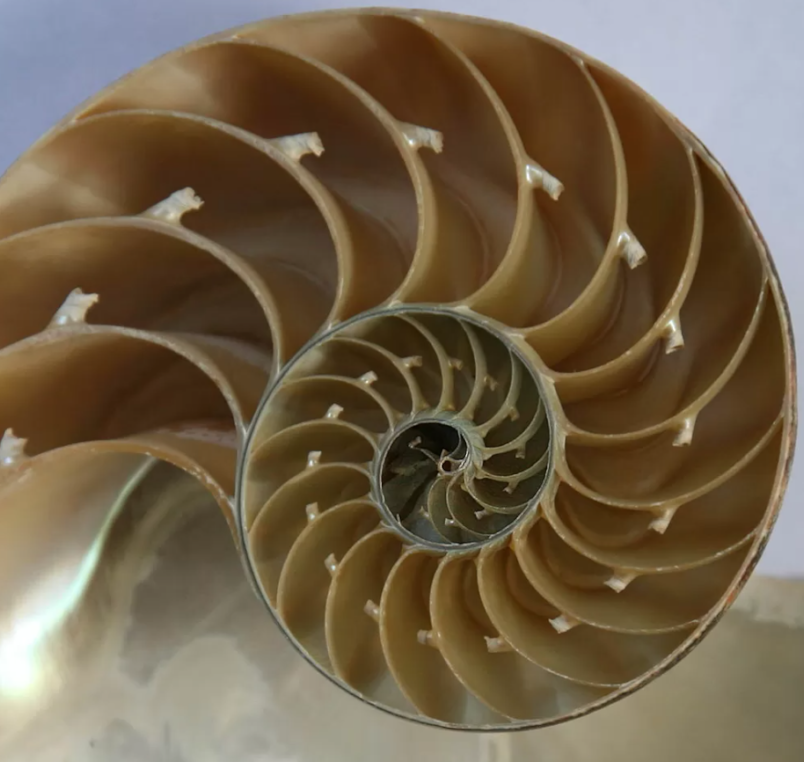
The Chambered Nautilus Sutures, the
immovable junction between two bones,
fanning out in the Fibonacci sequence at
roughly 1.618 times per sutured perfection.
Speaking of opalescence, Woodward admired the quality of
differential refractive coloring that produces iridencent light. Iridescence is a brilliant, lustrous, or
colorful in effect or appearance like the luminous radiance which he transitioned to from the tonalism of his
early career in the latter stages of his work as a luminist.
Woodward would use the term opulent to describe some of his
paintings on the back of sepia prints sent to galleries for their consideration to hang the painting. He even
named one of his chalk drawings, Opalescent April, 1933, which
appears to be of the Keach Farm in spring.
Either way, the evidence points to the work being catered specifically from the inspiration narrative of the poem, The Chambered Nautilus, by Judge Holmes's father Oliver Wendell Holmes. Still, as we said to begin this page, we do not know how literal or figurative this artwork is. Is it an actual nautilus or is it something that either through its design or appearance alludes to the nautilus and the golden ratio in some way?