
Quick Reference
1918
Unknown
Oil on Canvas
Landscape
Farm
27" x 30"
Unknown
Unknown
NA
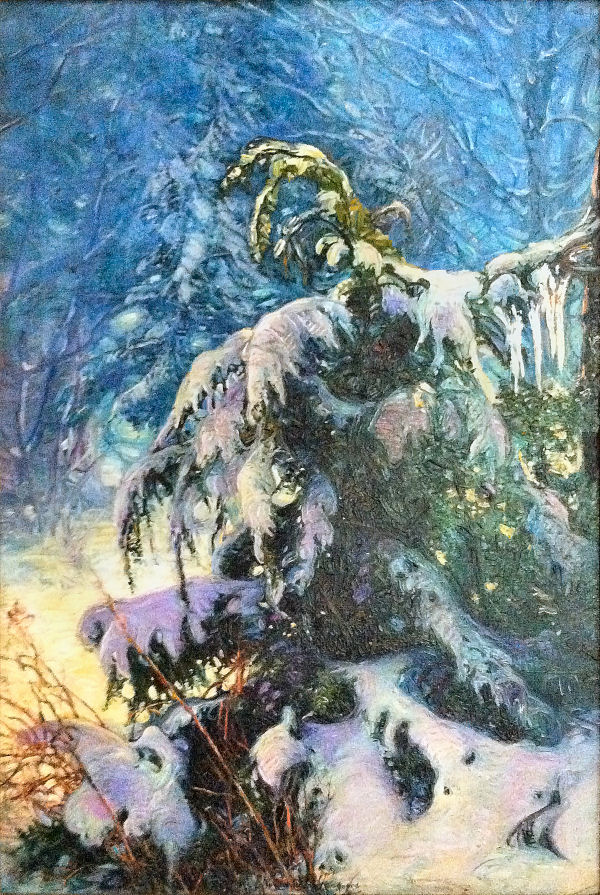

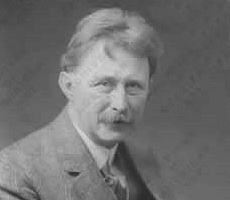 Colrain artist and RSW ally
 .png)
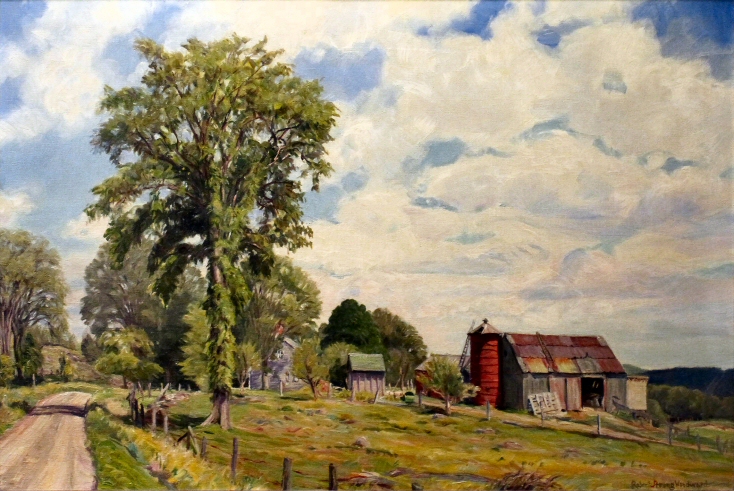
Featured Artwork: A Farm in Winter
734.png)
RSW's Diary Comments
♦ Rarely are unnamed paintings found in the artist Painting Diary, mostly because he didn't start the diary until 1942, 24 years into his career and did so entirely from memory.
-sigLG.png?url=photos/unnamed-collection_time(25)-sigLG.png)
 Woodward's signature from a painting recently
sold at auction online.
Editor's Note:
⮜ In November of 2025, we received several emails inquiring about the signature on a painting up for auction on Live Auctioneers, an online auction website. The inquirers were unfamiliar with the simple R. Woodward 1918 signature and was asking us for our opinion. Fortunately for us we had this painting with solid provenance as seen below to the right.
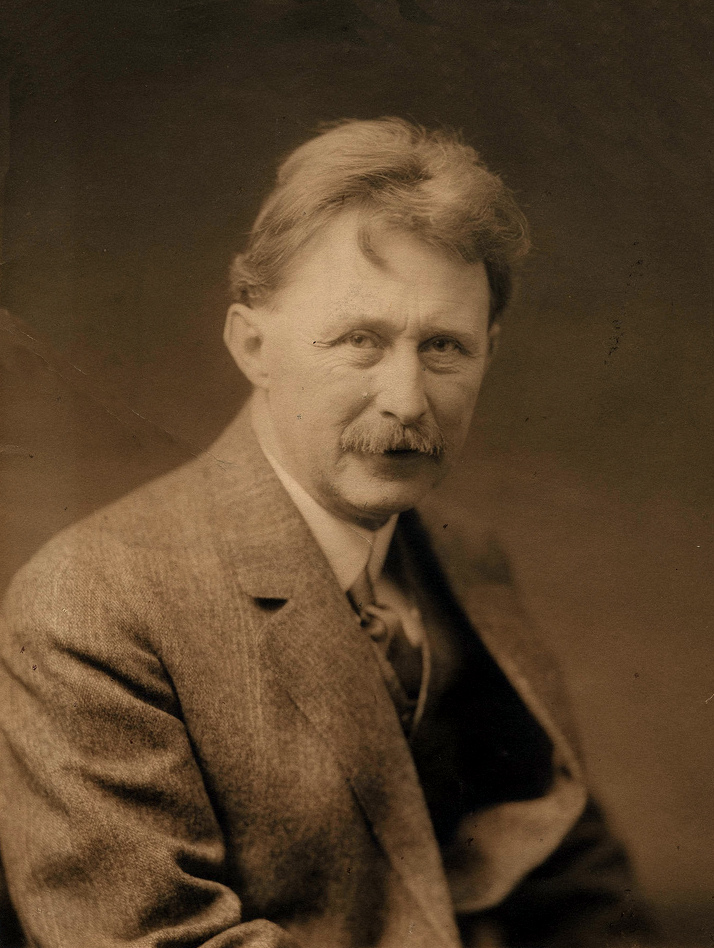
Two time NAD Altman Prize winner
Gardner Symons
Woodward did not begin painting professionally until April of 1917 as told by his high school
friend Charles Lambert in the 1919 Peoria Star article, Echos of the Past. He did not sell his first canvas until the summer of 1918 and we
have no description of that painting. We are as baffled as others as to why Woodward chose to sign his paintings
this way. We have numerous examples of the artist signing earlier artwork, "R.S. Woodward," "Robert S.
Woodward," even "RSW," and "Robert Strong Woodward." So why he started out with simply R. Woodward and the year,
what cannot explain other than to say we know he was very insecure about it in those early years. It was not
until he mustered the nerve to go see Gardner Symons in nearby Colrain
for his criticism of his work that he felt more sure of himself.
Woodward continued to add the year
after his signature only to 1919, and not all of those paintings has a year assigned to them. All of the 1919
paintings are signed with his full name but he did not begin using the trademark Red "S" consistently until
after 1922 and yes, he did experiment with other letters in red, including: the "R", "R" and "S", just the "W",
etc.
Additional Notes
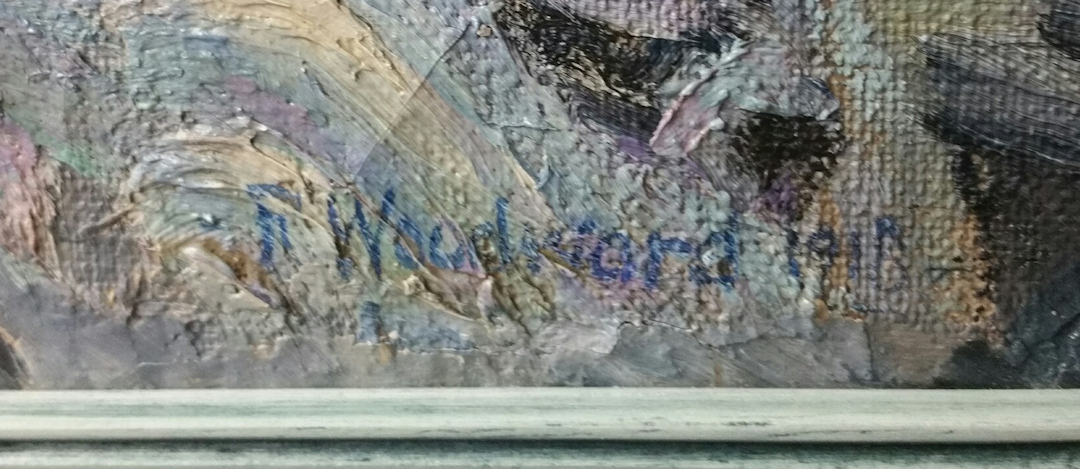
A close up of the signature from the painting's
lower right hand corner. The heavy impasti brush
technique of his early years easily seen.
This painting dated 1918, the first year of RSW's professional career, is unnamed and its location is unknown. Initially, we suspected its location was believed to be a farm neighboring his grandparent's old home, the Nilman House. However, that has yet to be established.
The painting appears to be in pretty good condition, despite some yellowing of age and a chip missing just right of the middle center. We filled it in using photo-editing software for the sake of not having a distraction in the middle of the image. Had the chip been anywhere else, we would have left it be.
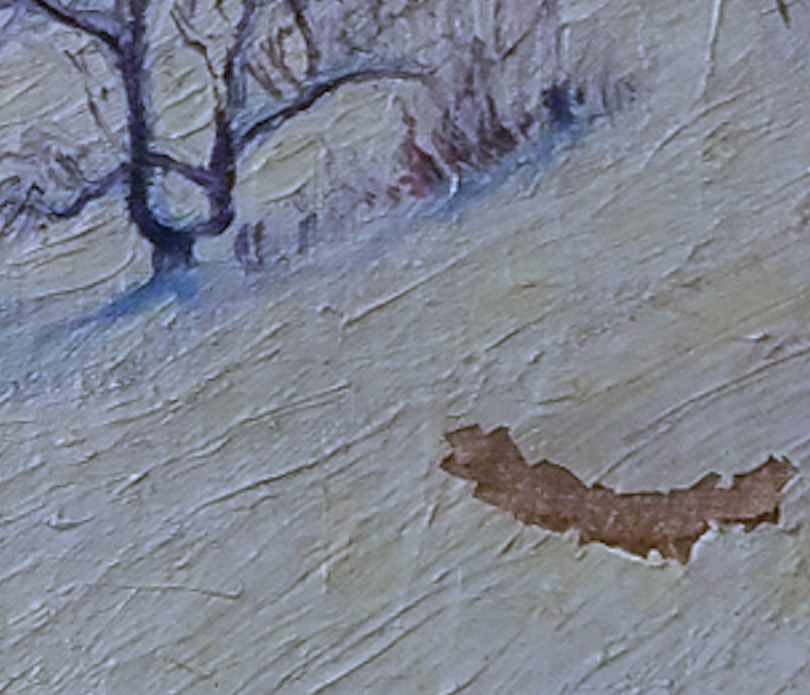
A close up of the chipped paint
It has held up well, considering it is 100 years old this year and early in RSW's career, he by his own admission, was still learning the techniques of mixing preservatives and other products to ensure the painting held up over time.
Furthermore, we want to draw your attention to the young, what appears to be an apple tree, in the center of
the painting among the other more mature trees. As we study Woodward more deeply, we are finding that this is a
common theme in his catalog. To him, it represented "new life" and hope, the cycle of nature itself, of which is
certainly be a message he would value unlike most. During editing of the photo, the editor accidentally stumbled
upon the fact that the fledgling tree is nearly dead center in the painting another theme he often
used.
For other examples see:
The Young Tree and The Old House
The Old House and The Young
Tree
Unnamed:
Stonewalls Meet
♦ This painting came to us via the current owner finding our website and contacting us. We wish to express our profound gratitude and appreciation to them for their time and willingness to provide us images of this artwork.