
Quick Reference
c. 1930
Old Boston, MA
Oil on Canvas
Landscape
Boston
27" x 30"
Myles Standish Gallery, 1931
Mass Mutual Life Ins. Co., 1932
Valleyhead Sanitarium, 1934
Unknown
N/A
 relationship with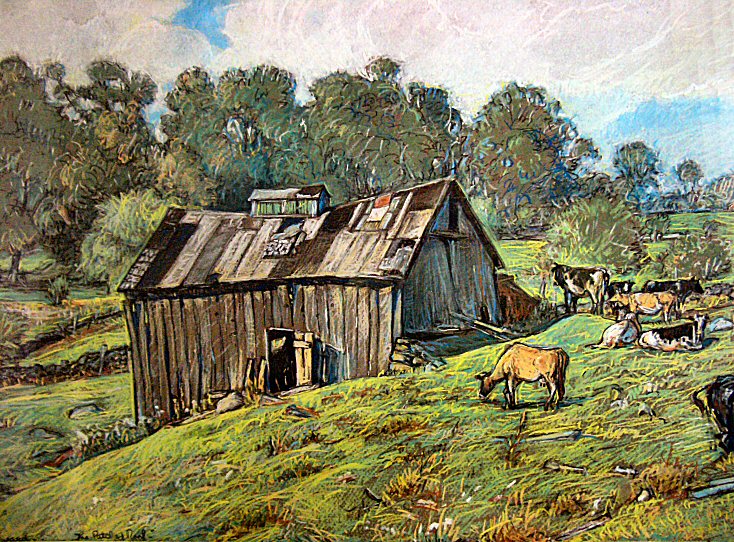
.png)
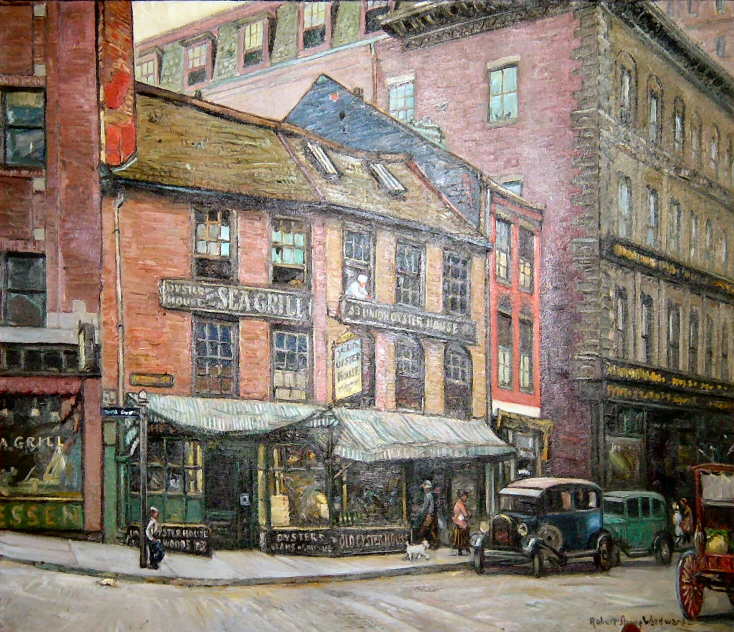
Featured Artwork: In Old Boston, (27" x 30")
RSW's Diary Comments
Diary Comments from the 36" x 42" In Old Boston:
"Painted in 1931. A larger painting of the Old Oyster House in Boston on Union Street, made from the smaller 27" x 30" canvas which in its turn was made from the chalk drawing made on the spot in 1931, the week I had Florence Haeberle's house in West Newton. The smaller painting 'Oyster House' was sold by the Grand Central Art Galleries from their Founders' Show in...... while the original chalk was bought by Dean and Mrs. Howard Robbins of Heath, Mass (summer address)."
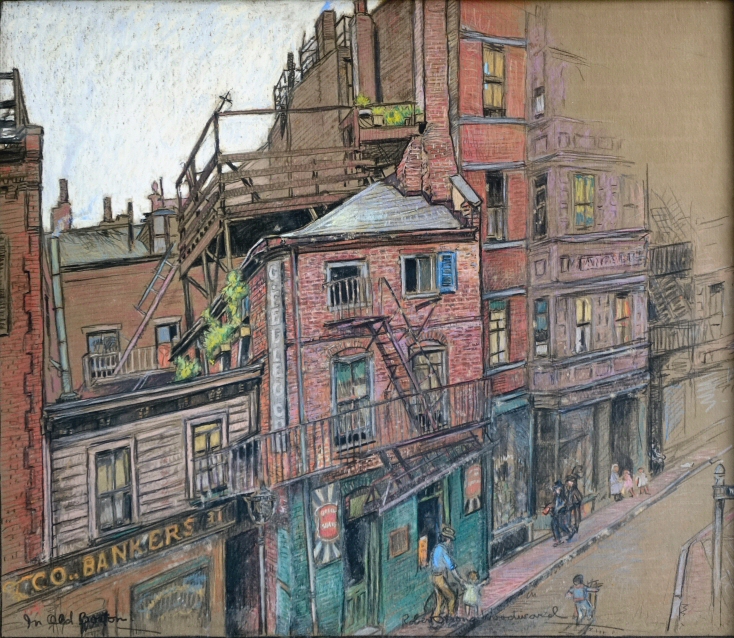
 In Old Boston, Chalk
As an aside, the pastel above is the artist's rare attempt
at emulating the NYC "Ashcan" school's methodology,
"art rooted in the raw, visceral reality of the city,"
much the same way RSW was doing for the old NE farm.
Editor's Note:
We believe Woodward is not remembering this painting in his remarks above. The paintings he
is referring to is a painting originally named The Oyster House (1931) and later changed to Boston Romance (1933). Boston Romance is the
painting that sold at the 1937 Grand Central Galleries Founders' Show.
However, the artist actually
had 4 paintings of two scenes all exhibiting at the same time but never together at the same place. We believe
the painting of this web page's subject is an oil version of the chalk drawing by the same name seen to the
left. For example, you will see that all four paintings, the 3 by the same name In Old Boston, and
the then named The Oyster House, ALL exhibited at the Myles Standish Gallery in Boston, in 1931, but
each in different months (Jan., Feb., Mar., and June)
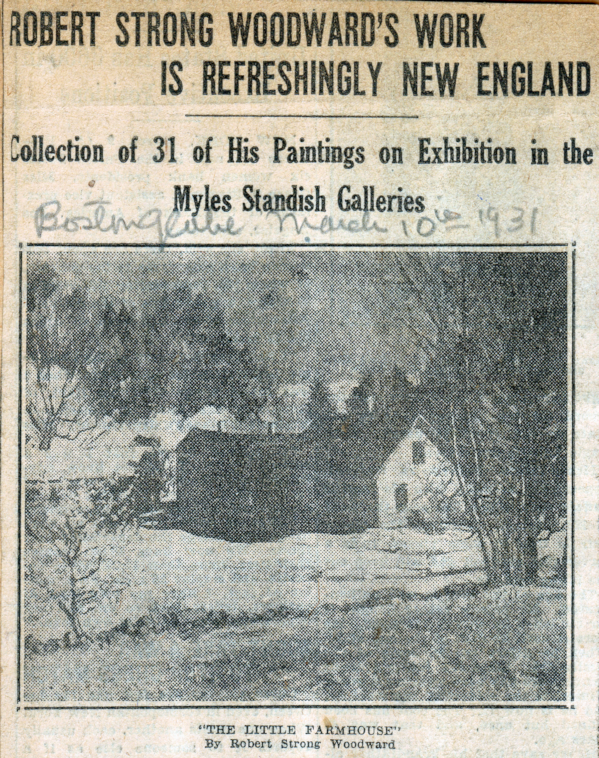
Boston Globe, March 10, 1931 by A. J. Philpott
"In Old Boston, a picture that should be in the
'old state house', for it shows one of the few archi-
tectural bits of old Boston along Union Street
which carry back to the 18th century. And it is
painted in just the right key."
This has been confirmed through the exhibition records as well as by newspaper. The Boston
Globe's art critic, A.J. Phillipott remarked on the painting in a March 10, 1931 column for the Myles Standish
Gallery in Boston where the only In Old Boston painting hanging at that time was the 27" x 30" oil
painting. Also note that Philpott makes no mention of the Oyster House. Instead he talks about 18th century
architecture, "along Union Street."
Philpott ends his comments on In Old Boston by the
painting is painted in "just the right key." What we think he means is that in music, "A key tells you the
tonal center and the mode," suggesting the architecture holds the central theme of the work.
Because Woodward has essentially forgotten this painting in his diary. According to the exhibition records its last known location was the Valleyhead Sanitarium run by the artist dear friend Dr. Lawrence F. Lunt. We know Dr. Lunt owned paintings by Woodward, in fact, in the artist earliest years the good doctor was his biggest advocate. Still, there is no tangible records of how many paintings the Lunts possessed in total or what happened to them all and so we can only speculate that this painting may have ended up with them. We would not be surprised to learn this.
Additional Notes
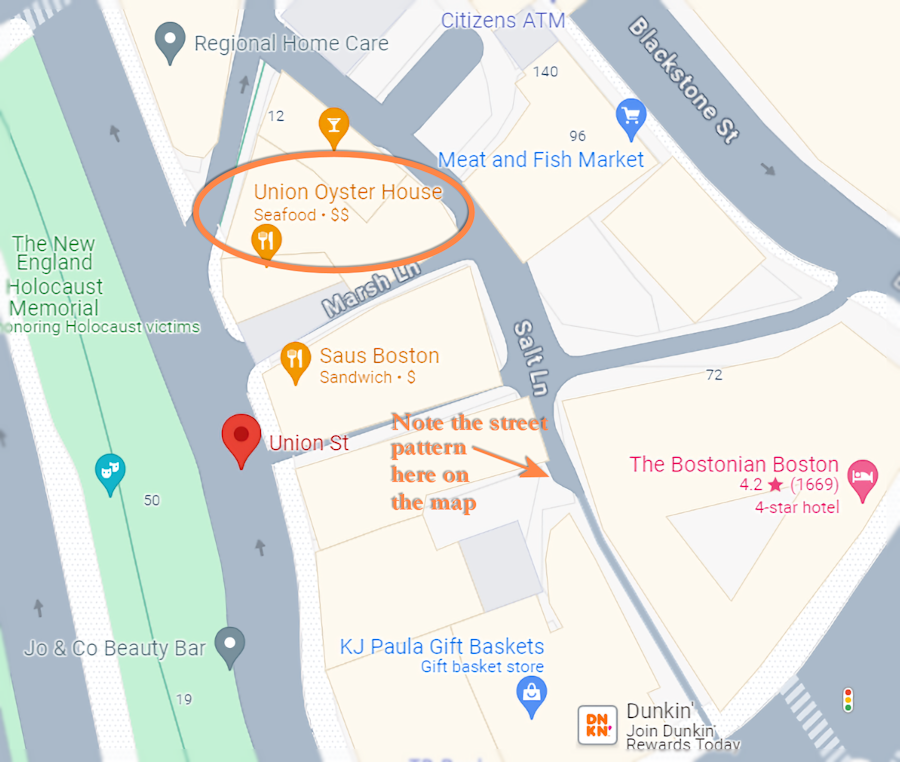
A capture of the area on Google Maps
If you look closely at the road area of the chalk drawing
you see that the street widens just to the lower right.
This map shows a similar street pattern on Salt Lane.
 The neighborhood street you see in the pastel painting above is most
likely in the same area as the Ole Oyster House on Union Street. It appears more residential, meaning less
touristy than the crowd you would see around the famous restaurant but we have been unable to identify it for
certain. However, if you see how the street widens from a narrow path to a wider one. This scene could
possibly be Salt Lane immediately behind the oyster house building. Note there are no cars on the "street"
near what is probably just an alley people can walk.
The neighborhood street you see in the pastel painting above is most
likely in the same area as the Ole Oyster House on Union Street. It appears more residential, meaning less
touristy than the crowd you would see around the famous restaurant but we have been unable to identify it for
certain. However, if you see how the street widens from a narrow path to a wider one. This scene could
possibly be Salt Lane immediately behind the oyster house building. Note there are no cars on the "street"
near what is probably just an alley people can walk.
Examine the Google map captured image to the
left and you will see a similar angle of road just behind the Oyster House on Salt Lane.
For an
excellent map of Boston in 1895 CLICK
HERE. The map will open in a new tab. Zoom in on it and see if you can find the location of the Ole
Oyster House. With the development of the new government center in the 20th century and the big dig of the
21st century. The area has changed so much. However, if you use the location of Faneuil Hall, and find Hanover
Street you will locate Green Dragon Lane today known as Union Street. Union Street did exist in 1895, just not
south of Hanover.
Just for fun, Click Here to learn what a good steak or lobster dinner cost in the
1940's