
Quick Reference
c. 1935
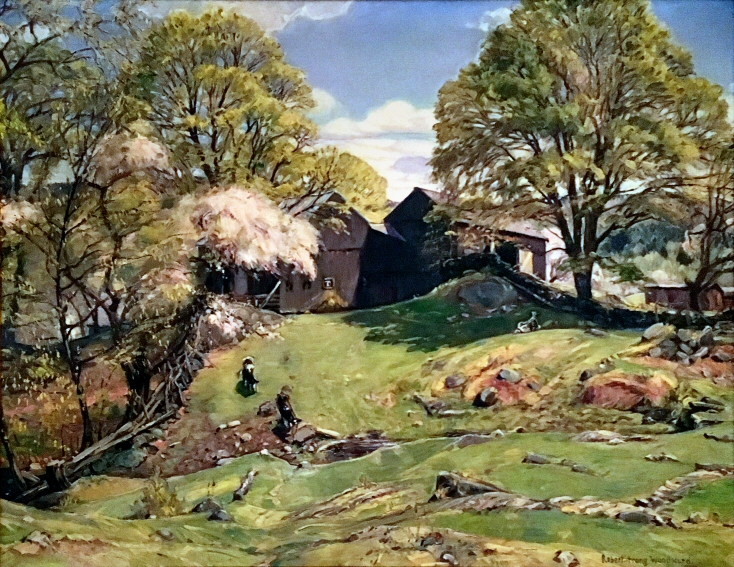
Somewhere from Purinton Hill
on the Wilder farm property.
Oil on Canvas
Landscape
24" x 40"
Memorial Hall Mus., Deerfld, 2019
Unknown
NA
.png)
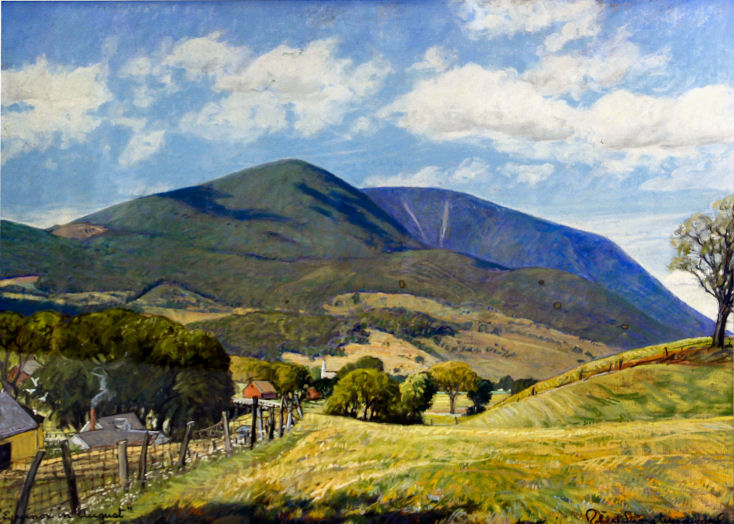
Featured Artwork: Mary Lyon Hill in September
734.png)
Diary Comments
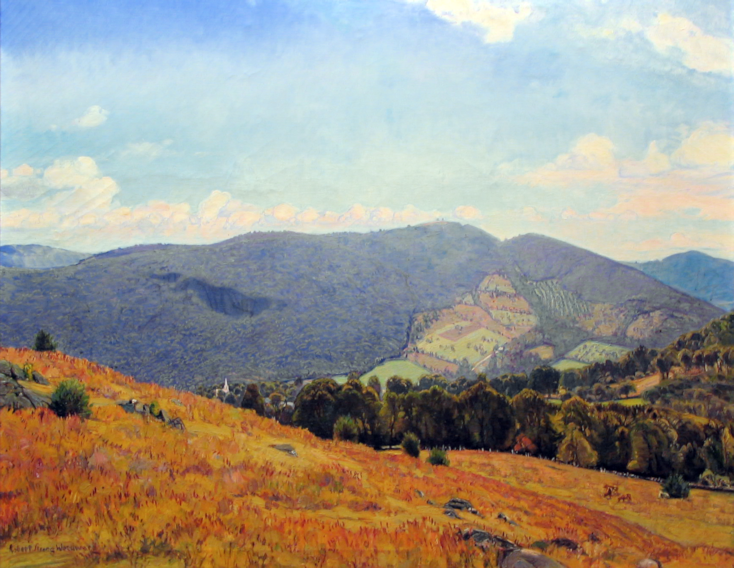
 Mary Lyon's Hill, 1935: 40" x 50"
This is in the Mount Holyoke College art collection.
• There is no entry for this painting in the painting diary.
Editor's Note:
This painting is one of two paintings featuring Mary Lyon Hill from the other side of the
village of Buckland, MA. The two paintings are made from similar but different perspectives. The subject of
this artwork page (above) is closer and farther north than its counterpart. Note the church steeple of the Mary
Lyon Church in the Buckland town center in each canvas. If you enlarge the image to the right, we illustrate
the subtle but clear differences.
Furthermore, we suspect that this painting, Mary Lyon Hill in
September was painted after Mary Lyon's Hill. The coloring tells us this. Mary Lyon's
Hill is darker and richer. The trees are still green, whereas in Mary Lyon Hill in September,
the trees are turning. We know both paintings where made after July of 1935 because there is a letter from Mt.
Holyoke asking him if he would like to participate in the exhibition. (see Mary Lyon's Hill for the
letter).
It is unclear to us why he made this painting. We know he liked this painting, and kept it
for his own collection. We would also argue that Mary Lyon Hill in September holds more of the
qualities Woodward valued. ⮟ MORE BELOW ⮟
Additional Notes
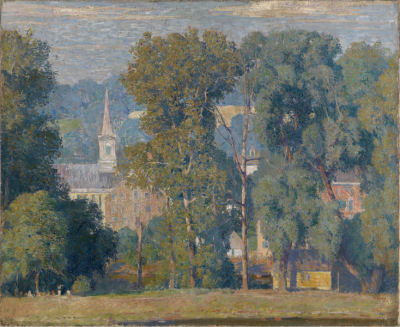
A Country Town, Daniel Garber (American 1880 - 1958)
Mount Holyoke College Art Museum, South Hadley, MA
Mary Lyon Hill was not selected by Mt. Holyoke's Class of 1935. The painting to the left,
A Country Town, by Daniel Garber was. [There is more information on this artwork on the Mary Lyon's Hill artwork page.] For our purposes here, we just want to
stress the fact that the exhibit was a competition or sorts and Woodward wanted to give his best.
So you might be asking, "How did Mary Lyon's Hill end up in the school's collection if the students
did not choose it?" You can read the details on that page but in short, the college's organizers of the
exhibit bought it! Not a bad consolation prize... we are not sure what to make of it. Did the organizers
disagree with the class choice? Or was it simply a matter of it was going to be bought by the school
regardless? It is most likely the second option.
734.png?url=photos/mary_lyon_hill_in_september(26)734.png)
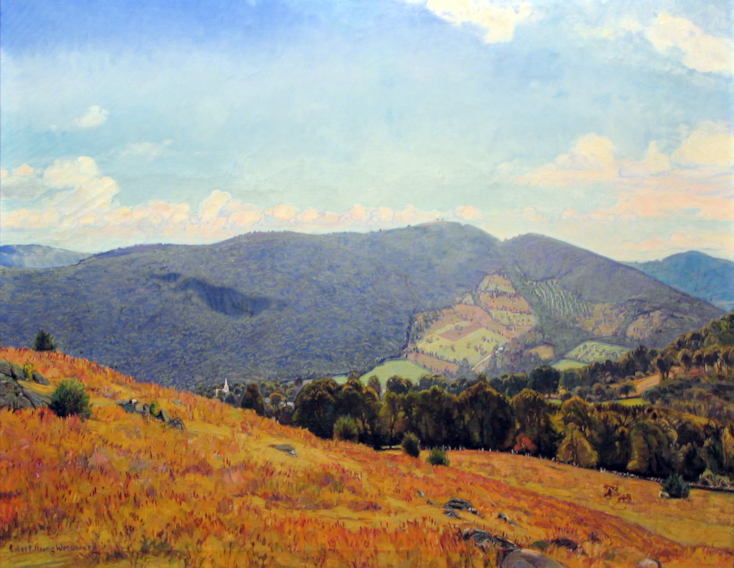
⮝ Here we have placed both Mary Lyon Hill paintings side by side to illustrate their
differences. You can see that the smaller painting (left: Mary Lyon Hill in September) looks huge by comparison.
There are two reasons for this: (1) A 24" x 40" canvas is much more rectangular [1.66 aspect ration] than the
squarer 40" x 50" [1.2 aspect ratio]. (2) To place them side-by-side we had to widen the rectangular painting
to fit. Still, the differences become very clear when next to each other at the same height.
It is
also much clearer that the painting that hung at Mt. Holyoke is richer in its depth of color (the other is more
pale and brighter by comparison) and the bigger sky and further distance of the larger painting does add to its
scale. Yet, the painting on the left is more intimate. Everything thing feels closer and still somehow grander
(a special skill of Woodward's). The clouds hanging just over the hill top, a trope Woodward seems to use a lot
in his mountain paintings, makes the hill appear closer and bigger. We wonder if Woodward, questioned himself
and made something he thought the class would like better than what he preferred which lends to the argument as
to why he kept the smaller painting for himself. It is because it was more personal to him... especially the pale
late summer look.