
Quick Reference
1919
Behind the Redgate Studio
Oil on Canvas
Landscape
Woods
50" x 40"
Yes, but not known where
Never sold...
N/A
Related Links
- See also the...
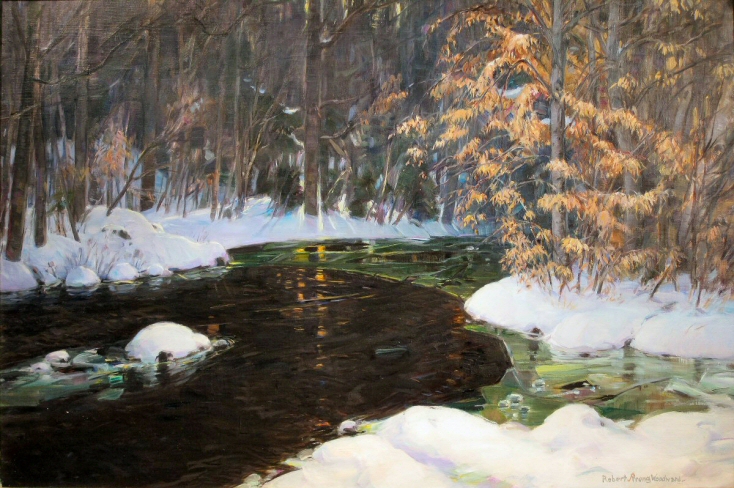 Quintessential Redgate Gallery to view related pieces.
- Read Our Essay on ...
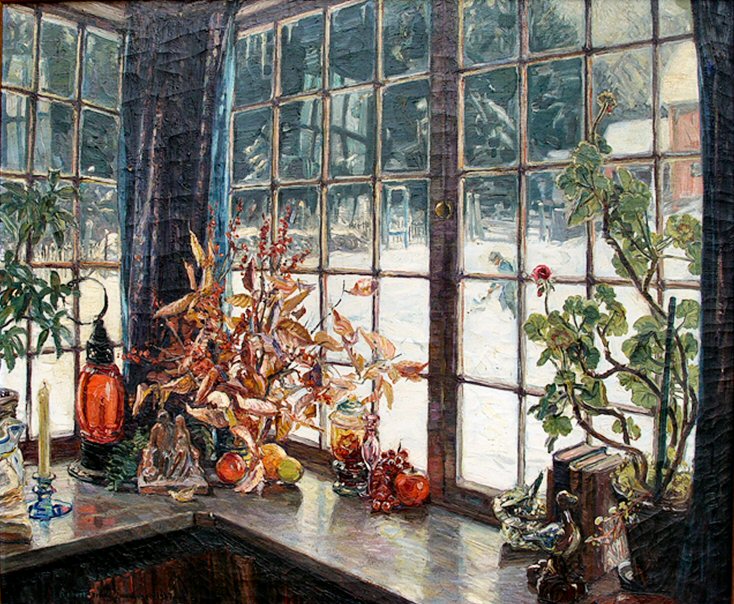 The Evolution of the Window Picture Paintings
- See also the...
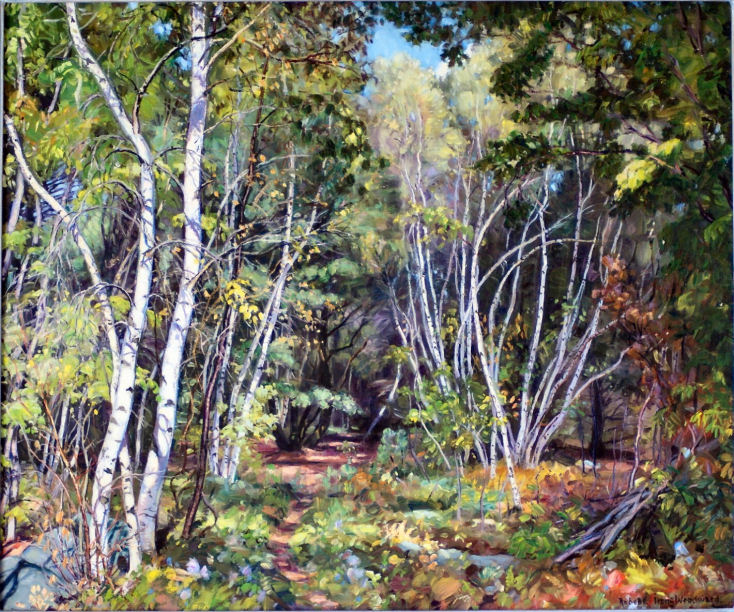 Woods Gallery to view related pieces.
- Read Our Essay on ...
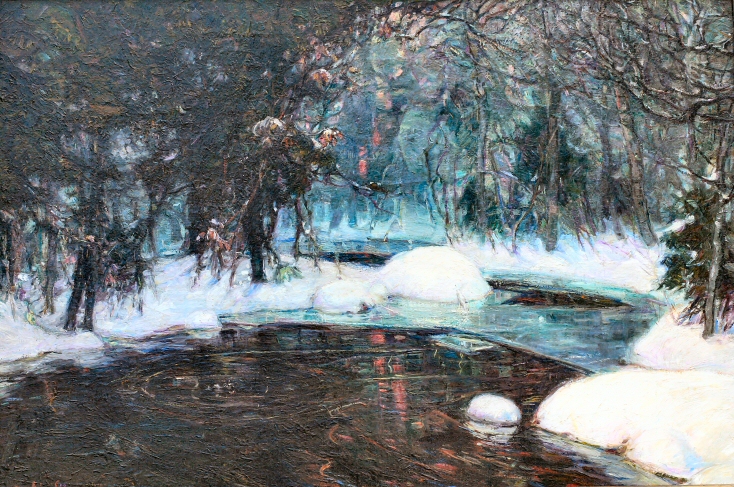 The Winter Evening Stream Paintings
- See also the...
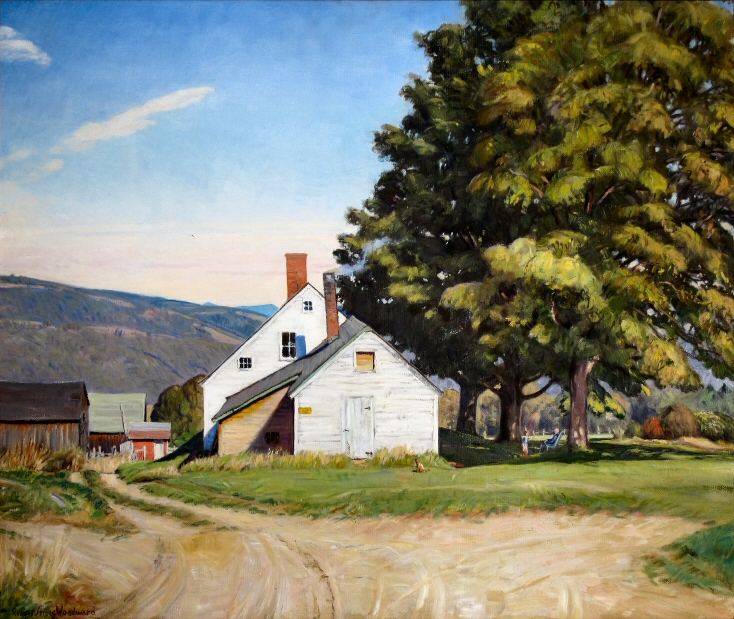 Late Summer Gallery to view related pieces.
- See also the...
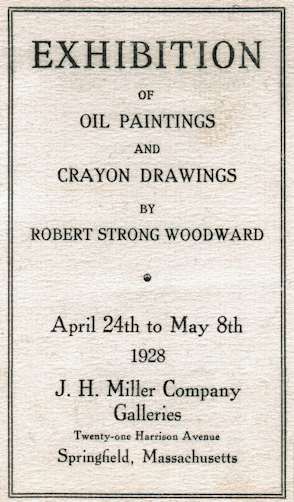 Exhibition List for a complete list of events
.png)
Featured Artwork: The Portal
679.png)
RSW's Diary Comments
-labelLG.png?url=photos/portal(25)-labelLG.png)
 An exhibit label attached to the rear stretcher
♦ Despite being in his personal collection, and having hung in his home for decades, the artist overlooked this canvas in his painting diary.
Editor's Note:
There is a lot to say about this painting, from its unique name for a Woodward painting, to
its significant meaning, and metaphor. Then there is the link between Woodward's interior, wooded, twilight
paintings to his later Window Picture Paintings. Finally, the mysterious
exhibition label to the right. ⮞
The label's only clue is that is was the "Thirty-second
Annual Exhibition." No name is provided otherwise. We searched and search every institution of that time we
could think of to find a match. The Carnegie Institute of Pittsburgh (PA) was the only match we could find.
Woodward is listed on their website as an exhibitor but we already knew that because Silent Evening hung at that exhibit. Did The Portal also
exhibit there? It's unlikely and there is no evidence of it. We will keep looking.
-sigLG.png?url=photos/portal(25)-sigLG.png)
Woodward's 1919 signature sans the red "S"
♦ As a result of his sudden and early success, RSW was
figuring things out as he goes. He did not expect or plan to
be a landscape painter. His interest were in other areas.
As Jeanette Matthews put in a 1928 interview, "An active life
denied, he turned his energies to the field still left open."
Springfield Union Republican, May 18, 1928
At this time in his career, Woodward is not signing his paintings with the firebrand red "S". He
is also including the year next to his name. That would start to change to change in 1920 through '22. He
would experiment with several versions, red "R" and "S", red "W", etc. before settling on the
"S".
After his Hallgarten Prize in 1919, Woodward made a series of these dusk-time nocturnes, and
began making what we termed, "Winter Evening
Stream" (WES) paintings. The WES painting reappear sporadically throughout his career, right to the end,
but the wooded interior nocturnes would lose favor by 1926.
---------------------------------------------------------------------------------------------------------------------------------
The Evolution of the Window Picture Painting, part 1
and the Winter Evening Stream Paintings
Additional Notes
-brushstokesLG.png?url=photos/portal(25)-brushstokesLG.png)
These paintings are so hard to photograph. Too much
light on the dark tones bleaches out the rich depth and too
much light dulls the vibrancy of color in areas where the
natural light of the scene is acting in contrast and affect.
These dusk-time nocturnes represent the artist's uncertainty. In many ways, it proves Woodward did not see himself as a professional painter. He did not have a vision (or dream) that would be his guide when things moved faster than he was comfortable and its name indicates his entry into this "dream-like" new phase. It is also interesting that "Portal" can also be a window. We make our case that these paintings are critical to the evolution of his beloved Window Picture Paintings in our Scrapbook essay on the Evolution of the Window Picture Paintings, Part One. Put briefly, both painting subjects are meditative and soothing to the artist because they are firmly anchored to "home" both literally and figuratively. He paints both, literally from his studio/homes. They have a calming, grounding affect on him that permits him to clear his head and in all likelihood, his anxiety.
-groundLG.png?url=photos/portal(25)-groundLG.png)
These nocturnes are more colorful than people give them
credit. Still, this painting differs from the others. First of all,
RSW is closer to the subject than the other Redgate nocturnes.
Also, it appears to be a late summer /mid-September time of
year. Finally, given the light source, the artist is also facing
a different direction (east) than all of the other canvases.
Again, as we have in other essays and art work pages, we need to stress the important influence Japanese art and culture had on Woodward and not just him but many artists. At the time of his accident in 1906, he was living with his parents in Los Angeles, CA, just a couple blocks from the 'Little Tokyo' neighborhood of Japanese immigrants with plans to visit Japan during the 'gap year' he convinced his father to let him have before shipping him off to Stanford University... The day of his accident there was a Japanese Festival in Venice Beach. It is one of the main reasons we believe, Woodward and his friends had to catch the earliest train to get back to the city after camping in the mountains.

The Torii Gate of Japan
In Japan there are these sacred "gates" in front of all temples called Torii gates. You must cross
through the gates to assure protection in the mystical/spiritual realm. They are most commonly red in color,
though you well also see white in some regions of the country. We suspect that Woodward's first studio's name,
Redgate, was derived from the symbolism of the Torii gates. In short, the name represented the studio as a
"safe place" for him to work.
Now, look at the painting of this artwork page and note the two most
prominent trees forming what looks like a doorway. See how the branches and leaves of the two trees intertwine
and mesh above completing the imagery of the doorway... the gateway to a protected realm. This painting is as
much a work of art as it is a prayer. It is one of his most personal canvases and probably the reason he kept
it for himself. It is almost too personal as a protector to let go...
---------------------------------------------------------------------------------------------------------------------------------
The Evolution of the Window Picture Painting, part 1
and the Winter Evening Stream Paintings