Quick Reference
c. 1920
Town Farm Hill
Buckland Center, MA
Oil on Canvas
Landscape
Roads & Streets
25" x 30"
Unknown
Gifted to RSW cousin Julia Wells
NA
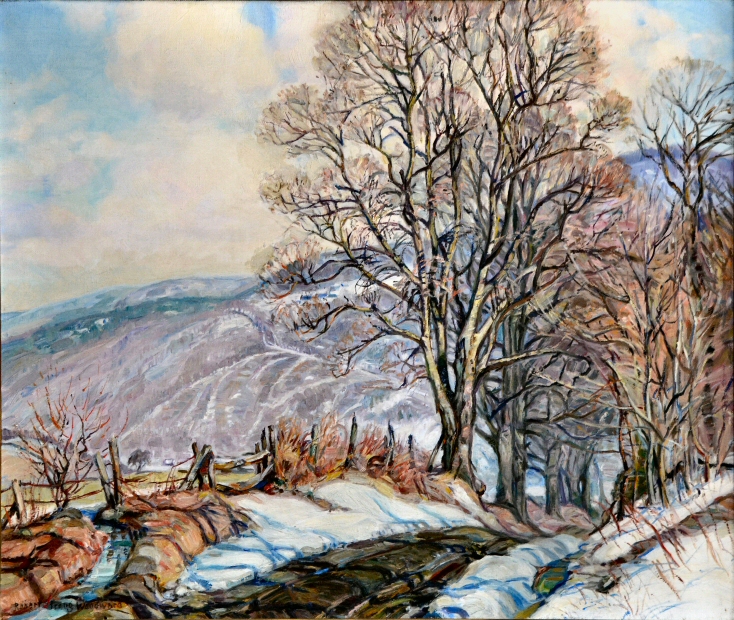
Featured Artwork: Spring Thaw, c. 1920
RSW's Diary Comments
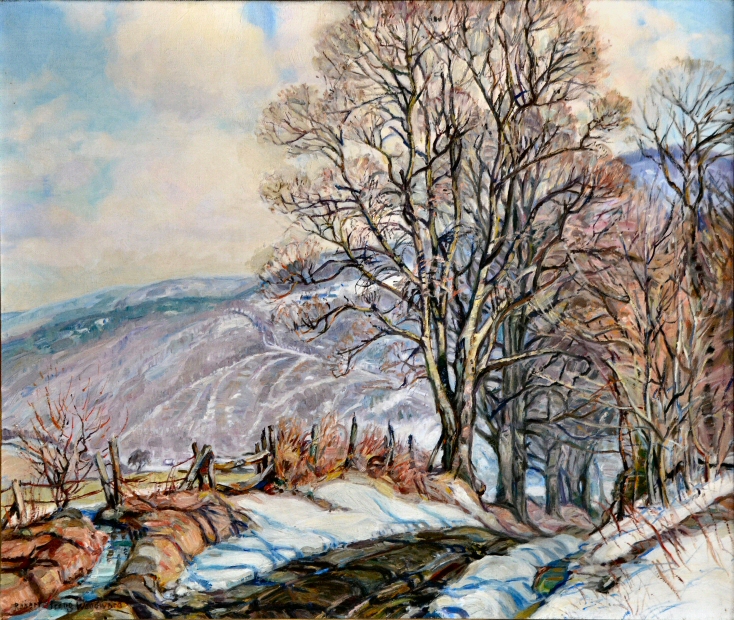
 Spring Thaw Sepia
Painting diary entry for Spring Thaw, 1941:
"Painted in winter of 1941. Made in the studio from one of my very early paintings (loaned to Julia Wells Rea) so there's an old one and a new one. Painted from halfway up Town Farm Hill, a muddy road, edged with flowing thaw water, all dipping down steeply through large spring maples."
Editor's Note:
It has alluded us for years that there are two existing versions of this painting and we only
have one artwork page. Typically, Woodward would destroy the original after re-painting an early canvas
but not in this case. He had given the original to his cousin Julia, another significant statement. yes, he says
he lent it to her. He is so funny when it comes to this sort of stuff but he is never going to ask for it back.
He is simply making it clear, in his round-about way, and that it was a gift and that she doesn't own it,
therefore she cannot sell it.
Julia is nearly as important to Woodward as his cousin
Florence Haeberle. Julia worked for Woodward through the as a
sort of assistant / secretary. She is mentioned quite often in Woodward's 1932 personal diary.
Additional Notes
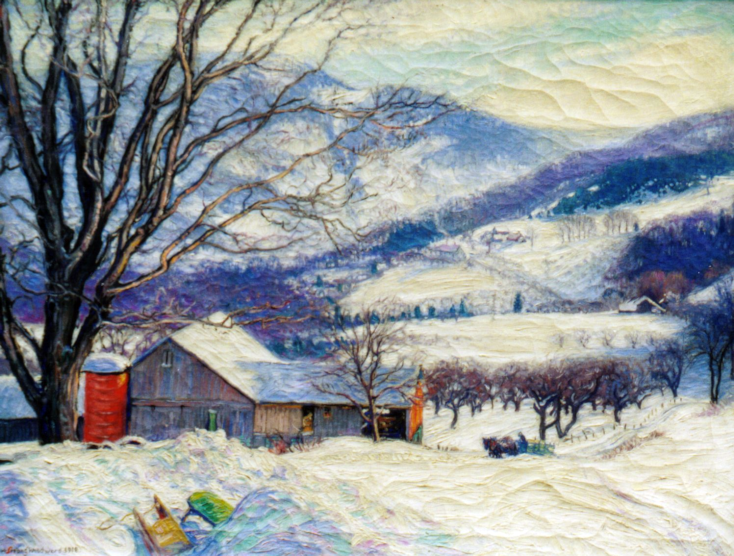
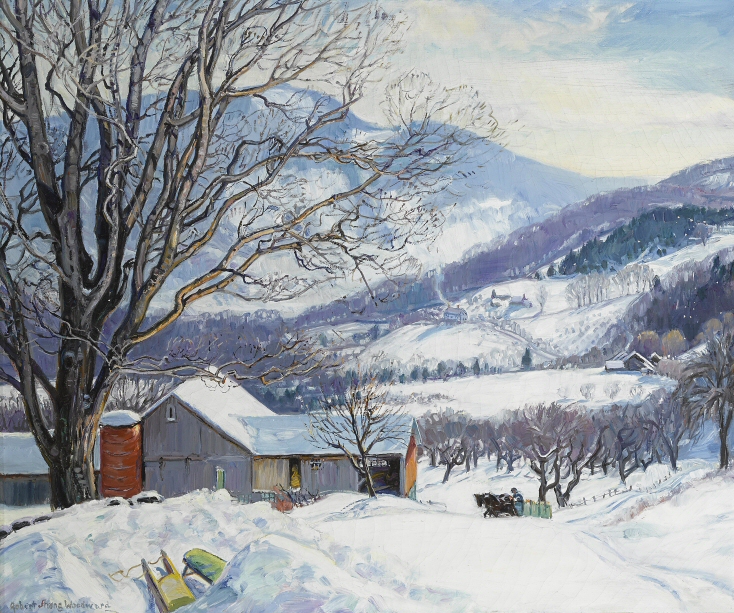
A Winter Day, 1938 (enlarge to see illustration)
Editor's Note:
As mentioned above, this is an unusual circumstance for an early career painting to survive
after Woodward paints a new one. He refers to these paintings as "re-painted" paintings. One know of only one
other example where an original survives with its new version and that is the 1922 canvas Snow on the
Mountain and its counterpart, the 1938, A Winter Day.
A Winter Day just so
happens to be the painting we used to illustrate the local from where Woodward painted Spring Thaw and
Snow on the Mountain is the ONLY painting saved from Woodward's disastrous 1922
Redgate Studio fire!
We do not know how Woodward managed to re-paint the original Snow on the Mountain because
it was owned by the owner of the subject, the Wilder Farm. Perhaps Woodward simply asked Wilder if he could
borrow it. It is a good thing he did because, as we mention above, it is the only example we have or the two
same-but-different versions.
We like when worlds collide like this during our audit of the artwork
pages. These two subjects over lap in multiple ways and offers a visible comparison of the artist's maturation
over the years.
Promotional Items
.png)