
Quick Reference
Painted 1919.
Crittenden (Hill) Road
Shelburne Falls, MA
Oil on Canvas
Landscape
Trees, Landscapes & Views
36" x 42"
Boston Art Club, 1920
Springfield Art league, 1927
Springfield Art league, 1927
Mr. John T. Spaulding, later given to
his sister Mrs. Alice Spaulding King
NA
Related Links
- See also the...
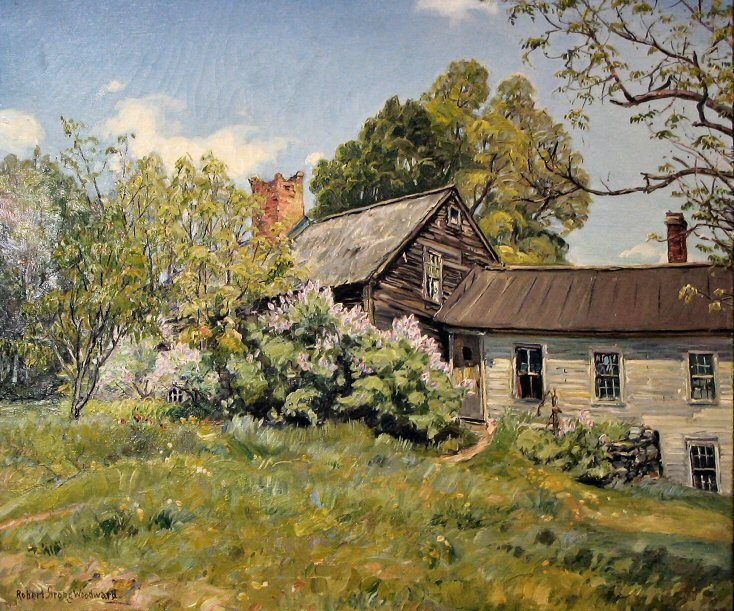 In Bloom Gallery to view related pieces.
- See also the...
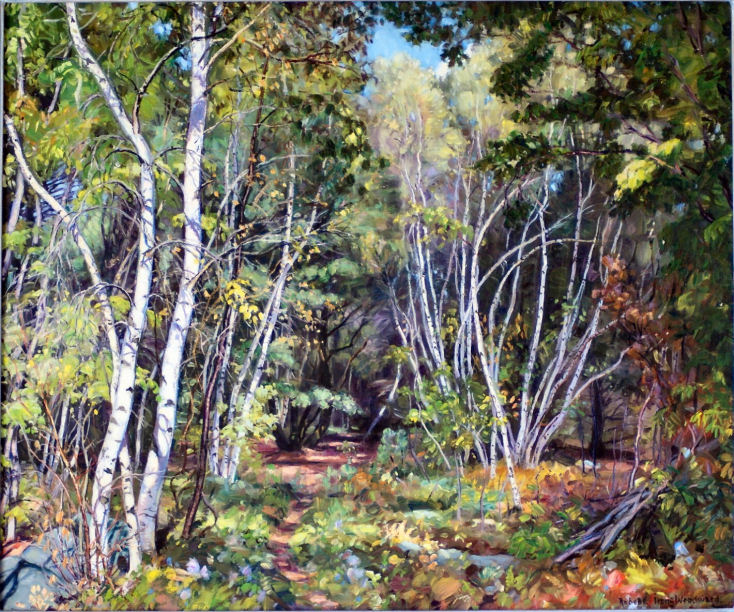 Woods Gallery to view related pieces.
- See also the...
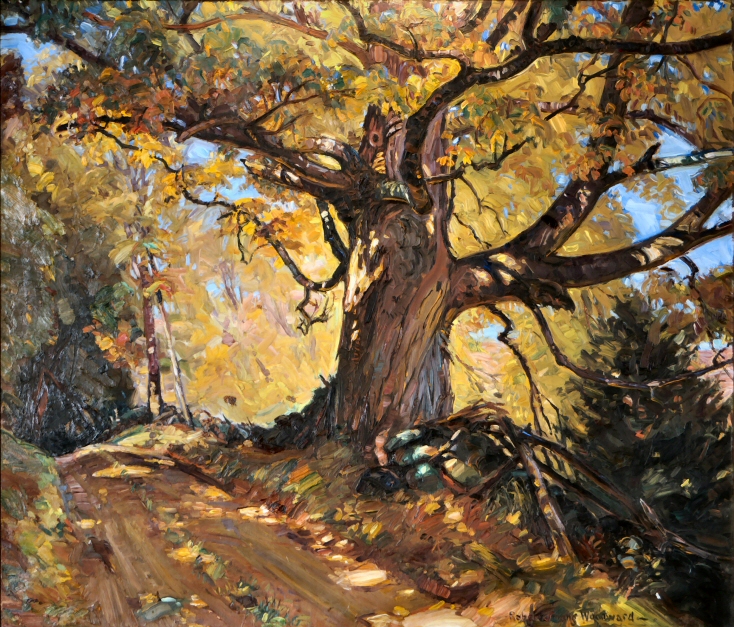 Trees Gallery to view related pieces.
- For more about the ...
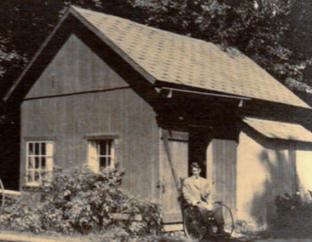 Redgate Studio, see our Scrapbook page.
- Read the Scrapbook story for more about RSW'sHorses and Pets.
.png)
Featured Artwork: Laurel and Wild Cherry (36" x 42")
RSW's Diary Comments
Written from the 36" x 42" painting but mentions the 27" x 30" as well:
679.png?url=photos/portal(25)679.png)
 The Portal, 1919- Exhibited at the
National Academy of Design
"Painted in summer of 1919. A beautiful painting of detail of laurel and bloom overhung by a wild cherry branch, against dark background. I painted a 27" x 30" up on Crittenden Road beyond Abbott place, beautifully successful. It burnt in Redgate fire, but had made this enlargement which was saved at the house. Right after the fire Mr. Spaulding, having seen the 36" x 42" at the art club previously asked if I still had it, and bought it. Mr. John T. Spaulding, 14 Beacon St., Boston,---but later I understand he gave it to his sister, Mrs. Henry P King of Beacon Street and Prides Crossing. Mrs. King died in 1938 -9"
Notebook comments of RSW:
"Enlargement copied from smaller canvas of same subject (burnt in Redgate) painted summer of 1919. Exhibited first, the same Fall at Boston Art Club--from where it went to Worcester Museum. Shown later at Springfield Art League show Springfield, Mass, Bought January 1923 by John L. Spaulding, 99 Beacon St. Boston for $600."
 Similarly based in concept, the painting to the left, The Portal,
also features blooming flowers in dark woods and is from the same time period.
Similarly based in concept, the painting to the left, The Portal,
also features blooming flowers in dark woods and is from the same time period.
AN EXCERPT FROM A LETTER MENTIONING THE 36" X 42" LAUREL AND WILD CHERRY
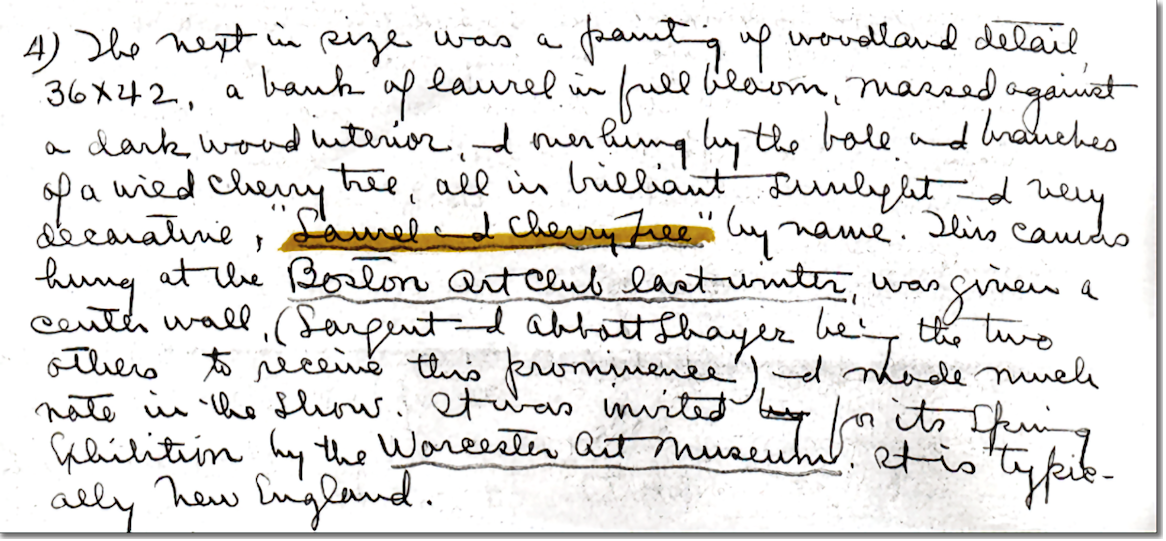
Transcription: "4) The next in size was a painting of woodland detail 36" x 42", a bank of Laurel and full bloom,
masked against a dark wood interior, and hung by the old branches of a wild cherry tree, all in brilliant sunlight and
very decorative, "Laurel and Cherry Tree" by name. This canvas hung at the Boston Art Club last winter was given a
center wall, (sergeant and Abbott Fair being the two others To receive this prominence) and made much note in the
show. It was invited by for its spring exhibition by the Worchester Art Museum. It is typically New England.
Additional Notes
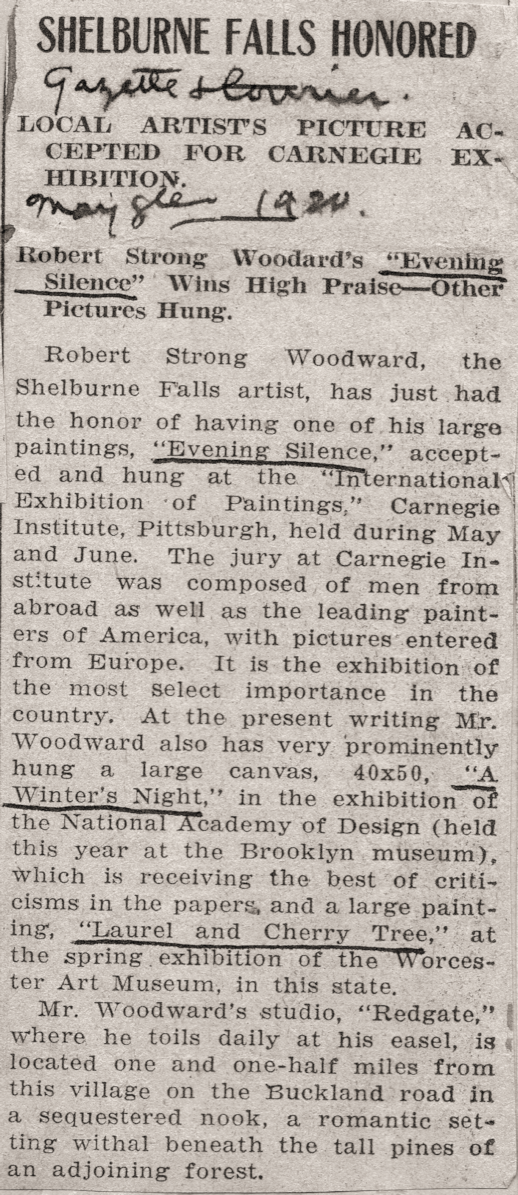
Greenfield Recorder Gazette
May 8, 1920
"...and a large painting, Laurel and Wild
Cherry Tree at the spring exhibition of the
Worcester Art Museum in this state."
Editor's Notes:
It is believed that Woodward compiled his painting diary sometime in the early 1940s at the
suggestion of Dr. Mark and encouraged by his
friend F. Earl Williams. We are beginning to realize that he most
likely did it all mostly from memory. If he remembered a painting, he made an entry for it. It does not appear
that he ever made it a point to check his facts because we are finding more and more omissions, incorrect years
and in a couple of cases- mixing up one painting for another (i.e. Dusty Rafters [1929] for Old Rafters
[1924]).
In the diary comments above, he omits a diary entry for the 27" x 30" painting and forgets
that the 36" x 42" also exhibited at the artist's premiere exhibition at the Myles Standish Gallery in Boston.
Also, he does not mention: 1) why he made the larger version, or 2) why the same scene exhibits two years in a
row at the Boston Art Club. We suspect there is a reason with a story behind it. Our theory is that it was at
the suggestion of artist Charles Hovey Pepper, the chairman of the newly organized "New England Artists'
Series."
Nonetheless, we do have enough information to surmise that Woodward like the painting enough
to keep it in his personal collection which is how it survived the
Redgate fire. This information, along with Mr. Spaulding buying the painting shortly after that fire was
perhaps a gesture by the collector to aid in the artist financially after the great loss. Spaulding would also
buy the first painting from Woodward first major show four years later. He would buy The Window; a Still Life and Winter Scene from the 1926 Lyman Residence show of
1926. That painting is in the Museum of Fine Art Collection.
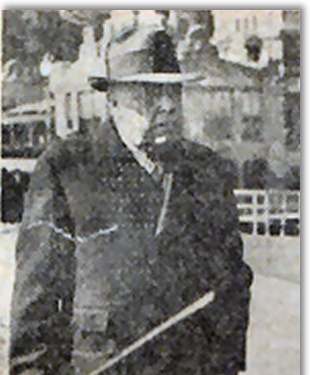
Noted Art Collector
John T. Spaulding
John Taylor Spaulding is a
noted art collector whose collection of over 6,000 Japanese prints was given to the Museum of Fine Art (Boston)
in 1921. Additional works of art by contemporary artist were given later. Spaulding later gave the painting to
his sister Alice Ormond Spaulding King, the wife of Henry Parson King. The Kings are also the owners of The Spring Tub which they, along with this painting, loaned to the 1929 Myles
Standish Gallery Exhibition and previously the 1927 Springfield Art League event where Woodward won the top
prize for his painting, When Drifts Melt Fast.