Quick Reference
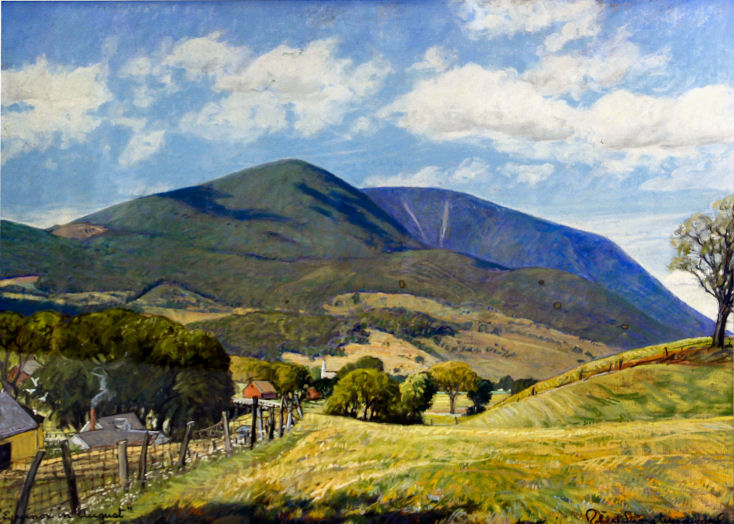
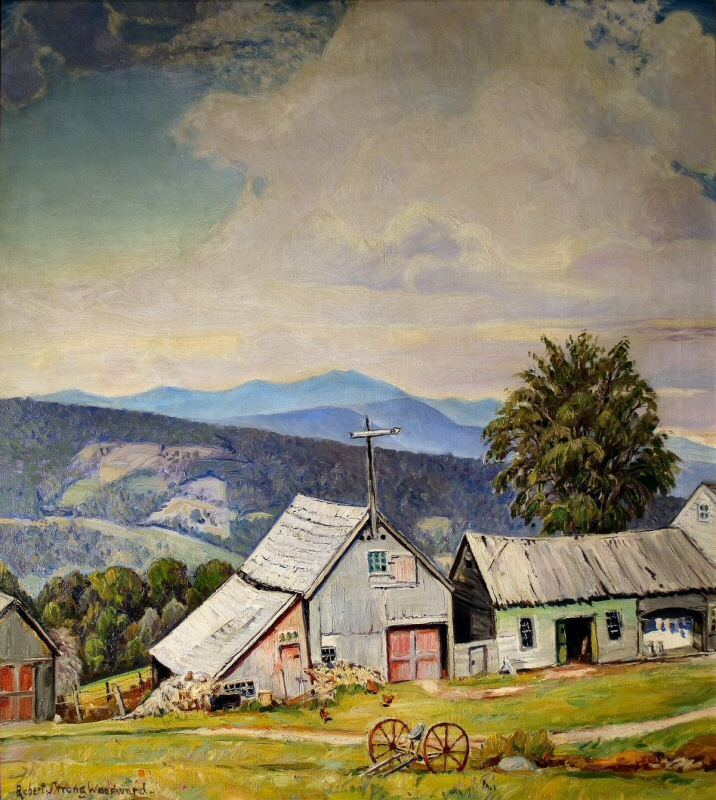
c. 1928
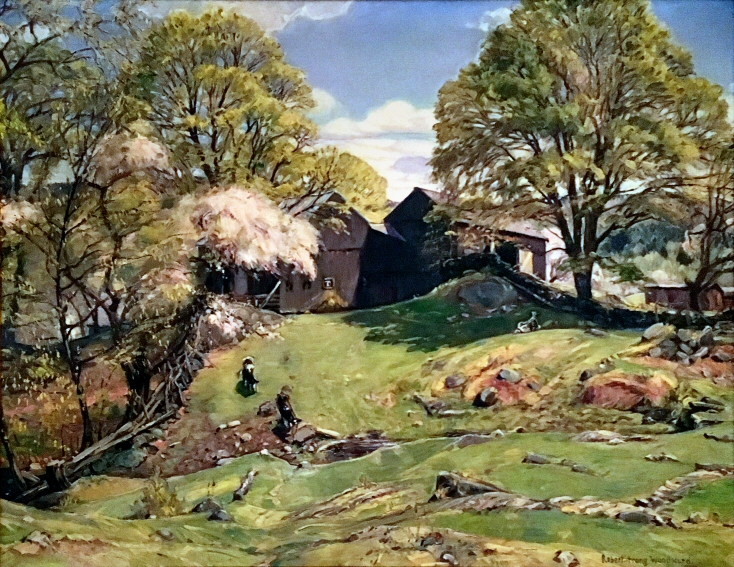
Norton Farm
Riverton, VT
Oil on Canvas
Landscape
Barns, Farms
30" x 27"
Vose Galleries (Boston), 1942-'43
Williston Academy, 1942
The Kastoff Gallery, 1945-'46
Unknown
NA
Related Links
- See also the...
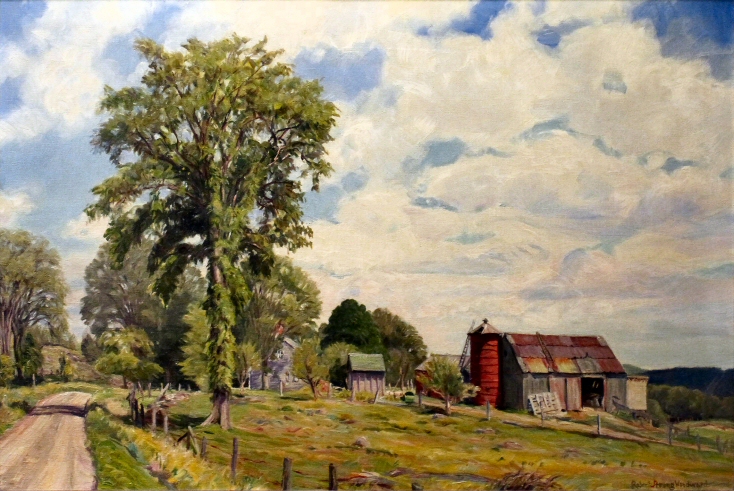 Farms Gallery to view related pieces.
- See also the...
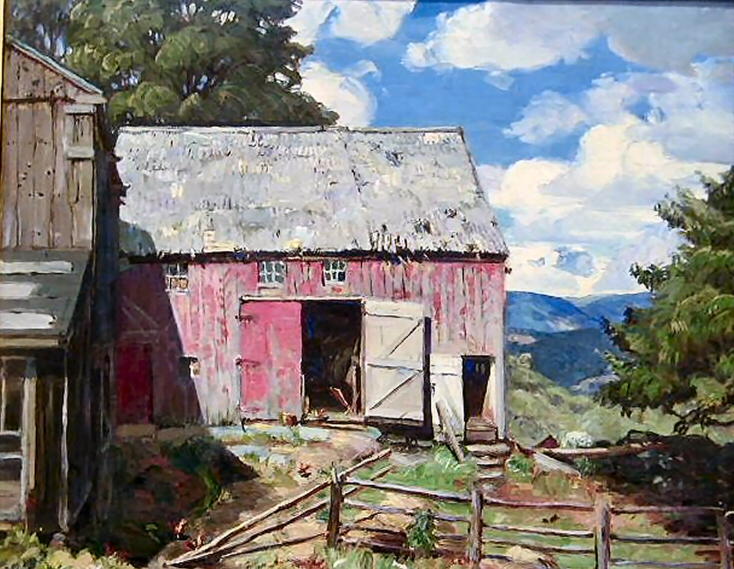 Barns Gallery to view related pieces.
- See also the...
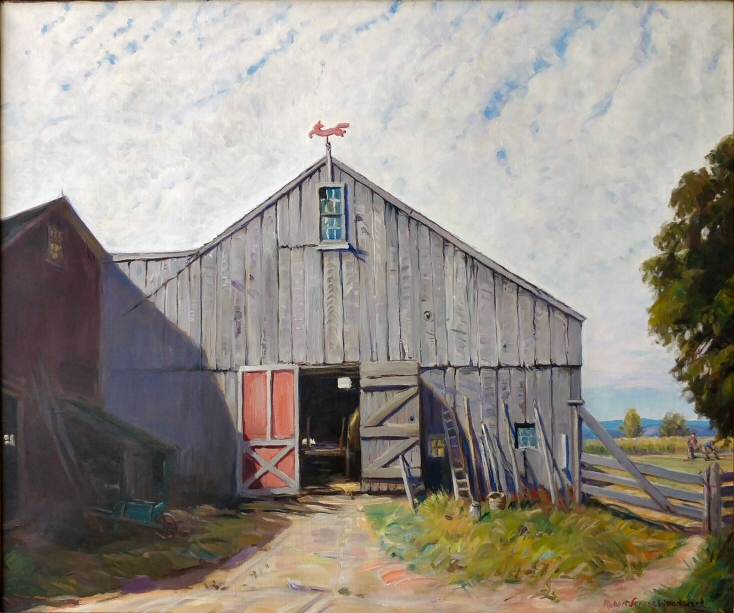 Fences, Gates & Doors Gallery to view related pieces.
- See also the...
 Mountains Gallery to view related pieces.
- See also the...
 Exhibition List for a complete list of events
- See also the...
 Landscapes & Views Gallery to view related pieces.
- See also the...
Fences, Gates & Doors Gallery to view related pieces.
- See also the...
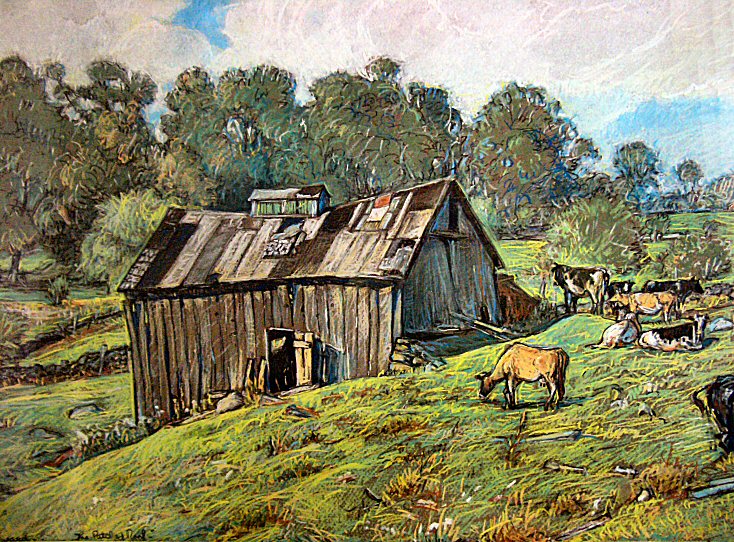 People & Livestock Gallery for related pieces.
- See also the...
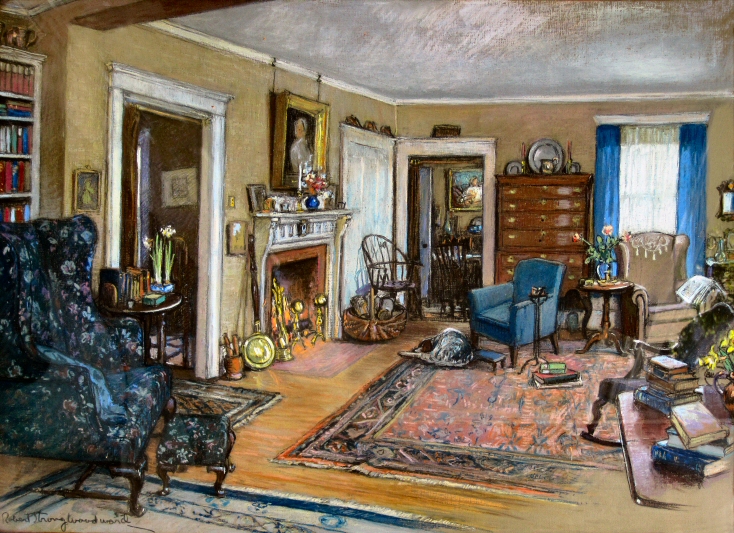 Chalks & Crayons Gallery to view other drawings
- See also the...
 Pastures Gallery to view artwork.
- See also RSW's ...
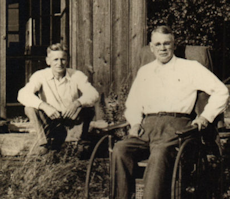 Personal Friends Gallery
- See our page devoted to ...
 RSW's travel we titled Car Troubles & Other Mishaps
.png)
Featured Artwork: In Vermont
The Five Norton Farm PAINTINGS in Riverton, Vermont |
||||
| Saddleback Barn | Vermont Barns (Chalk) | In Vermont | Up in Vermont | Vermont Barns (Oil) |
|
22" x 29" |
22" x 29" |
30" x 27" |
42" x 36" |
25" x 30" |
|
Pastel on Board |
Pastel on Board |
Oil on Canvas |
Oil on Canvas |
Oil on Canvas |
|
First Exhibited |
First Exhibited |
First Exhibited |
First Exhibited |
First Exhibited |
|
1928 |
1928 |
1928 ⮜ |
1935 |
1928 ⮜ |
|
Noteworthy: Believed to be made the same day, or at least started on RSW's visit to VT. |
Noteworthy: Believed to be started the same day of RSW's visit to VT but finished later in the studio. |
Noteworthy: Said to have been made the same day of his visit but does not exhibit until 14 years later. |
Noteworthy: RSW says he made this larger painting from the original 1928 painting, In Vermont. |
Noteworthy: Said to have been made the same day of his visit but does not exhibit until 6 years later. |
|
Website Commentary: Woodward's painting diary is mostly unreliable when it comes to the year some thing was made. Notice how RSW claims to have made four of the five paintings all in one day, as well as numerous sketches. Then there is the great mystery of In Vermont being made in 1928 but not exhibiting for 14 years. We have a theory, that RSW did make the "original" painting in 1928, but for whatever reason was never satisfied with it. Maybe he left it with Mrs. Dresser until she returned her canvases to him before her death. In his possession again, he re-paints, like he does for a dozen other paintings between 1937 and 1945, destroying the original and failing to say so in its diary entry. |
||||
RSW's Diary Comments
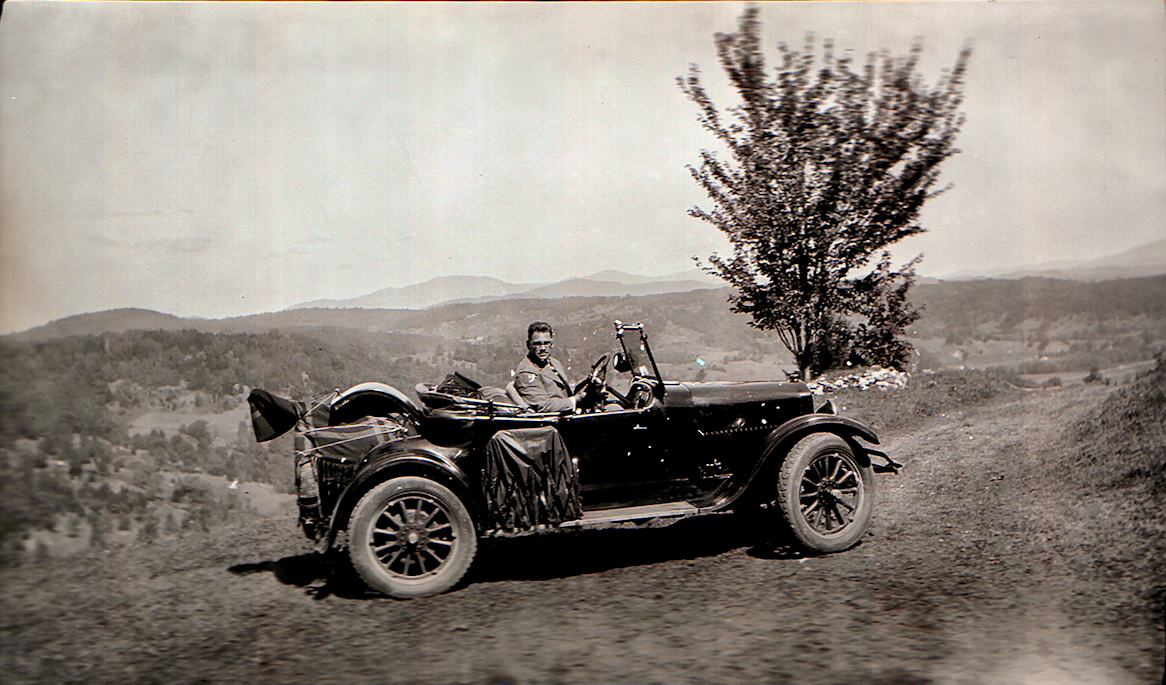
 Woodward in his 1923 Studebaker, mid-1920s. The picture
was taken during a visit to the Dressers. That tree looks like it
matches the one in the cottage picture you can see below. ⮟
"Painted around 1930. Painting made somewhere around 1930 of Norton farm, when visiting Mrs. Dresser at Riverton, Vt. (near Montpelier); row of old barns with 'left out' farm machinery in foreground, hills capped by Mt. Mansfield in the background, topped by very pure dramatic summer sky. I made similar larger painting, 36" x 42", from this, called Up in Vermont (which see). Sold by art agent, Peter Kastoff, of 124 State Street, Springfield, Mass in April,1945. Do not know to whom."
Editor's Note:
Woodward's painting diary is unreliable when it comes to the years something was made because the artist; (1) did not begin to assemble it until the 1940s, and (2) did so almost entirely from memory. There is another question we have. Where was this painting for at least a decade? We have no record of it exhibiting in the 1930s, or the 20s for that matter... Mrs. Dresser passed in 1937 and the artist indicates in the diary comments for Up in Vermont, which was painted in 1935 from this canvas, and that this painting was "made prior to 1930," conflicting with the diary entry above.
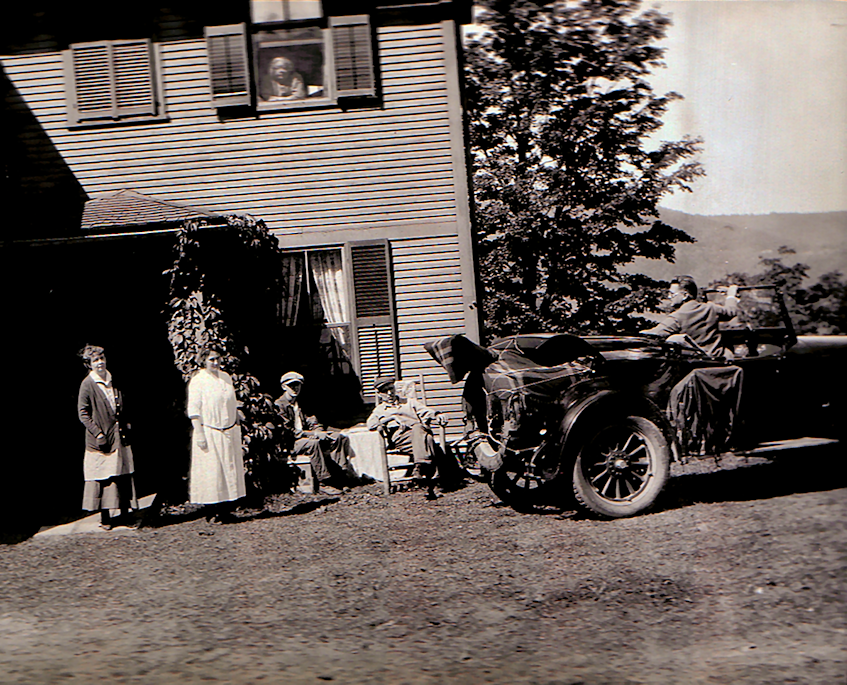
Woodward in front of the cottage with
a number of people we cannot name. Mrs.
Dresser is the woman in the white dress.
We have a theory for the history of this painting that fits with Woodward's typical past practices. He visited Mrs. Dresser around 1927 or '28, took the pictures you see on this page of him in the 1923 Studebaker. He was there to paint the Norton farm. He makes two pastels, Saddleback Barn, and Vermont Barns (Chalk), as well as paints In Vermont (probably finishing it in his home studio). Years prior, Mrs. Dresser had bought a painting he made from her property named, September Mountain (c. 1925) and she already owned Silent Evening which is a pre-1922 Redgate canvas and we believe he lent Mrs. Dresser this painting as a gift of appreciation.
734.png?url=photos/september_mountain(25)734.png)
Fast forward seven or eight years and Mrs. Dresser health is declining. She wants to return her
paintings to Woodward. Her and her husband George have no children, no one to leave them to, so Woodward
accepts them along with In Vermont. The year is probably around 1935 or '36. Mrs. Dresser dies in
February of 1937; her husband preceded her by six months. It is at this time, according to the diary entry for
Up in Vermont, the artist painted the larger 42" x 36" canvas from the smaller 1928, 30" x 27"
above.
There is one last hanging thread we cannot figure out. Up in Vermont exhibits
several times over the next two years and suddenly, 14 years after it was made, In Vermont, exhibits
four times in the 1940s and is sold, as the dairy entry above says, "in 1945." We suspect that Woodward may
have "re-painted" a new canvas from the original 1928 one, though he does not say so in the diary comments.
The artist "re-paints" as many as a dozen 1920s paintings between 1937 and 1945, so for this painting to
re-appear 14 years after it was made and 5 years after he gets it back is just too weird to ignore without
questioning it. Stranger still is it that there is one main difference between the two paintings. For more on
that ⮟ SEE BELOW ⮟
Additional Notes
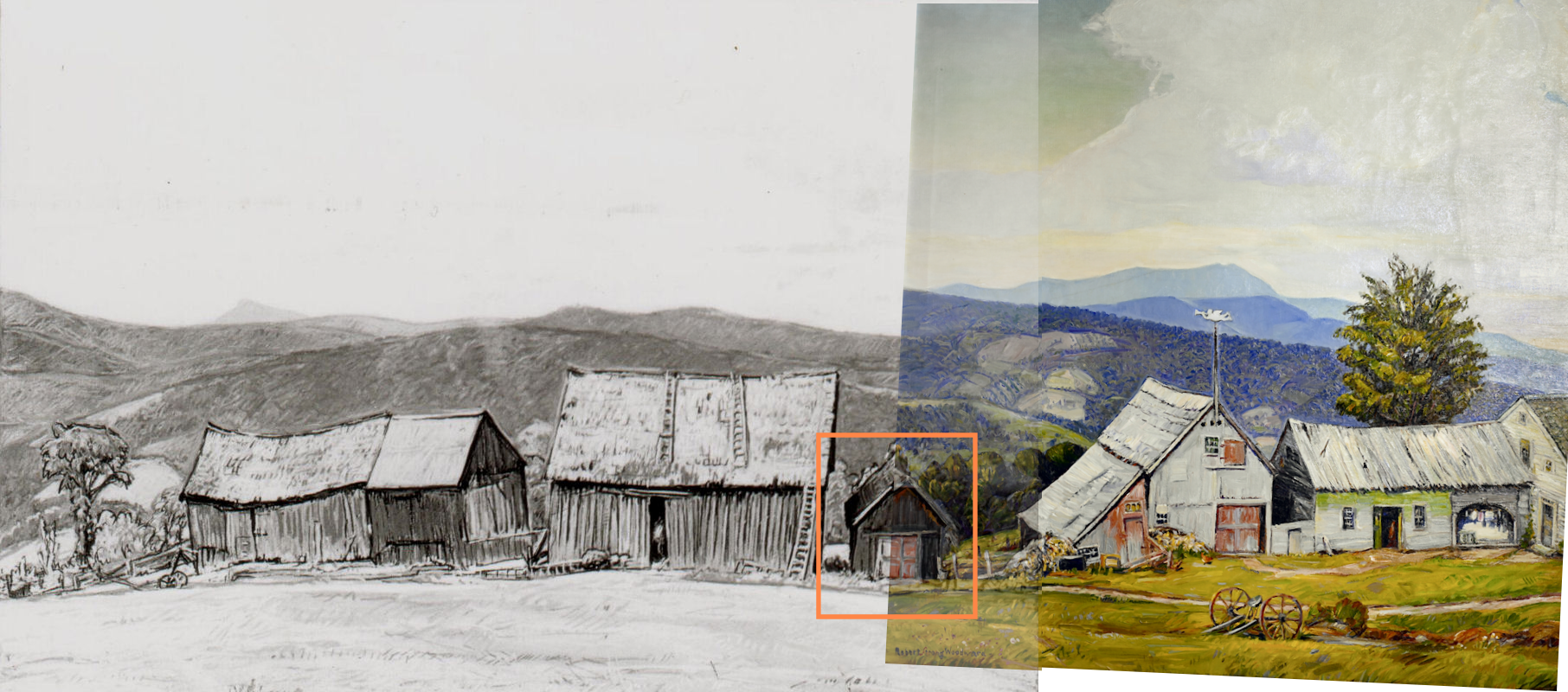
Below are side by side images of the weathervane for this page's painting, In Vermont, with that of the weathervane for Up in Vermont and they are dramatically different. Since Woodward made it clear that Up in Vermont was made from In Vermont, than it is apparent that the artist indulged himself by changing the weathervane from a simple arrow-point to the archangel, Gabriel blowing his horn, weathervane. The symbolism is important, in that, Gabriel only blows his horn when judgment or atonement day arrives. This is also, sometimes called "the reckoning." We suspect that this a tribute to Mrs. Dresser's passing. Woodward never says anywhere that he returned to the Norton farm after his 1928 visit. Four paintings came out of that 1928 visit to Mrs. Dresser. The two pastels mentioned above as well as In Vermont, and Vermont Barns an oil painting of a completely different perspective of Saddleback Barn. But even that painting has big question marks we address on its page. Back to the weathervane, Woodward did use the Gabriel weathervane motif as the featured piece of his 1926 Lyman Ballroom exhibition that relaunched his career after a four year recovery from his 1922 studio fire... and finally, we cannot help noting that the Gabriel is facing in the opposite direction than the original weather-vane towards Mrs. Dresser's cottage. See Trumpeting Angel for more on the Gabriel Weathervane!
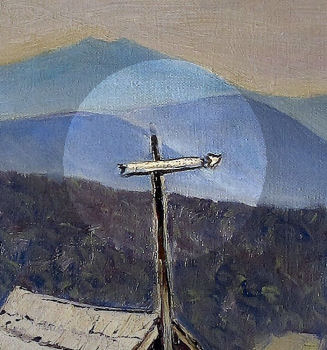
A close up cropped from In Vermont.
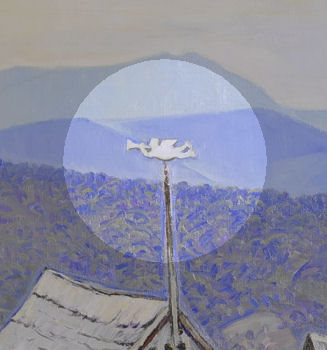
Trumpeting angel weathervane in Up in Vermont.
---------------------------------------------------------------------------------------------------------------------------------
The Norton Farm, Riverton, VT:
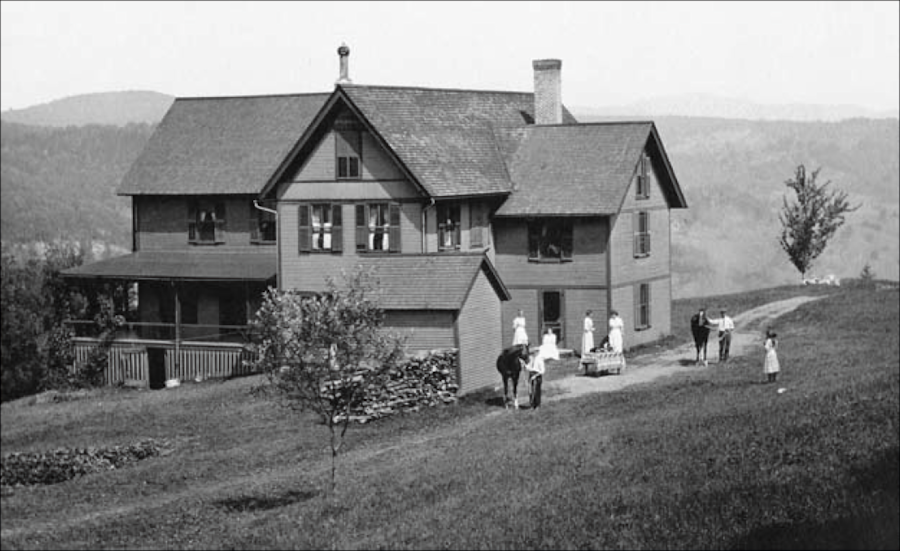
The Dresser Cottage, Riverton, VT
The small tree at the end of the cottage driveway is seen in
a photograph of Woodward in his Studebaker, fully packed,
pointing in the direction leaving the image you see, possibly
because he is headed toward the Norton farm to paint! We are
not certain of the year but it is between 1924 and 1928.
The Norton Farm is located in Riverton, VT, down the way from Mrs. Julia Dresser's summer cottage. Mrs. Dresser is a friend of Woodward's and he occasionally drove the 2 hours it would take to visit in his 1923 Stude-baker. We do not know how the two knew each other to be this close. Mrs. Dresser is 17 years older than the artist. She was born and had a home in Thompson, CT, however we have learned that the Thompson home is a family home going back to her grandparents. She primarily grew up in Chicago where her financier father was a prominent businessman dealing mostly in shipping (railroads and ships) and trade (grocery wholesalers). Beside the house in Thompson and the cottage in Riverton, there was also a place in New York City. With that information, our best guess would be that their paths crossed in Chicago when a young Woodward was living in Peoria, IL.
We only just recently put together that five paintings of two different set of barns are all from the same farm. We have diary comments for all three oil paintings mentioning the Nortons but Woodward did not keep a record of his pastels. The two pastel paintings, Saddleback Barn and Vermont Barns (Chalk) have always been linked to Vermont Barns (Oil) because it is clearly the same "end-barn" in all three scenes. However it was never understood how In Vermont, and Up in Vermont fit into the picture. They were the barns closest to the house but where were they in relation to the other barns? Then we noticed that a small shed appeared in three of the five paintings. It is in both "in Vermont" canvases and one pastel. We take that shed, size and merge it with the pastel, Vermont Barns(Chalk) to make one full-length image and it all lines up. ⮟ SEE BELOW ⮟