Quick Reference
1928 or 1934 (see Editor's Notes)
The Norton Farm
Riverton, VT
Oil on Canvas
Landscape
Barns, Farms
27" x 30"
Westfield Athenaeum, 1934
Vose Gallery, 1936
Westfield Athenaeum, 1936
Williston Gallery, 1936
Deerfield Valley AA, 1936
Grand Central Galleries, 1938
Rutland (VT) Pub. Library, 1945
Springville (UT) Nat. Art Ex., 1949
RSW Studio Gallery, 2017
Spaulding Rehab. Hosp., 2018
RSW Studio Gallery, 2018
Memorial Hall Museum,
Deerfield, MA, 2018
Mr. and Mrs. Ernest F. Goodner
See the "Diary Comments"
Related Links
- See also the...
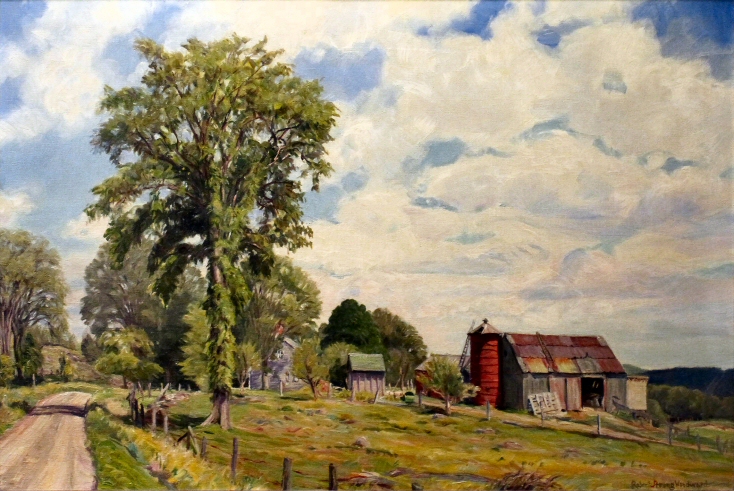 Farms Gallery to view related pieces.
- See also the...
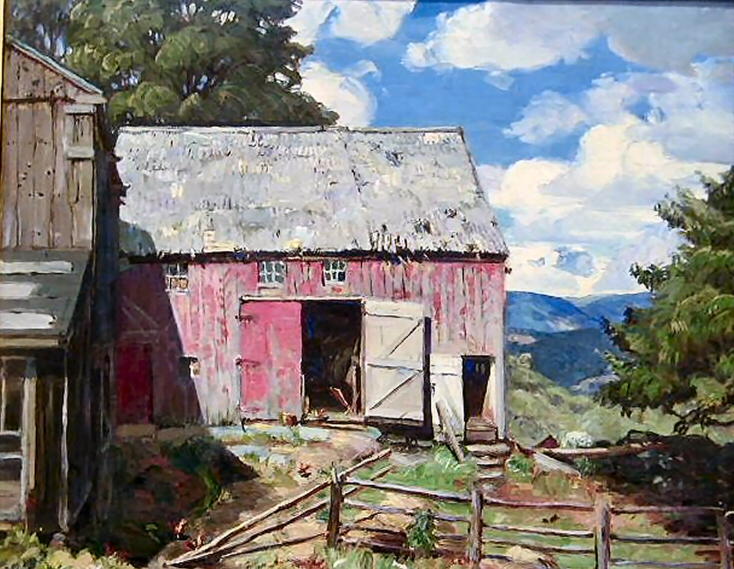 Barns Gallery to view related pieces.
- See also the...
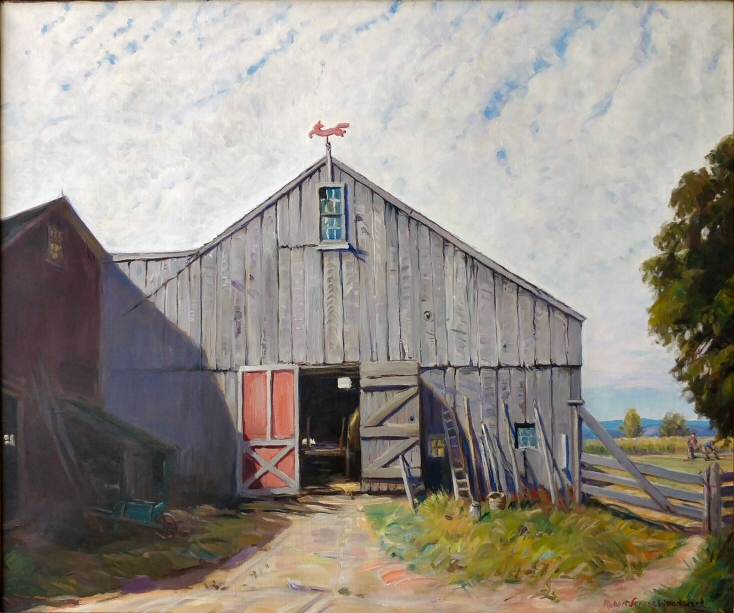 Fences, Gates & Doors Gallery to view related pieces.
- See also the...
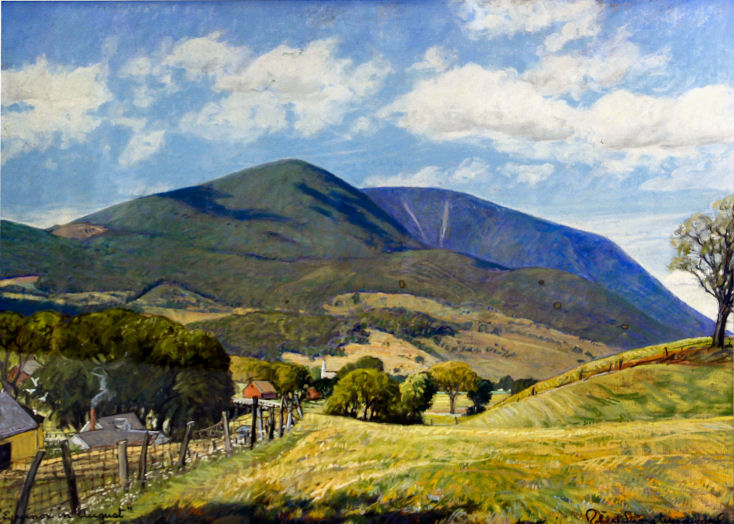 Mountains Gallery to view related pieces.
- See also the...
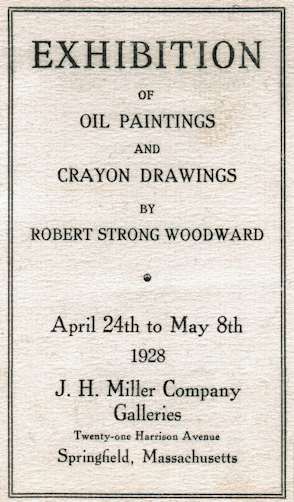 Exhibition List for a complete list of events
- See also the...
 Landscapes & Views Gallery to view related pieces.
- See also the...
Fences, Gates & Doors Gallery to view related pieces.
- See also the...
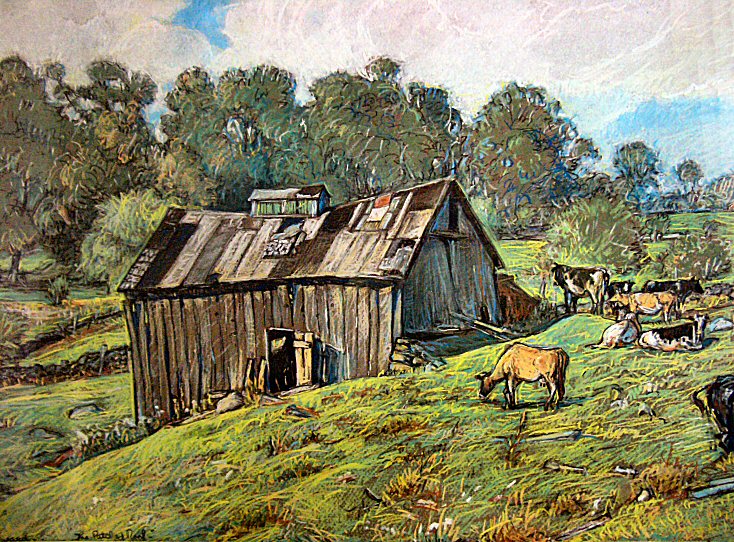 People & Livestock Gallery for related pieces.
- See also the...
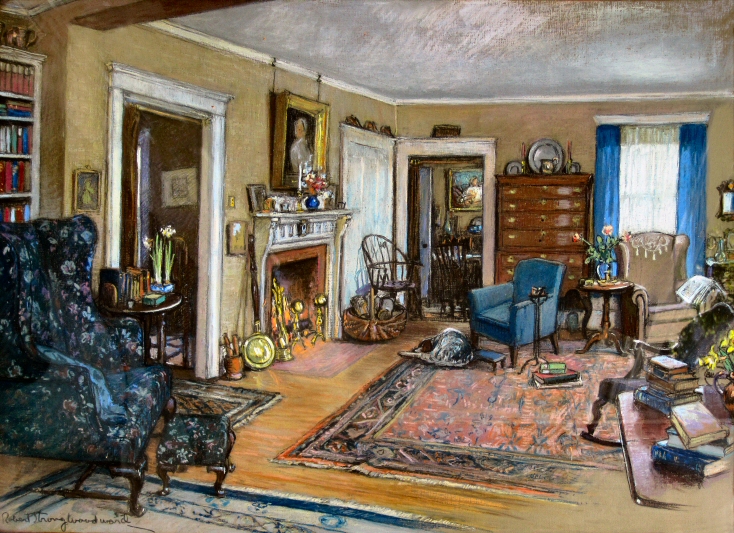 Chalks & Crayons Gallery to view other drawings
- See also the...
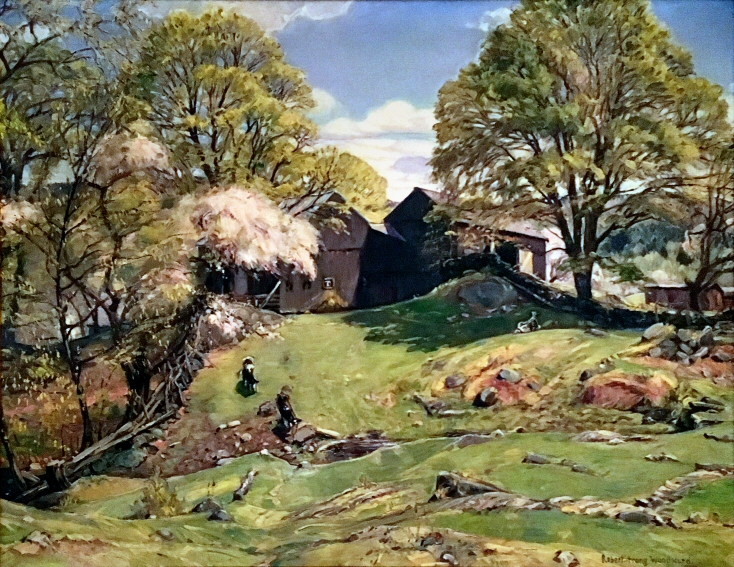 Pastures Gallery to view artwork.
- See also the...
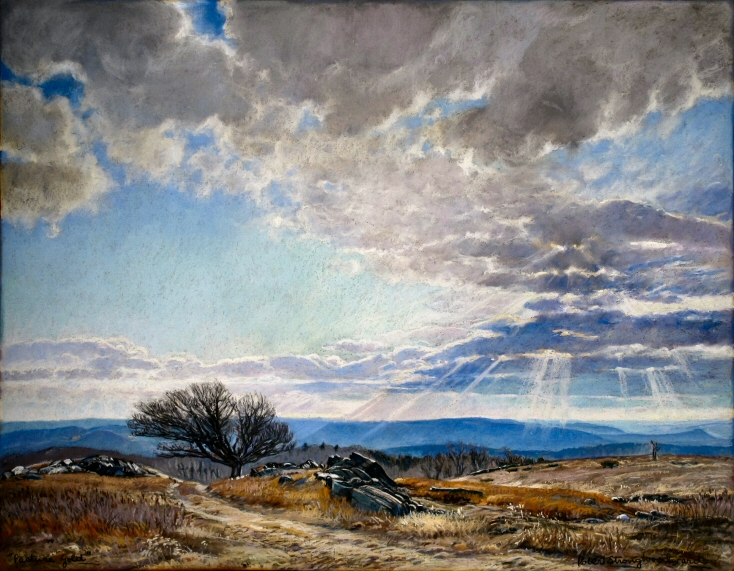 Stunning Skies Gallery to view related pieces.
- See also RSW's ...
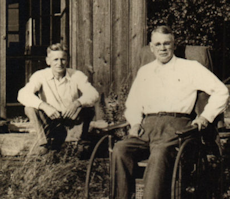 Personal Friends Gallery
- See our page devoted to ...
 RSW's travel we titled Car Troubles & Other Mishaps
- See also the...
Farms Gallery to view related pieces.
- See also the...
Barns Gallery to view related pieces.
- See also the...
Fences, Gates & Doors Gallery to view related pieces.
.png)
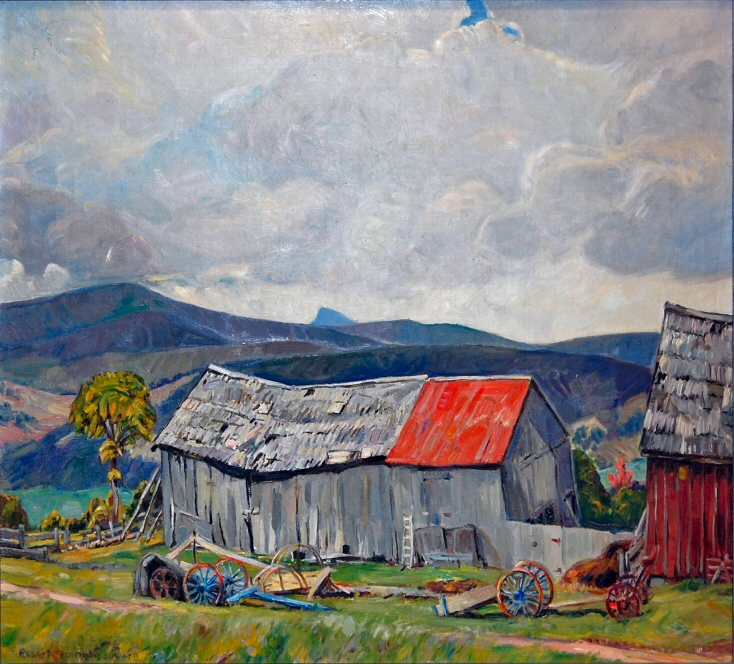
Featured Artwork: Vermont Barns, Oil
The Five Norton Farm PAINTINGS in Riverton, Vermont |
||||
| Saddleback Barn | Vermont Barns (Chalk) | In Vermont | Up in Vermont | Vermont Barns (Oil) |
|
22" x 29" |
22" x 29" |
30" x 27" |
42" x 36" |
25" x 30" |
|
Pastel on Board |
Pastel on Board |
Oil on Canvas |
Oil on Canvas |
Oil on Canvas |
|
First Exhibited |
First Exhibited |
First Exhibited |
First Exhibited |
First Exhibited |
|
1928 |
1928 |
1928 ⮜ |
1935 |
1928 ⮜ |
|
Noteworthy: Believed to be made the same day, or at least started on RSW's visit to VT. |
Noteworthy: Believed to be started the same day of RSW's visit to VT but finished later in the studio. |
Noteworthy: Said to have been made the same day of his visit but does not exhibit until 14 years later. |
Noteworthy: RSW says he made this larger painting from the original 1928 painting, In Vermont. |
Noteworthy: Said to have been made the same day of his visit but does not exhibit until 6 years later. |
|
Website Commentary: Woodward's painting diary is mostly unreliable when it comes to the year some thing was made. Notice how RSW claims to have made four of the five paintings all in one day, as well as numerous sketches. Then there is the great mystery of In Vermont being made in 1928 but not exhibiting for 14 years. We have a theory, that RSW did make the "original" painting in 1928, but for whatever reason was never satisfied with it. Maybe he left it with Mrs. Dresser until she returned her canvases to him before her death. In his possession again, he re-paints, like he does for a dozen other paintings between 1937 and 1945, destroying the original and failing to say so in its diary entry. |
||||
RSW's Diary Comments
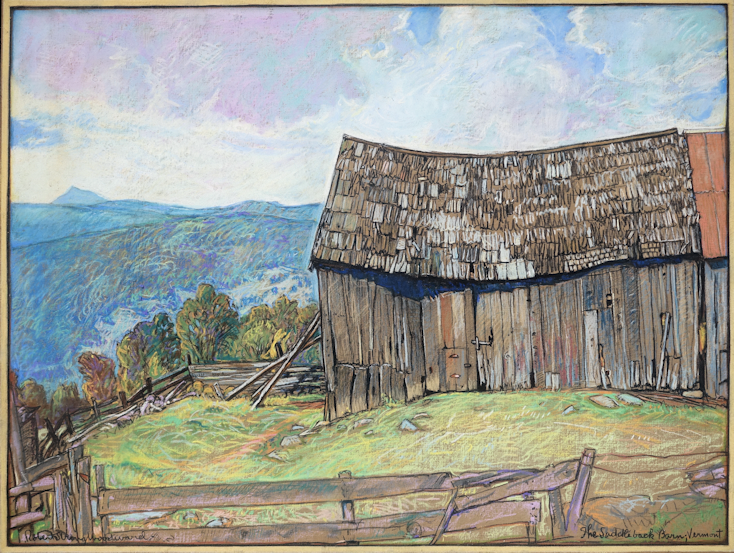
 Saddleback Barn, 1928
This is the same barn, made on the same visit to Mrs.
Dresser in 1938. The perspective is obviously differ-
ent but so are the tones and hues of color. This is warm-
er than its sibling, with Camel's Hump further away.
"Painted around 1928-9. A painting of Vt. barns (one with half the roof bright tin red) by the roadside, farm tools strewn all out in front, backed by piled up Vt. mountains, topped by the blue peak of Camel's Hump. The Norton Farm (of which I made several different composed paintings: Up in Vt,, In Vermont etc.) at Riverton, Vt., near Montpelier, when visiting Mrs. Dresser at her summer home, then sold, July 1952, to Mr. and Mrs. Ernest F. Goodner of Salt Lake City Utah, 2029 Wilmington Avenue."
Editor's Note:
This canvas's story is one of the strangest, mysterious and most traveled of all of Woodward's paintings. Let's start from Woodward claiming it was "painted around 1928-9" and reaffirms it in his diary entry for Up In Vermont, "... where I used to go to visit Mrs. Geo. E. Dresser. I made several paintings and chalk drawings of these Norton buildings, and several later paintings from original sketches..." Vermont Barns, along with In Vermont, were among those "several paintings." It is difficult to believe he did this all in one day and so we now feel strongly he stayed for at least a couple days. We have some of his personal diaries, and know while he can work fast while out en plein air, he almost always finished canvases in his studio usually taking a week or more.
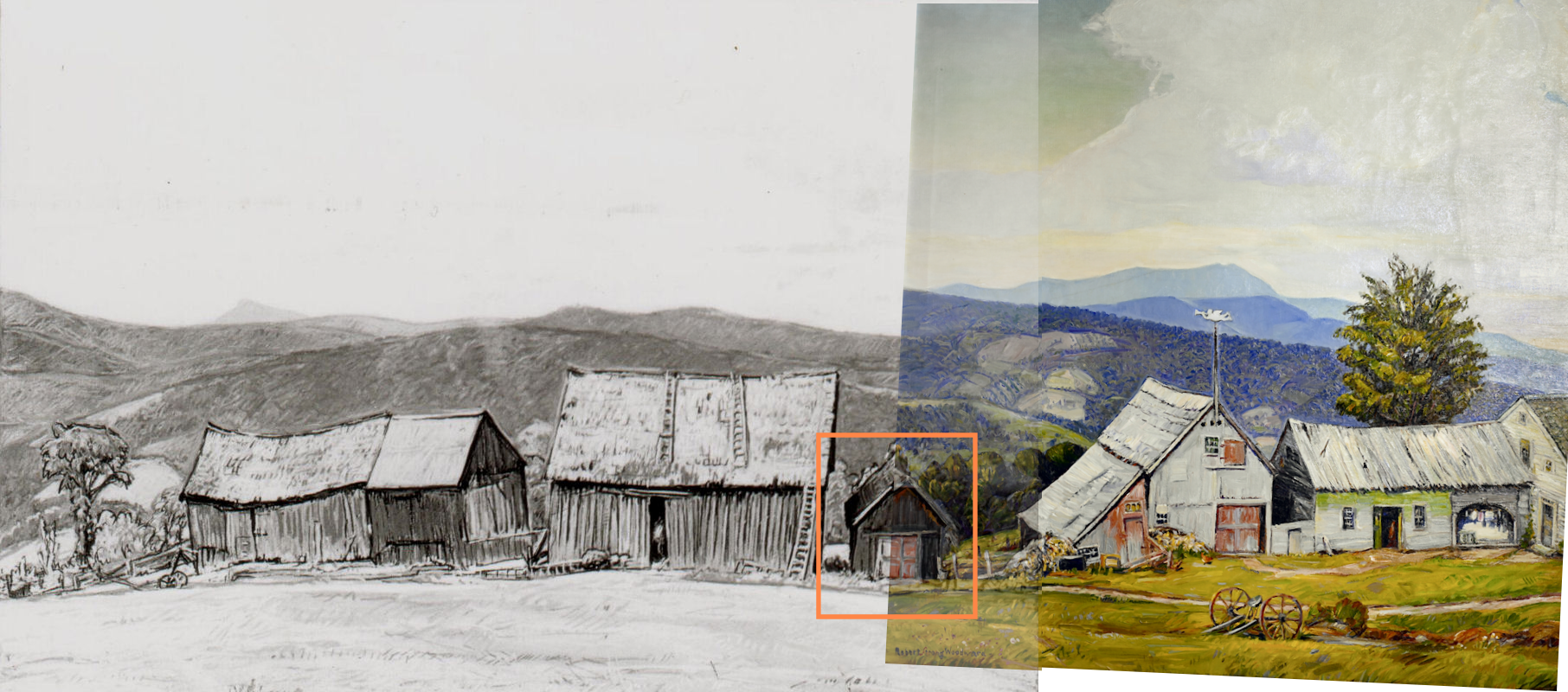
The length of the Norton Farm in Vermont as illustrated
by merging two paintings together. This is NOT proportion-
ally accurate. The barns to the left of the picture are clearly
too large to be a correct match to the barns on the right.
Still you get the gist and different perspectives from it.
Lets say he finished this canvas within a month of his visit (which we believe was late summer, sometime in September) where was it for six years because it does not exhibit until 1934; then disappears in 1935, and exhibits four times in 1936, goes missing again in 1937, exhibits in 1938, disappears for another seven years, reappears to exhibit close to its origins in Vermont in 1945, vanishes for four years before it exhibits again in 1949 at the National Art Exhibition held annually in Springville, Utah, and does not sell for another three years after that to a couple living in Utah... do I end this long sentence with a question mark?

This is an image of well-known American artist
Edward Hopper's painting diary. It is very detailed and
includes sketches and was made as the artist worked.
RSW did not begin his until the 1940s, encouraged by
Dr. Mark and F. Earl Williams. We do not believe RSW
took it very seriously. We believe he did not want to
leave any record at all. He did, after all, burn all let-
ters and correspondence for that purpose as well...
Perhaps the reason has to do with all he had lost in
the number of fires that he had— ashes to ashes...
dust to dust, if you will. In his maturity, he let a lot go.
This is where Woodward's painting dairy is woefully insufficient. He is also terrible when it come to giving just basic information and omitting important things. For example, we are finding that paintings that disappear like this, do so, because he has lent them to a friend or business for an extended period of time, or because the painting was chosen to tour the country with the traveling exhibitions sponsored by the American Federation of Art (AFA) which was most active in the 1930s and 40s. Yet, he specifically mentions the AFA in just one of his diary entries. Typically, those paintings only go missing for one to two years but this one twice has no presence for over five years and he says nothing about any of this in his diary entry for this painting.
This is not even the weirdest part, the other canvas we know he made on this trip, In Vermont, ALSO does not exhibit for years. Only its nots just years, it is more than a decade, 1942! This is pure speculation but this is what we think probably happened... Mrs. Dresser had both canvases hanging in her summer cottage until at least 1934. Why? Because that is the year Woodward paints the larger version of In Vermont he names Up In Vermont. It is also around the same time Mrs. Dresser (whose name is Julia) insists on returning two paintings she had bought from Woodward in the early 1920s, Silent Evening (c. 1920) and September Mountain (c. 1925). She insisted on returning her paintings because her health was waning and she and her husband had no children so they were being to sort out their estate. Also, let's not forget that the cottage was just a summer home for the couple. Their permanent residence is Thompson, CT. The couple would pass about two years after returning the paintings six months apart.
734.png?url=photos/september_mountain(25)734.png)
That covers the first six years of this painting's life, next we have, 1935, in which the painting probably hung in the restaurant or lobby of the Myles Standish Hotel in Boston. We think this because (1) he always had at least one painting hanging somewhere in the hotel and 1936 this canvas hangs at the Vose Gallery that same year Vose officially becomes Woodward's representation. The missing year, 1937, could very well be the years it travels with the AFA show and then it ends up in New York City.
After that we cannot not hazard a guess... perhaps the home of a family member or friend. F. Earl Williams is somehow involved in it exhibiting in Rutland, Vt in 1945, and Woodward lent him numerous paintings to hang in his home so that is a possibility. The fact that four years later it ends up in Utah suggest that Vose was involved because if you review the exhibit catalogs, their name appears as a contributor to the event. Vose was also responsible for paintings exhibiting in North Carolina, Florida, and Texas in the time it represented the artist.We do not have much of a theory as to why the painting do not sell till three years later to a couple in Utah the year Woodward retired other than to say they remembered the painting from the 1949 show and convinced Woodward to sell it to them. Unfortunately, we do not have the 1949 show catalog to verify this information.

A side by side color comparison illustrating the differing
color tones with this reminder, they were supposedly made on
same trip. It also proves it is the same barn if you enlarge it.
Let us add one final note. The long and wild journey of this painting indicates to us
that Woodward considered it, what we call, an editorial painting, meaning that it represented
something he saw as important commentary of the times. Perhaps it is the sagging roof of a still
vital farm or the compliment of old mountains to the age of the farm, with the time of the year—
right before the fall come in its full glory. Maybe it is all of those things, but it is the cool
tones of the barn that differs from the pastel above that piques our interest the most.
In most cases, Woodward
worked hard to make the pastels look every bit the same as the oils, however, not in this case
which suggest further that the artist is editorializing. Also both chalks, made on the same trip
exhibit within a few months to a year after their creation. This is another anomaly to the story
particularly since at this time is when Woodward begins to pair to two mediums in his exhibitions,
particularly the 1929 Pynchon Gallery event that featured first the pastels in the main room
with its oil counterpart secondary and in another room! Those oils are NOT mentioned by name
in newspaper accounts with only one exception. Did Vermont Barns hang in other room in 1929? We
do not think so because of how different they are.
In The Press...

Hampshire Gazzette, May 29, 1936
Another thing that strengthens our argument of the editorial status of this canvas is how often it appeared, one, as the featured art work picture accompanying the announcement of an exhibition but, two, what was said about it. To the left is a clipping for the 1936 Williston Academy event where Vermont Barns was the selected picture introducing the show. Williston held a special place in Woodward's heart. He exhibited there 10 times over his career, second only to Amherst College and we believe the reason for this is because his cousin, physical education pioneer, Flore White is teaching there at the girls school, the Northampton School for Girls. The two schools will merge as one in 1971 but in this time they were run separately.
It is rare for a painting to be mentioned in a newspaper article. Space is limited and measured in inches. It is even rarer for a painting to be mentioned in the newspaper at a show featuring a number of other artist; and rarer still is a picture of a painting being selected to accompany an article on an exhibition. More rare than that is to be selected to be pictured twice for two different events more than a decade apart— one of them a national show. This painting did ALL of that cementing its status as editorial.
Herald-RutlandPubLibExHLN.png?url=photos/Newspapers/1945-08_00-Rutland(VT)Herald-RutlandPubLibExLG.png)
Rutland (VT) Herald, (the date is not given)
by Louise Hadley Fiske...
Louise Hadley Fiske, Rutland Herald:
"In sharp contrast to Kopf's heavy paintings Robert Strong Woodward's Vermont
Barns seems crystal clear, sparkling and vibrant in color and technique. The effect of
weather-beaten buildings is nearly photographically clear and to those who are not familiar with his
works, Woodward could be compared to Vermont's artist laureate, Luigi Lucioni, except for the fact
Woodward's paintings show more sensitive imagination and he is not so intrigued by detail."
Note ⮝ we do not know much about this exhibit. The article says it was organized by the
Mid-Vermont Artist Association as opposed to the Southern Vermont Artist Association (SVAA) in
Manchester or the Northern Vermont Artist Association based in Shelburne. We do not think Woodward was
a member. Ms. Fiske gives Woodward some pretty high praise, even, slighting Luigi Lucioni while doing
so which surprises us. But we feel Woodward, in terms of landscapes, hold his own to the Vermont laureate.

Salt Lake City (UT) Tribune, April 07, 1949
It would be a mistake to overlook how important getting your art work selected by a
newspaper editor to accompany an article on a particular exhibition, and while one may think a
"national" art exhibit in Springville, Utah, is second or third rate show. You would be wrong. This
is a legitimate exhibition featuring many of the nation's best artist that still exists to this day.
Many of the nation's top art dealer participated, including Woodward's Boston dealer, the Vose
Galleries.
Vermont Barns was not only selected, out of nearly 300 paintings,
but it was the four time his work was chosen by editors of the Salt Lake Tribune as the featured
art work.
Additional Notes
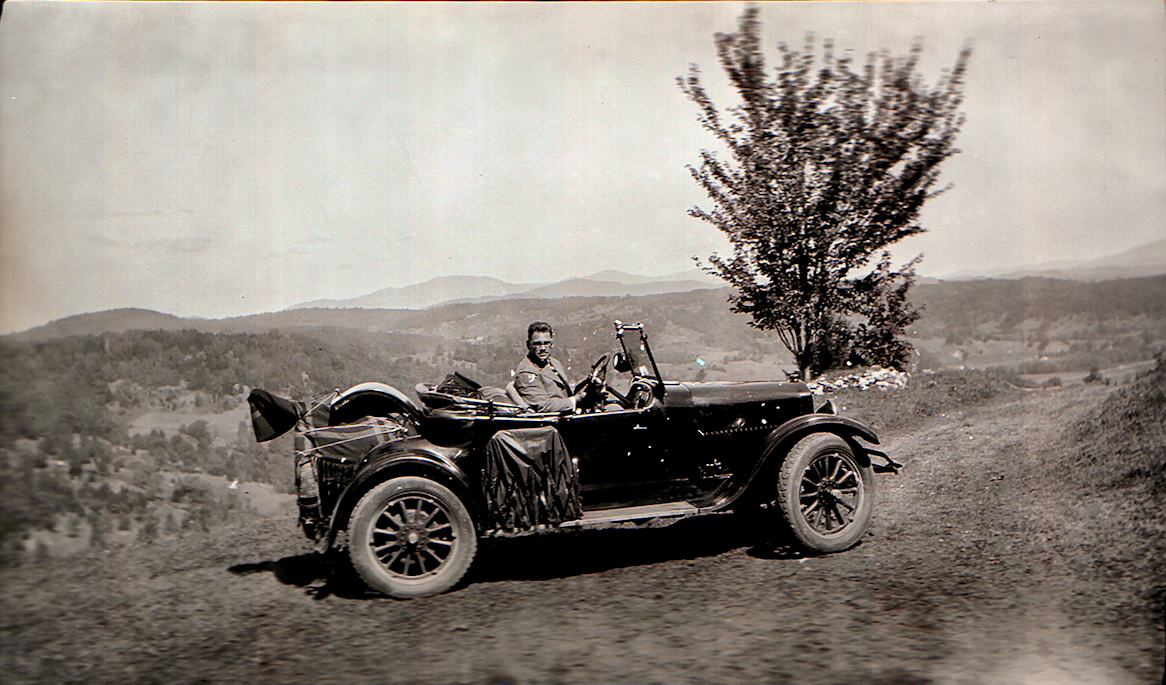
A picture of Woodward in his 1923 Studebaker we believe
was taken on the trip he made to visit Mrs. Dresser and make
the paintings that would grow to become the Norton Farm Five
paintings. He is positioned at the end of the Dresser driveway.
We have already said so much about this painting, it would be too much to now add what
we also explain about the trip itself and how it all connects. The other Norton Farm paintings have
all the other details on the trip, the diary comments and how they varying, etc. Use the links above
to hop around those pages.
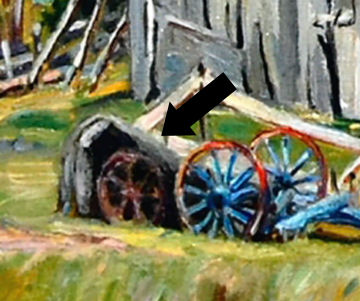
Below we added on the left a modern picture of Camel's Hump
mountain from Montpellier, VT near Riverton. It illustrates the flat edge shown in the saddleback
barn paintings. In the lower right is a close up picture of what we believe is a modern, mechanized
piece of equipment. The wheel's spokes is what is seen in many steel rims making this the only
example of Woodward recording such a device. It is no surprise it is under a tarp!

Camel's Hump Mountain from Montpellier, VT